Suphalak (Thong Daeng): Thailand’s Copper-Coated Heritage Cat
 From palm-leaf poems to modern registries — a traceable Thai timeline
The Suphalak, also called Thong Daeng (meaning “copper”), is a natural Thai cat described in the historic Tamra Maew (Cat-Book Poems) compiled during the Ayutthaya era, circa 1351–1767. Surviving manuscripts are held in Thai and overseas collections. A Thai legend attached to 1767 — the year Ayutthaya fell — helps explain the breed’s rarity but is regarded as folklore rather than documented history.
In the 2000s–2010s, Thai preservationists organized to revive a solid, red-brown “whole-body copper” cat matching the old description; The International Maew Boran Association (TIMBA) formalized its program in 2014. In 2024, the World Cat Federation (WCF) published a distinct Suphalak breed standard under the code SUP. Breed overviews also report that on September 6, 2015, a female named Thonga — exported to the United States in 2013 for the Thai Dee Maew program — was recorded by the American Cat Association (ACA) as “Suphalak,” often cited as the first such registry entry (noting that ACA’s primary registry is not publicly searchable).
One color, subtle shades — how varieties work
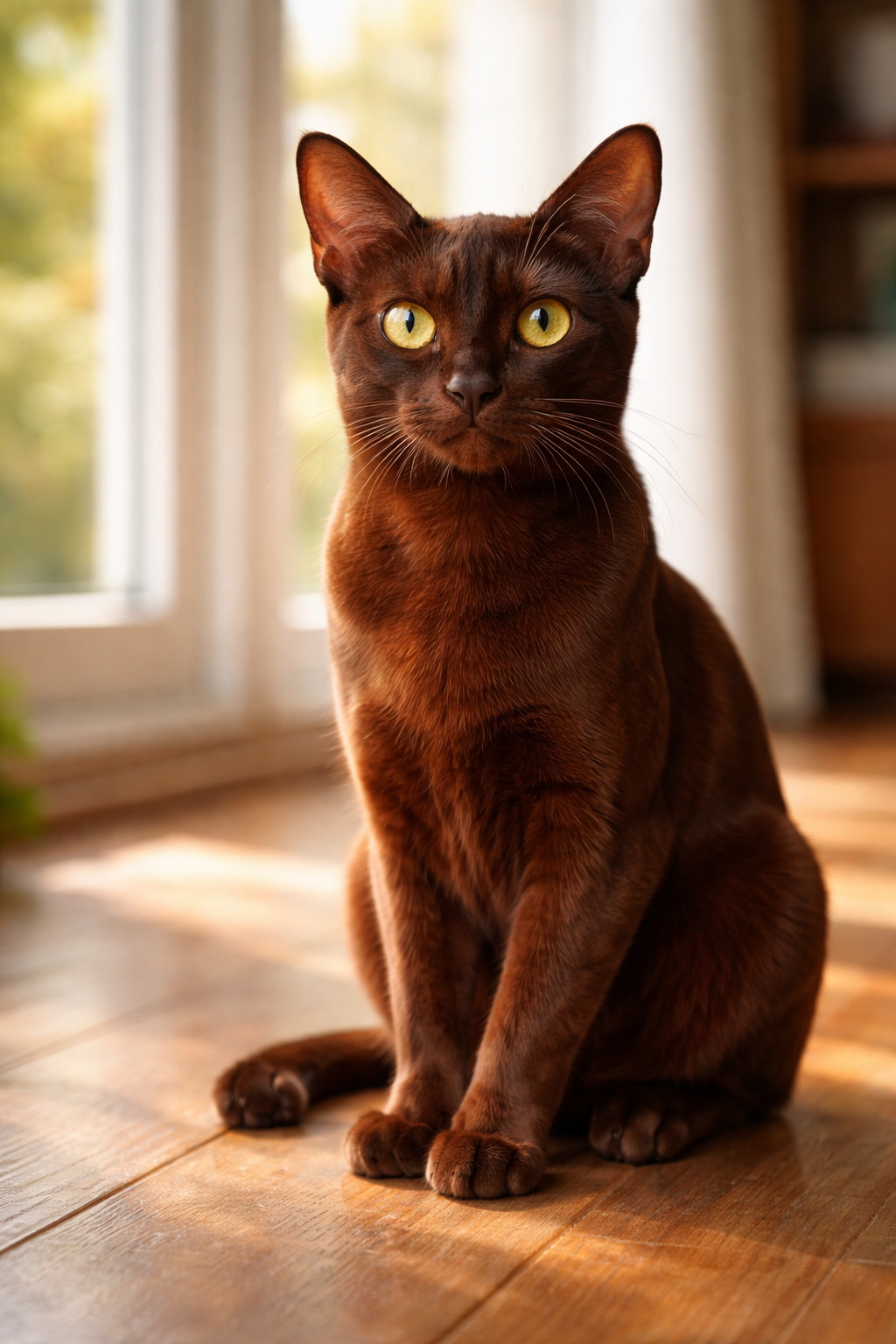
Coat color: one self color — a warm, glossy chocolate that reads as reddish copper (thong daeng). Slight “ghost” markings may appear in kittens and fade with maturity.
Eye color: golden or yellow preferred; greenish tones permitted; blue eyes are not permitted.
Nose, pads, whiskers: chocolate-brown nose leather; warm cinnamon paw pads; brown whiskers to harmonize with the coat.
Physical profile — copper sheen, moderate Thai type
Body and build: medium, semi-foreign, muscular and balanced; neither cobby nor extreme.
Head and face: moderate wedge with gently rounded contours and a slightly heart-shaped impression; high, rounded cheekbones; slight profile dip below eye level; fine, well-developed muzzle.
Ears: moderately large, wide at the base, set well apart with rounded tips, giving an alert, open look.
Eyes: large, wide-open, slightly slanted; golden to rich gold preferred, greenish allowed.
Tail and legs: tail medium to moderately long and tapering; legs long, slender and muscular; oval paws.
Coat and feel: very short, close-lying, fine and silky with notable luster; above the eyes the coat can appear sparse, enhancing the bright, alert expression.
Size and weight: no official weight is set in standards. Breeder profiles commonly describe a medium cat around 8–12 lb (3.6–5.4 kg). Treat this strictly as guidance — judges assess type, balance and condition rather than weight.
What makes it unique: a solid, warm copper-chocolate coat (not pointed and not sable), matching brown whiskers and chocolate nose leather — a look anchored in Thai manuscripts and formalized by WCF.
Personality and daily habits — people-focused like many Thai natives
Reports from Thai lines and preservation groups describe the Suphalak as social, inquisitive, communicative and playful — a follow-you, talk-to-you companion similar in people-orientation to other native Thai breeds such as the Korat and Khao Manee. Interactive play and human time rank high.
How it compares — close cousins, clear differences
Not Burmese: the Suphalak is a full-color self chocolate; Burmese type derives from the Burmese color-restriction allele and produces darker mask and points, which the Suphalak must not show.
Within Thai cats: Suphalak is the copper self within the native Thai population (Maew Boran); WCF provides a distinct Suphalak show standard.
Lifespan and health — what owners realistically see
Lifespan: typical of healthy, medium domestic cats; many profiles cite roughly 10–12 years with good care.
Health focus: no breed-specific disorders are established. Maintain routine preventive care (dental hygiene, vaccinations as advised by your veterinarian, parasite control). Color-genetics testing helps avoid mismatches that would produce disqualifying patterns.
Care tips for owners — diet, grooming, environment and show notes
Diet: feed a complete, high-protein diet appropriate for life stage and activity; adjust calories to keep a firm, athletic body. Provide fresh water at all times.
Grooming: a weekly rubber brush or grooming glove lifts dead hair and polishes the coat; a soft chamois wipe can enhance shine. Trim nails and brush teeth routinely.
Environment and enrichment: provide vertical space, puzzle feeders and at least two interactive play sessions daily. These cats thrive on people time, so plan for companionship.
Sun and coat color: the copper sheen can warm in bright sun; sensible exposure is fine, but avoid prolonged harsh midday sun in hot climates.
Show specifics (WCF): avoid white lockets or medallions, kinked tails or incorrect eye colors — these are penalized or disqualifying. Maintain the rich, glossy red-brown coat and correct cinnamon-toned pads.
At a glance — essentials to remember
Status: distinct WCF standard (SUP, 2024).
Origins: described in Ayutthaya-era Tamra Maew; modern preservation via TIMBA since 2014.
Color and features: solid warm chocolate with a copper cast; brown whiskers; chocolate nose leather; cinnamon paw pads; golden eyes preferred, greenish allowed.
Build: medium, semi-foreign, muscular with a very short, lustrous coat.
Temperament: social, communicative, active and people-oriented.
Typical weight: commonly around 8–12 lb (3.6–5.4 kg) — guidance rather than a standard.
What would you like to add to meow-cats.com?
- Cats funny videos (20%, 118 Votes)
- Ask vet online (15%, 87 Votes)
- Message board about buying and selling cats (13%, 79 Votes)
- More useful articles on various feline topics (13%, 76 Votes)
- Online cat memorial (11%, 63 Votes)
- Forum about felines (8%, 49 Votes)
- Breeding catteries ads (8%, 48 Votes)
- Cat hospitals ads (7%, 41 Votes)
- Boarding catteries, cat boarding kennels ads (6%, 38 Votes)
Total Voters: 273
 Loading ...
What are your 3 favorite cat breeds?
- Siamese Cat (11%, 184 Votes)
- Maine Coon (7%, 116 Votes)
- Bengal Cat (7%, 111 Votes)
- American Shorthair (6%, 104 Votes)
- Ragdoll (5%, 81 Votes)
- Persian Cat (5%, 79 Votes)
- Russian Blue (4%, 74 Votes)
- Egyptian Mau (4%, 68 Votes)
- Munchkin (4%, 61 Votes)
- Scottish Fold (4%, 61 Votes)
- Abyssynian (4%, 58 Votes)
- Other... (3%, 56 Votes)
- Norwegian Forest Cat (3%, 55 Votes)
- Turkish Angora (3%, 55 Votes)
- Siberian Cat (3%, 55 Votes)
- Himalayan Cat (3%, 53 Votes)
- British Shorthair (3%, 48 Votes)
- A Breedless Cat (2%, 40 Votes)
- Ocicat (2%, 40 Votes)
- Savannah Cat (2%, 39 Votes)
- Sphynx (2%, 38 Votes)
- Birman Cat (2%, 28 Votes)
- American Bobtail (2%, 25 Votes)
- Bombay Cat (1%, 23 Votes)
- Burmese Cat (1%, 21 Votes)
- Manx Cat (1%, 17 Votes)
- Havana Brown (1%, 16 Votes)
- Balinese Cat (1%, 12 Votes)
- Devonshire Rex (1%, 11 Votes)
- Singapura (1%, 9 Votes)
- Cornish Rex (0%, 7 Votes)
- Thai Cat (0%, 7 Votes)
- Donskoy Cat (0%, 1 Votes)
Total Voters: 661
Loading ...
Leave a Reply