About the Russian Blue Cat (Archangel Cat)
Russian Blue (Archangel Cat): The Silver-Blue Cat with Emerald Eyes

The Russian Blue combines a shimmering silver-blue coat, vivid green eyes, and a graceful, athletic body with a quiet but deeply affectionate personality. These cats often appear reserved when meeting someone new, yet they form strong bonds with the people they trust. Intelligent, observant, and playful, the Russian Blue tends to study a situation before joining in, as though every household event requires a brief feline security review.
Russian Blue at a Glance
- International name: Russian Blue
- Historical name: Archangel Cat
- Coat length: short
- Country of origin: Russia; the modern breed was further developed in Britain, Scandinavia, and North America
- WCF code: RUS
- WCF category: 3 – Shorthair
- Size: medium
- Weight: approximately 5–11 pounds, with males generally larger than females
- Life expectancy: approximately 12–16 years, sometimes longer
- Activity level: moderate; athletic, agile, and energetic during play
- Social behavior: devoted to family, often cautious with unfamiliar people
- Affection level: affectionate and loyal without usually being demanding
- Notable traits: dense double coat with silver tipping, vivid green eyes, quiet voice, high intelligence, and a preference for familiar routines
Origin of the Russian Blue
The exact origin of the Russian Blue has never been fully documented. The breed is generally believed to descend from blue cats found in northern Russia, particularly around the port city of Arkhangelsk on the White Sea. Their unusually dense double coat may have helped local cats tolerate the region’s cold climate, although there is no continuous pedigree connecting today’s show cats to a particular early Russian population.
Stories sometimes claim that these cats lived in the Russian imperial court, were treasured by czars, or were presented to European royalty. Russian folklore has also associated blue cats with good luck and healing. These accounts add color to the breed’s history, but they should be treated as legends rather than proof of royal ancestry.
More reliable records begin in Britain during the late nineteenth century, when blue cats believed to have arrived from northern Russia appeared at early cat shows. Sailors traveling from Arkhangelsk may have brought some of them to England. They were known as Archangel Cats, a name derived from the English form of Arkhangelsk, and initially competed alongside other solid blue shorthaired cats.
In 1912, the slender blue cats of foreign type were given their own show class under the name Foreign Blue. The breed was also known at different times as Russian Shorthair or simply Russian, but Russian Blue eventually became the internationally established name.
Why Is It Called the Archangel Cat?
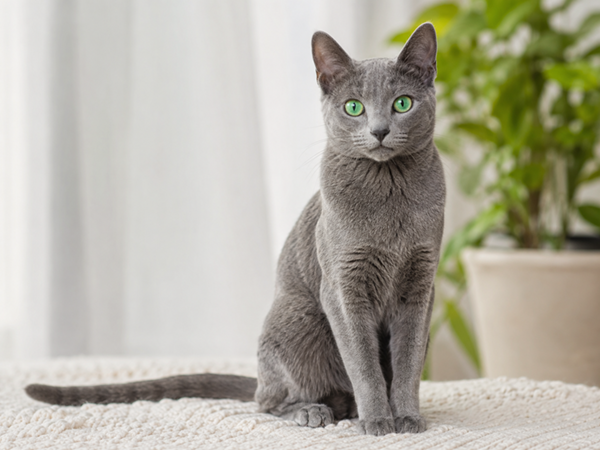
Archangel Cat is a historical English name connected to Arkhangelsk, whose name was traditionally rendered as Archangel in English. It does not refer to the cat’s temperament, eye color, or an association with angels, although the silver coat and serene expression make the interpretation tempting.
Today, major registries use Russian Blue as the official breed name. Archangel Cat remains a useful historical alternative and a meaningful part of the breed’s identity, especially when discussing its presumed northern Russian origins.
Development of the Modern Breed
The two world wars severely reduced pedigreed cat populations in Europe. After World War II, breeders working to preserve the Russian Blue used other cats with compatible traits. In Britain, some breeding programs introduced blue British Shorthairs to reinforce the pale, dense coat and physical strength. Other breeders used blue-point Siamese cats to restore the long body, fine legs, large ears, and elegant head shape.
These crossings helped the breed survive, but they also changed its appearance. Some lines became too slender and Siamese-like, while others developed heavier bodies and rounder heads. Scandinavian breeders developed cats with darker coats, triangular heads, and especially vivid green eyes.
North American breeders later combined English and Scandinavian lines, selecting for a balanced cat with an elegant but muscular body, a dense silver-tipped coat, large ears, and bright green eyes. The modern Russian Blue is therefore a carefully developed international breed founded on cats believed to be of Russian origin, not an unchanged relic preserved since the time of the czars.
Not Every Blue Cat Is a Russian Blue
Blue is the feline term for a diluted form of black. This color occurs in many pedigreed breeds and in countless domestic cats without pedigrees. A gray-blue coat, greenish eyes, or a slender body alone does not identify a cat as a Russian Blue.
A pedigreed Russian Blue is defined by documented ancestry and a specific combination of traits, including body structure, head shape, ear placement, eye color, coat texture, and silver tipping. A rescued or stray blue cat may be beautiful and may resemble the breed closely, but without registration records it is more accurate to describe it as a blue domestic shorthair or a possible Russian Blue mix.
Russian Blue Compared With Other Blue Cat Breeds
The Russian Blue is often confused with the Chartreux, British Shorthair, and Korat. All may have solid blue-gray coats, but their structures and coat types are distinctly different.
The British Shorthair has a heavier, more compact body, a broad round head, smaller widely spaced ears, and usually copper or orange eyes. Its coat is dense and plush, but the cat lacks the elongated, fine-boned outline and vivid green eyes expected in a Russian Blue.
The Chartreux is a robust French breed with full cheeks, a trapezoidal head, a slightly woolly coat, and gold, amber, or copper eyes. It is heavier and more powerfully built than the Russian Blue.
The Korat has a muscular body, a heart-shaped head, large green eyes, and a close-lying single coat. The Russian Blue has a particularly dense double coat that stands away from the body and creates a softer, more plush outline.
Russian Blue Appearance
The Russian Blue is a medium-sized cat with a slightly elongated, graceful body and firm, well-developed muscles. It should look refined without appearing fragile, underweight, or excessively narrow. The body is lithe and athletic rather than heavy or compact.
The neck is long and slender, although the dense coat and high shoulder blades may make it look shorter. The legs are long and fine-boned but strong, ending in small, slightly rounded or oval paws. The tail is long and proportionate to the body, tapering gradually from a moderately thick base.
Males are generally larger and more substantial than females, but even an adult male should retain the breed’s characteristic elegance. A heavy, broad-chested cat with a round head would resemble a British Shorthair more than a correct Russian Blue.
Head and Characteristic Smile
The head forms a smooth medium wedge with clean, straight lines. It is neither long and sharply tapering nor short and massive. The top of the skull is long and relatively flat, flowing into a straight nose without a pronounced break or stop.
High cheekbones and the meeting of the muzzle and facial planes create the Russian Blue’s famous subtle smile. The expression is enhanced by widely spaced eyes and a firm chin. The face should appear alert, intelligent, and gently amused rather than narrow, pinched, or severe.
Breed standards vary slightly in how they describe the exact planes of the head, but they agree on the overall impression: sculpted straight lines, a medium wedge, and harmonious proportions without Siamese exaggeration or British roundness.
Ears
The ears are large and broad at the base, with tips that are more pointed than rounded. They are set far apart and may angle slightly outward or forward, depending on the registry’s preferred type.
The ear leather is thin, and the inner surface has very little hair. This can make the ears look almost translucent when light passes through them. Their size and placement contribute strongly to the breed’s attentive, alert expression.
Emerald-Green Eyes
The eyes of an adult Russian Blue should be vivid green. Depending on the registry, their shape may be described as rounded, oval, or almond-shaped, but they are always set widely apart and should appear large and expressive.
Green eyes are not a recent novelty, and yellow eyes are not the usual adult standard. Kittens are born with blue eyes that gradually change through yellowish or yellow-green stages. A green ring normally begins to develop around the pupil during kittenhood, while the final intensity of the eye color may continue to improve as the cat matures.
Adult yellow, orange, or copper eyes are characteristic of other blue breeds and do not meet the principal Russian Blue standards.
The Dense Double Coat
The Russian Blue’s coat is one of its defining features. It is short, fine, soft, and unusually dense. The undercoat and guard hairs are approximately equal in length, producing a true double coat that stands away from the body rather than lying flat.
When a finger is drawn through the coat, the impression may remain visible until the hair is smoothed again. This plush resilience distinguishes the Russian Blue from breeds with a sleek, close-lying coat.
The coat should feel silky rather than coarse or woolly. It must remain short and should not form a ruff, long tufts, or flowing sections. A sparse, flat, or noticeably long coat does not match the traditional breed type.
Blue Color and Silver Tipping
The traditional Russian Blue has an even blue coat of medium intensity. In cat terminology, blue is a cool gray color produced by dilution of black pigment. The preferred shade is clear and uniform, without rusty patches, brown tones, white hairs, or visible markings.
The tips of the guard hairs are lightly silvered. These pale ends reflect light and create the breed’s characteristic shimmer, especially when the cat moves or stands in sunlight. The effect is silver tipping on a blue coat, not a separate silver tabby or shaded color pattern.
The nose leather is blue-gray, while the paw pads are typically lavender-pink or dark lavender. Faint tabby markings may be visible in young kittens but should disappear as the adult coat develops. White lockets or spots are not accepted in the traditional Russian Blue.
Are There Black and White Russian Cats?
Recognition depends on the registry. CFA, TICA, and FIFe recognize the Russian Blue only in blue and only with short hair. In these organizations, a black or white cat cannot compete as a Russian Blue.
WCF and GCCF recognize a broader Russian group that includes blue, black, and white varieties. These may be called Russian Black and Russian White. The differences reflect registry policy rather than disagreement about the appearance of the traditional Russian Blue.
For readers in the United States, the name Russian Blue almost always means the blue, silver-tipped cat with green eyes recognized by CFA and TICA.
Russian Blue Personality
Russian Blues are usually intelligent, observant, and devoted to their families. Many prefer to watch unfamiliar people from a safe place before approaching. This reserve is sometimes described as shyness or aloofness, but a well-socialized Russian Blue is often affectionate and playful once it feels secure.
These cats commonly follow their people from room to room, settle nearby during quiet activities, and seek attention without demanding it continuously. Some enjoy laps or riding on a trusted person’s shoulder, while others prefer to remain close without being held.
Individual temperament depends on genetics, early socialization, and experience. A confident kitten raised with gentle handling may welcome visitors after a short introduction, while a poorly socialized cat may remain fearful. No personality trait should be treated as guaranteed simply because of breed.
Routine, Order, and Change
Many Russian Blues appreciate predictable routines. They quickly learn feeding times, play schedules, and the sound of a familiar person returning home. Some will wait near the food bowl several minutes before dinner, just in case the human clock requires correction.
A preference for routine does not mean the breed cannot adapt to moving, visitors, children, or another pet. Changes are simply easier when introduced gradually, with familiar beds, hiding places, food dishes, and litter boxes kept available.
Russian Blues are often fastidious about their surroundings. A dirty litter box may be rejected, especially in a multi-cat home, so regular scooping and an adequate number of boxes are important.
Intelligence and Play
The Russian Blue is a capable problem solver. These cats watch people closely and may learn how drawers, cabinets, doors, or treat containers work. Food puzzles and interactive toys provide useful mental exercise and give that mechanical curiosity a safer destination.
Many Russian Blues enjoy retrieving toys, chasing teaser wands, climbing to high observation points, and learning simple cues. They may appear calm while resting, then transform into swift athletes as soon as an interesting toy moves across the floor.
A tall, stable cat tree, scratching posts, window perches, tunnels, and several short daily play sessions help maintain muscle tone and prevent boredom. Scratching is normal feline behavior, so even a notably well-mannered Russian Blue needs appropriate scratching surfaces.
Can a Russian Blue Be Left Alone?
A Russian Blue can generally spend part of the day alone in a safe, enriched home. Many are less demanding than highly vocal or intensely social breeds and will use quiet time to sleep or observe the world from a favorite perch.
That independence should not be mistaken for emotional detachment. Russian Blues form close bonds and need daily play, affection, and interaction. Regularly leaving any cat alone for very long periods without companionship or enrichment can lead to boredom and stress.
Children and Other Pets
A well-socialized Russian Blue can live successfully with considerate children, other cats, and cat-friendly dogs. The breed often does best with children who understand that a cautious cat should be allowed to approach on its own terms.
Rough handling, chasing, and forced cuddling may cause the cat to hide or avoid interaction. Children should learn to respect the cat’s resting places and leave it alone while eating or using the litter box.
New pets should be introduced gradually. Each animal needs separate food and water bowls, resting areas, litter boxes, and opportunities to retreat. Breed reputation cannot guarantee that two individual animals will immediately become friends.
Who Is the Russian Blue Best Suited For?
The Russian Blue may be an excellent match for someone seeking a graceful, intelligent, affectionate cat that does not constantly demand attention. The breed can adapt to apartments and larger homes as long as it receives play, climbing opportunities, and regular human companionship.
It often suits individuals, couples, families with respectful older children, and people who work outside the home for part of the day. A quieter environment may help a cautious cat settle more quickly, although well-socialized Russian Blues can also thrive in active households.
The breed may be less suitable for someone expecting a cat to greet every stranger immediately or tolerate being carried whenever a person chooses. Trust is one of the Russian Blue’s treasures, and the cat generally prefers to award it rather than have it requisitioned.
Grooming
The Russian Blue’s short coat is relatively easy to maintain. Gentle brushing or combing once a week is usually sufficient to remove loose hair and keep the dense coat in good condition. During seasonal shedding, slightly more frequent grooming may be useful.
Aggressive deshedding tools can remove too much undercoat and alter the coat’s characteristic texture. Bathing is rarely necessary unless the coat becomes unusually oily or contaminated with something the cat should not lick.
Nails should be trimmed regularly, ears checked for debris, and teeth brushed with toothpaste made for cats. Routine coat care also provides an opportunity to notice lumps, skin irritation, parasites, or changes in body condition.
Is the Russian Blue Hypoallergenic?
The Russian Blue is frequently promoted as a hypoallergenic breed or as a cat that produces unusually little Fel d 1, the major feline allergen. There is no reliable evidence that every Russian Blue consistently produces less allergen than other cats.
Cat allergens occur in saliva, skin particles, and other secretions, not simply in the fur. All cats produce allergens, and individual allergen levels can vary considerably within the same breed. A short coat and limited visible shedding do not make a cat allergy-free.
Someone with cat allergies should spend time with the specific cat before making a commitment and discuss the risks with an allergist. A mild reaction during one short visit does not guarantee that symptoms will remain mild after continuous exposure at home.
Feeding and Weight Management
Russian Blues are often enthusiastic about food and can gain excess weight when portions are not controlled. Their elegant outline should be supported by firm muscle, not hidden under a soft layer of body fat.
Feed a complete and balanced diet appropriate for the cat’s age, health, and activity level. Measure portions, include treats in the daily calorie total, and monitor body condition rather than relying only on the number shown by a scale.
The ribs should be easy to feel beneath a thin layer of tissue, and a waist should remain visible from above. Daily play helps maintain muscle and reduces the health risks associated with obesity. Fresh drinking water should always be available.
Russian Blue Health
The Russian Blue is generally regarded as a healthy breed, and major registries do not identify a single genetic disorder known to affect a large proportion of the breed. This does not mean that every Russian Blue is immune to inherited or acquired disease.
The breed’s relatively limited gene pool makes careful pedigree management important. Responsible breeders track the health and longevity of related cats, avoid excessive inbreeding, and arrange appropriate veterinary examinations for their breeding animals.
Obesity is one of the most practical health concerns because many Russian Blues have strong appetites. Excess weight increases the risk of diabetes, joint problems, and other disorders and may shorten a cat’s healthy lifespan.
Every Russian Blue needs routine veterinary examinations, vaccination, parasite prevention, dental care, and monitoring of appetite, weight, mobility, urination, and behavior. The absence of a required breed-specific DNA test does not make preventive care optional.
Choosing a Russian Blue Kitten
Choose a breeder who registers litters, provides a pedigree and veterinary records, and discusses health and temperament openly. Ask about the health and longevity of the parents and close relatives, the breeder’s approach to genetic diversity, and how the kittens have been socialized.
A healthy kitten should be active, curious, and able to move freely. The eyes and ears should be clean, breathing should be quiet, and the coat should be dense and well maintained. Some caution around a stranger is acceptable, but a kitten should not remain panicked, unreachable, or completely unaccustomed to human contact.
The final green eye color may not be fully developed in a young kitten. Look for the beginning of green around the pupil and evaluate the entire cat rather than choosing only by eye color or the palest possible coat.
Be cautious when a seller labels any gray kitten a Russian Blue without documentation. A blue coat is common in domestic cats. Breed identity is established by pedigree, not by a photograph, a shelter label, or an especially persuasive shade of gray.
Interesting Facts About the Russian Blue
- Archangel Cat is a historical name. It refers to Arkhangelsk, the northern Russian port associated with the breed’s presumed origin.
- The breed was once called Foreign Blue. In 1912, blue cats of the foreign type received a separate British show class.
- The modern Russian Blue combines several European lines. North American breeders blended English and Scandinavian cats to establish today’s balanced type.
- The coat is blue, not genetically silver. Its sparkling appearance comes from pale silver tipping on the ends of blue hairs.
- The undercoat and guard hairs are nearly the same length. This produces the dense texture that stands away from the body.
- The coat can retain temporary finger marks. Patterns drawn through the fur may remain visible until the coat is smoothed again.
- Green eyes develop gradually. Kittens pass through changing eye colors before reaching the vivid green expected in adults.
- Faint kitten stripes may disappear with age. Temporary ghost tabby markings can be visible before the mature coat develops.
- The subtle smile comes from facial structure. The angles of the cheekbones and muzzle create the breed’s characteristic expression.
- Not all registries recognize the same colors. CFA, TICA, and FIFe accept only blue, while WCF and GCCF also recognize Russian Black and Russian White.
- The Nebelung is a related longhaired breed. It shares the blue color and silver tipping but has a semi-long coat.
- The Russian Blue is not proven hypoallergenic. All cats produce allergens, regardless of coat length or breed reputation.
The Russian Blue, historically known as the Archangel Cat, is much more than a beautiful gray cat. Its silver-tipped double coat, emerald-green eyes, sculpted head, and graceful body belong to a carefully preserved breed with a complex international history. Given time to build trust, the Russian Blue becomes an affectionate, playful, and quietly devoted companion whose presence is elegant without ever fading into the background.
64 Responses to About the Russian Blue Cat (Archangel Cat)
Leave a Reply
What would you like to see added to meow-cats.com?
- Funny cat videos (20%, 118 Votes)
- Ask a vet online (15%, 87 Votes)
- Classifieds for buying and selling cats (13%, 79 Votes)
- More useful articles on feline topics (13%, 76 Votes)
- Online cat memorial (11%, 63 Votes)
- Forum for cat lovers (8%, 49 Votes)
- Breeder and cattery ads (8%, 48 Votes)
- Veterinary clinic ads (7%, 41 Votes)
- Cat boarding and boarding cattery ads (6%, 38 Votes)
Total Voters: 273
 Loading ...
What are your 3 favorite cat breeds?
- Siamese Cat (11%, 184 Votes)
- Maine Coon (7%, 116 Votes)
- Bengal Cat (7%, 111 Votes)
- American Shorthair (6%, 104 Votes)
- Ragdoll (5%, 81 Votes)
- Persian Cat (5%, 79 Votes)
- Russian Blue (4%, 74 Votes)
- Egyptian Mau (4%, 68 Votes)
- Munchkin (4%, 61 Votes)
- Scottish Fold (4%, 61 Votes)
- Abyssynian (4%, 58 Votes)
- Other... (3%, 56 Votes)
- Norwegian Forest Cat (3%, 55 Votes)
- Turkish Angora (3%, 55 Votes)
- Siberian Cat (3%, 55 Votes)
- Himalayan Cat (3%, 53 Votes)
- British Shorthair (3%, 48 Votes)
- A Breedless Cat (2%, 40 Votes)
- Ocicat (2%, 40 Votes)
- Savannah Cat (2%, 39 Votes)
- Sphynx (2%, 38 Votes)
- Birman Cat (2%, 28 Votes)
- American Bobtail (2%, 25 Votes)
- Bombay Cat (1%, 23 Votes)
- Burmese Cat (1%, 21 Votes)
- Manx Cat (1%, 17 Votes)
- Havana Brown (1%, 16 Votes)
- Balinese Cat (1%, 12 Votes)
- Devonshire Rex (1%, 11 Votes)
- Singapura (1%, 9 Votes)
- Cornish Rex (0%, 7 Votes)
- Thai Cat (0%, 7 Votes)
- Donskoy Cat (0%, 1 Votes)
Total Voters: 661
Loading ...
Yeah! Russian Blue cats have very majestic appearance.
hi im 12 and i have a russian blue and his name is smokey and i feel like he is my son me and him are very good together when we lay down togeather i will tell him to laydown and he will laydown beside me and go to sleep and if i wake him up or i move he will make growning sound and it makes me laugh
wow my cats name is smokey too and hes also a russian blue and i also call him my son..we are so close
my russian blue smells like feet
smokey is 1 year old
i have a feeling that my cat is a russian blue cat his name is mylo
i love cats and kittens they are soooooooooooooooooooooooooooooooo cute
mylo is 4
All listed traits are very true of the Russian Blue. I have really only ever been exposed to Tabby’s, Bengal’s, Persian’s and Siamese cats. My Russian Blue was a rescued cat from an abused home, and he is the sweetest, most serene cat that i’ve ever been in contact with. He definitely thinks he is the king of his domaine, and we are all his loyal servants lol.
He is great around my children and around guests. All other Russian Blue’s that i’ve been in contact with since adopting mine, have the same demeanour as ours.
A salute to one of the most wonderful breeds ever!
i have a russian blue. loveable and very sweet cats.
i cant find what russian blue cats eat!!!
they eat cat food like all cats
They are picky ! Ours will only eat Fancy Feast dry and then pick certain pieces out with her paw and also only the cream in canned Fancy Feast Creamy Delights. Good Luck. She’s worth it though. She is the most loving cat I have ever owned. Everyone and everything has to be in place although. House guests if they like cats or not will be sniffed, licked, and hey look at me!
Russian Blues eat cat food. Obviously. What else would they eat?
Russian Blues eat cat food.
I really want a Russian Blue! I dont have a cat but I have looked after one when a friend went on a holiday and I have really wanted one ever since!!!!
We just got a kitten that physically looks exactly like pictures of the Russian Blue Cats. BUT, she is anything but serene. HA HA She is 6 months old, and plays constantly. Except at night when she sleeps all night between my husband and I. She loves people, and plays with children wonderfully. She brings her toys to you to throw so she can fetch them. The ONLY problem is her claws and teeth. Likes to bite, not hard to break the skin, but those baby teeth HURT. She will walk by me, then reach out and nip the top of my foot. And when playing she uses her claws to such an extent you get scratched a lot. She has not shown the timidity mentioned regarding the russian blue. Will let anyone pick her up, including the young children. Very very loving. Until she’s ready to play. Then anyone becomes fair play for her claws.
Your cat sounds just like ours. Dorian is very friendly to strangers (too friendly; we almost lost him several times) and is very playful. As a kitten he lacked judgement about how rough he could be, but as an adult he tempered his biting. Dorian continues to be very social with people and does not hide when we have visitors. He is an avid hunter. Despite being well fed, we can’t stop him from eating his prey and getting sick. Does anyone have a solution other than keeping him inside??
My blue boy, Leo, is now 3. He is the sweetest, most relaxed, loveable kitty ever. He is not the “typical” blue, as he is very large weighing almost 20lbs. We call him a puppy-kitty because he follows you around, comes when called, growls when someone comes to the front door, just like a dog. He is so relaxed he allows my girls to stroll him around in a babydoll stroller– he loves it!
I think my cat is a cross between this breed and some other breed. She’s very cautious of new people and pretty much sticks to who and what she knows. We’ve moved twice since we got her and she hid out in one spot in each new house for almost a month or better before warming up to it. She runs away if you come to pet her too suddenly, you have to let her approach you. When she does, she’s very affectionate. She’s also spoiled and prissy. When we got her we were told she was a “Dilute Calico”. We always thought her jumpy behavior was abnormal and odd, even for a cat, and just assumed she must have been abused before we got her.
i am 8 and i have an awsome rb cat
what the heck is a russian blue cat i have 10 cats
I had the most wonderful Russian Blue Mix, “Piper Blue”(“Pip”). She had the “smile,” the waterproof dense soft gray coat with the silver “tips” & the almost invisible “ringed” tail, but “jack-rabbit,” powerful hind legs. Every landing took your breath away. She loved her “family,” human & feline, was meticulously clean (she insisted to my 2 males they separate their #1 & #2 into separate boxes), wouldn’t allow furniture scratched (she’d gently bump them away), make sure each cat received quality time with me. She loved to play hard, slept under the covers, very very affectionate. Would run past me, then plop down in front suddenly, roll on her back so her tummy could be rubbed & patted. She liked to be carried with her front paws wrapped around my neck & her back paws around my waist. She was shy to strangers. She was terrified of the outdoors & wouldn’t go near an open door. When she was quite ill with cancer, both “boys” (who worshipped her) licked her from head to tail. She did love being clean! After she died, “Chipmunk” grieved for at least a year. “Pink Floyd” carried her collar to “meals” & to “bed” for months. She had ran her household smoothly, & when she died, it was chaos. Such a great FRIEND!
i have a Russian blue cat, he is the best cat i have had. although i love him hes meow annoys me. there is something wrong with his voice box. but never the less that cat is smarter than me in some ways
are they a pet for a 8 year old
that is a real nice story,we have a Russian Blue Cat and at six weeks he fell from top of our stairs on to a wooden floor and was a sick little boy for a couple of weeks but with good vet care he is now perfect in every way, to any body who would like a Russian Blue cat you could not get a better cat for companion or just a pet we love him, and even though he has cost around $1000 to get better would spend it again as the enjoyment he gives back with his nature and mad antics you would not be without a Russian Blue, Would recommend a desexed male as we have had females but the male is more affectionate.
i herd your story and i am sad
I read your Article, and so far, I have read about all Blue Russian Male cats. Well I “found”, a female , Blue, iImed Her Blue or Boo Boo. She is so Awesome , and loving, affectionate, and checks out Everything, as it comes in the Door !! She likes to get up early 6:00 or so, and I take meds , so it throws Me off my schedule , a bit.I would not give Her up , for the World, I found Her in the bushes outside of a Church(Archangel) . Sometimes , I had given Nicknames to my Previous Cats, and @ times , she comes to Kitna (Cowboys back up Q B)..lol , Big Time Dallas fan, but anyway, it was like a small or BIG miracle, that I found Her, she is Fixed and declawed. She is My daughter , and what a Great ONE !!~~
Hello
Have read , that you ar looking for kittens of blue russians
Please look on www Haus-der-Sechem.de
Think you will find what you are looking for
With regards
Silvia Mohr & Michael Abert
Oh! help! i checked the site you listed and the russian blue kitties are absolutely breath taking… but i do not read, write or speak german. (my father did but he is 10 plus years passed on).
I wish to be able to contact these people but … do they speak english, if not … any suggestions? I really was blown away by the magnificence of the pictures of their RB’s. if it helps i am interested in a desexd male.
TX a keane –
i had a russian blue cat named Rascal…She lived to be 21 years old and she was like my daughter and friend. She was the most loving and friendly cat I ever had. She became my pet when I was I was 11 and she passed away when I was 29. I miss her dearly. I recently got married and I hope to get another russian blue cat in the future.
I think the rusian blue is my cat but idk he has. Longer nose and not even the vet knows what he is
I found a russian blue kitty outside a little tiny shopping mall in Phoenix Az. He had the coat characteristics described and all of the personality traits. He was devoted to me from day one. he slept under the covers with me his arm around my neck pulling me close he would scoot realclose and put his nose to my nose and forehead to mine and stay that way all night. he was gentle and unaggressive with my other cats. he was so in tune with me it was really incredible. all my kitties love me but nothing before or since has ever come close to this bond that he initiated and maintained the entire 10 plus years we were together. He did occasionally sneek out the front door and get lost only 4 or 5 doors down from our apt. He would realize he was lost and sit right where he was until i or my husband came for him. (LIL goobernaut cat) He dropped the habit about 4 to 5 years ago. 2 Months ago i had to put him to sleep because his cance had advance too far for him to be comfortable anymore. He was sweet to the nurse when i took him n that day nuzzlong her and trilling.
I miss this cat so much I cannot describe my heartbreak. i am thinking of adopting a russian blue as though i can never be sure of his breed it sounds remarkably like my kitty husband and i wish to have one more relationship that special and close . Sadly as much as i adore all my kitties none can fill the hole in heart. could someone take a look at his pics and ell me if they think he has blue in him. It is very important to me so i adopt an RB if it is the breed specific characteristics (personality) that made such abond possible. He had slate grey pads and russian blue’s supposedly have only mauve pads, everything else seems to coincide…Please email me if you can help identify the possibility of his heritage.
When I found him he was immaculately clean, declawed and looked as though he had just walked out the door of a pampere home 5 minutes prior. I posted fliers and pics back then but no one ever reponded and so KarlosAKitty staid with me. Thx broken hearted kitty-widow.
oh my email address is karlosakitty@gmail, thx kitty- widow
Andrea, I found my Russian Blue at the humane society. I was astonished to hear that they get Russian Blue’s (usually a Russian Blue cat mix) fairly often. Mine is eight years old (their guess) and he’s such a love, I dare to hope to have him for another eight to twelve years — it is becoming more common for cats to live to twenty or so and being a mix may make him more hardy. My only concern is I would like to look for another Russian Blue (one a bit younger so I won’t be devastated when he has used his 9th life), but the one I had in Pennsylvania wouldn’t tolerate any other cats but him in the house and when my son brought home a kitten and begged to keep him I said okay. It was a couple weeks before I realized my Russian Blue youngster (approx. 8 months) was showing his disapproval by spraying and pooping on my husband’s pillow. I also know from the people where my kitten was born that their indoor Russian Blue was the same way. Does anyone else out there know if this is true of the breed (that they prefer to be an only cat)? I’ve seen mine watching out the screen door and get kind of growelly and make go away noises when he sees other cats outside. Any comments on this would be very much appreciated. Thanks, Janet
My email address is JoJo1133@aol.com
do the russian blue cats shed?
I have an orange tabby female named Lucy and when she was a year old I adopted my little bundle of mischief, a Russian Blue female named Layla. Lucy was not happy when I came home with a new cat and she hissed and batted at her for about a month. Then they got used to each other and have been fine ever since. If the Russian Blue cat starts out as the dominant cat it may have problems accepting another cat in the house and act out accordingly. But after I’d had Layla for awhile and she didn’t know what it was like to be the only cat and even started giving Lucy kisses. She’s a cuddlebug and isn’t shy around strangers whatsoever. I’ve had plenty of cats since I was a kid, but Layla’s personality is definitely one of my favorites.
please contact me with information regarding adopting a pedigreed russian blue. thank you! andrewilliams8403 @ hotmail.com
I’ve had a hard time finding a Russian Blue cattery online and the only one I found was down south and I live in NH and they absolutely will not ship any of their kittens or cats. I’ve had a heck of a time trying to find a breeder too. For as many blue cats as there are out there, you wouldn’t think finding a cattery or breeder would be so difficult. My best recommendation to you is to keep your ears to the ground and see if there might be a cat show within a reasonable distance of where you live. For instance, I live close to UNH and I believe they have an annual cat show. There you WILL meet breeders and people looking to sell kittens and you can get a lot of information. For instance, Russian Blue cats are not the only breed that come in the lovely blue color — quite a few breeds have blue available and you may discover a different breed of cat has characteristics you prefer to a Russian Blue and then discover that the breed also has blue available. Russian Blues have some very “strong” personality traits and will not fit into all families, particularly since they tend to bond to one family member more than the others and if you have a family, your new kitten might not choose you to love the most.
If you check your local humane societies, the chances of coming across a blue cat is very high. You might not find one the first time you go, but if you keep checking, the chances of finding a blue cat is bound to happen. Good luck on your search.
I am a proud 13 year old owner of a 2 year old russian blue cat named smurf, he is the most sweetest, loving and loyal cat my family and i have ever owned. Smurf loves to play with our dog and walks like a cheeta. He follows me into the shower every morning and sits on the seat in the walk-in shower. He wakes me up for school every morning and waits until after supper to have his wet food. Smurf likes to sleep in the sink and give tons of kisses. I raised him and everyone in my family calls him my cat. Russian blues are hyperallergenic which makes our kitty a perfect addition to our family, along with all of his unique qualities! (:
hi i have a 5/6 month old russian blue, her name is costa, she is super sweet loves us to death and truly the best pet ever. Our best friend also has a russian blue cat, his name is plomo and we are currently cat sitting him for a week. They had already met once. While she bullies, growls and hisses at him, he only wants to play around … is there anything we can do about this. I don´t want to be nervous all week about my cat attacking my friend´s cat or my cat hating me for bringing a visitor, this is the first time i ever have a pet i am pretty naive on cat behaviour … please help me!
i love russian blue cat breed .
I own a 4 month old Russian blue male named Milo. He can be sweet when he wants to be. He act more of a dog than cat. He likes to bite, claw and growl. He plays with stuffed animals rather than his cat toys. When I get home from work he runs to me crawls up my arm and kisses my cheek. But after about 5 minutes of being sweet hes ready to play. At night he sleeps in his own room. I’ve tried him sleeping in my bed. But he stays up all night pouncing on me and smacking my cheek or clawing my head trying to play with my hair. But he’s a true character and I love him like he’s my child.
I adopted a female Russian blue cat named Grettle about a 3 years ago I love her very much and she has been a good cat, but at times she seems stressed out and on edge. I was wondering if this is something that is normal for the breed or if I should take her to see the vet? Help me please!
I have wonderful Russian Blue cat. We live in Iceland. He comes and goes out the door as he likes. He is nine years old and is very lovable. My Russian Blue Cat doesn’t like children much but is very relaxed when he is outside, he doesn’t like the neighbors to take him or cuddle him. I got him here in Iceland but i haven’t seen many like him here.
i have a Russian blue cat he is a new born. i love him soooooooooooo much i don’t think about any thing but him he goes where i go and never goes any
where with out me by his side as you can see i am in his heart and he is in my heart
i have a russian blue, ive had him for 10 months and now has gone missing . he was a very friendly and playful cat and my children and i love him very much . we r hoping he will return home soon.
I really like their blue color on russian blue cats!
I have a mix breed Russian blue his name is Mickey. He’s the smartest cat I ever had the honor to own. He’s so playful. He’s my little angel.
I lost my 18 and a half year old Blue Birman a few months ago which was very sad. But then for Christmas I was given a desexed Russian Blue boy. It has taken him a few weeks to settle in, but he is already the most affectionate cat I have ever known. He stays in bed with us all night purring constantly. He plays like a lunatic the rest of the time, but isn’t destructive in any way. He is inquisitive but quite shy with it. He hasn’t been introduced to anyone else yet – I have a feeling he might just hide, although if someone offers him a treat, I have a feeling he will always come to get it – he LOVES his food. They are a great breed, with a beautiful nature. He has well and truely made a place for himself in my heart, next to that of my beautiful Birman who will never be replaced.
so sad i just lost mine 2 :[
I love my Russian Blue/Tabby Mix but he looks like a russian blue the only thing is his eyes are yellow. He is two years old and my husband brought him home after the death of my beloved cat easy two years ago. My cat is named Ash and he was about 4 months old. I have fallen in love with him and I consider him my son. (My husband and I have no children by choice at this time). Ash has a wonderful temperment and I hope and pray that he lives 20 years or more.
We have a beautiful Russian Blue x Siamese female 9 month old desexed cat, and we would like a kitten [ male ] if possible, we live in S.A. and the cat would be indoors, and we do have a cat door, and lock it up at night if it did want to go out, our cat does only for a short time, and wants to come back in, we are elderly and have no others living with us, so the cat would be well looked after, and be one of the family, we are pensioners, so would have a lot of time every day with it. Ron.
i layla have a russian blue cat for five years and my cat just had babys
my russian blue just had baby cats just right now first litter in 1 year 4 cats smokey pepper oreo and misty full russian blue
i have a russian blue cat
We had one Russian Blue for 16 years. We named her Sheena because the first day we got her home she acted like she was the queen of the jungle. She was very loyal to us, but stayed away from everyone else. When she went outside she did not allow any other cats near her territory. Miss her.
I found my Grey C. in a gas station parking lot. He was 8- 10 weeks old. He is very playful, curious, and gets along great with my 3 chiauhas. He never meows unless my dogs are outside without him, and he only goes out on a long leash. I love him! He’s kinda naughty, and runs everywhere in the house. He’s laid back, but hates loud noises. He’s a joy. He doesn’t like to be held, but enjoys being near me. I am so lucky to have found him! He is absolutely gorgeous with a precious personality!
one day when i was walking around the mall with friends i saw a whole litter in the humain society office they were just brought in and were still in the kennel. me being a dog person I NEVER wanted a cat till then.The breed reminded me of my favorite movie Pet Sematary. The very next day I Pawned off my Favorate guitar which was my electric Little Baby Dean pitch black flying V which ran up to 350 used and with broken parts after i exchanged it with a decent Fender. I had gotten enough money after doing the same with my Amp.Not even the next day I rushed to the mall to pick out one of the little beauty’s. When one of the volunteers opened the cage one of them came right to me his name on the card was Tom Tom I knew he was the one i wanted because he sweetly touched his paw to my cheek and played with my head band. I was lucky I got hm for 80 buckes when if anywhere else he would be much more expensive hes matured a little sine then and he is now known as Meleniko.
i have what i believe is a russian blue. he was a stray when i moved in, and when it started getting cold out he eased his way into my house.. i was never a cat person, but, an animal lover i am.. i adore him now.. i’ve had him for about 3 years, and he’s unlike any cat i ever knew. he comes in and out as he pleases. he just scratches on the door. if i leave him out for the day, he greets me at my car when i get home.. if i go outside at night alone, he’s right beside me. he loves to cuddled before he goes to bed, and when i get home from work and pick him up, he wraps his arms around my neck and burrows in with his head. he’s very well behaved. he is very social when company comes over. he stands guard on my porch and if another cat walks by, he just stares it down, on guard.. if he’s in a playful mood, he’ll grab your feet as you pass by him. i consider him my watchcat.. his name is pal (being that he was a stray and i didnt know his name). he’s my best friend..
my russian blue loves to attack me, is this normal?
I just got a kitten he's a calico mixed with tuxedo in which 8 weeks and I also got a russian blue simesse mixed the russian blue hissed at my 8 week kitten is that normal.
My russian blue loves to paw at us that means he's bored want to play and get alotta attention