Serengeti: A Long-Legged Cat with the Look of the African Savanna
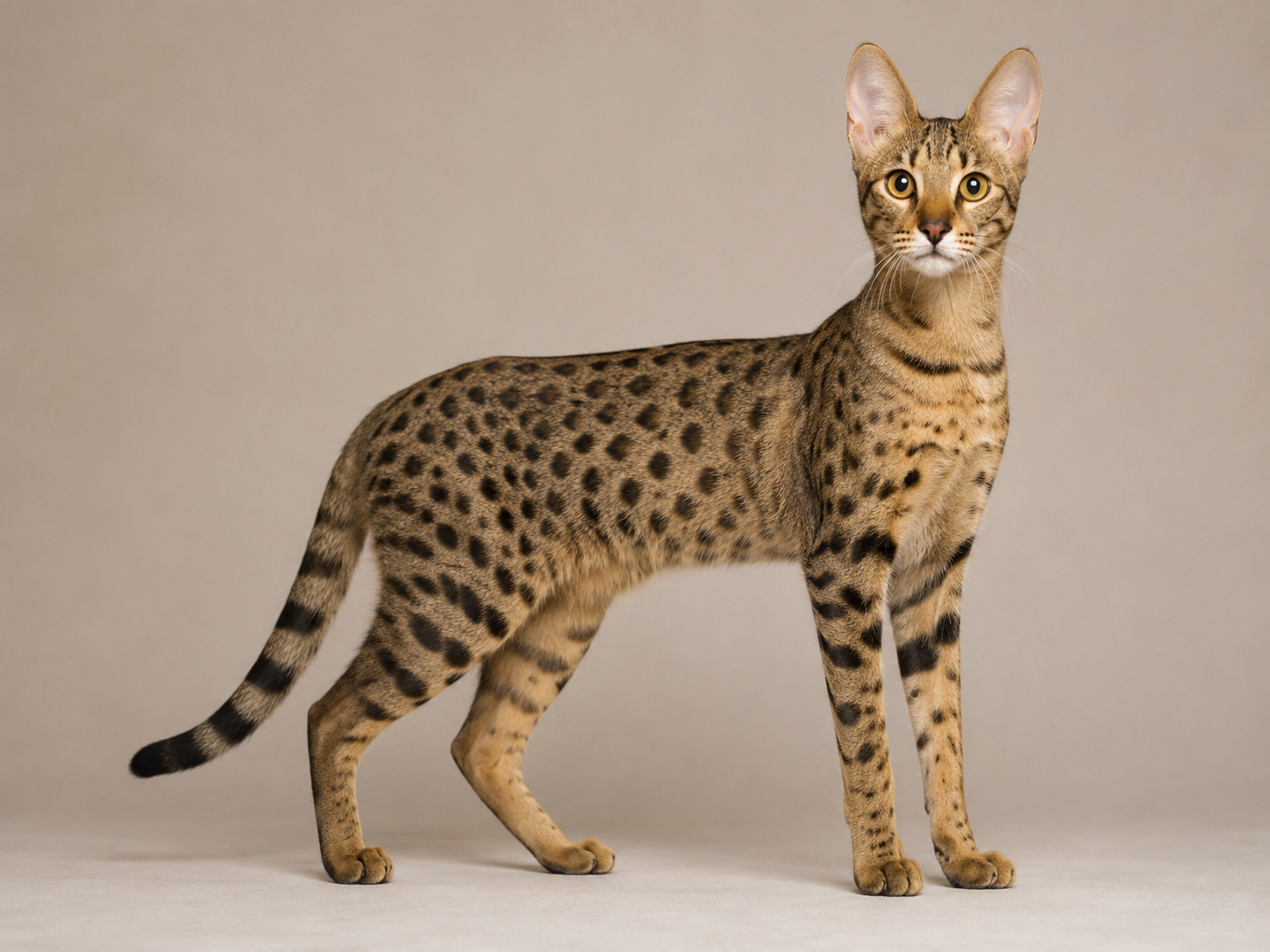
The Serengeti looks as though a small African wildcat has quietly stepped into the living room. Its exceptionally long legs, enormous rounded ears, spotted coat, and alert expression were deliberately developed to resemble the serval. Despite this wild appearance, the Serengeti is a domestic breed and was created without breeding domestic cats directly to servals.
Behind the exotic looks is an energetic, social, and highly inquisitive companion. Serengeti cats enjoy running, jumping, climbing, and taking part in whatever their people are doing. Many become closely attached to their families, follow them from room to room, and express themselves through an impressive range of sounds.
Quick facts:
- Coat: short, dense, and even in length
- Activity level: very high
- Social nature: outgoing and people-oriented
- Affection: devoted, although not every Serengeti enjoys being held for long periods
- Female weight: commonly about 8-12 pounds, or 3.6-5.4 kilograms
- Male weight: commonly about 10-15 pounds, or 4.5-6.8 kilograms
- Life expectancy: reliable breed-specific statistics are still limited
- Coat pattern: spotted or solid, depending on the color
- Breed status: Advanced New Breed in TICA
Males are generally larger than females, but the Serengeti should never appear heavy, stocky, or low to the ground. The ideal cat combines a strong body, lean muscle, exceptionally long legs, and a tall, upright stance.
History of the Serengeti Cat
The Serengeti is a young American breed developed in California during the mid-1990s. The breeding program was established by Karen Sausman, a conservation biologist and the owner of Kingsmark Cattery.
Sausman’s goal was to produce a domestic cat with the visual drama of an African serval without using the serval itself in the breeding program. She wanted the long-legged silhouette, large ears, spotted coat, and watchful expression of a wild savanna cat combined with the temperament and manageability of a domestic companion.
The foundation of the breed came primarily from Bengal cats and Oriental Shorthairs. Bengals contributed the spotted pattern, athletic build, and substantial body. Oriental Shorthairs contributed long legs, elongated lines, large ears, high activity levels, and a tendency to communicate vocally with their people.
No serval was used to create the Serengeti. This is the most important distinction between the Serengeti and the Savannah. Savannah cats descend from crosses between servals and domestic cats, while the Serengeti was developed entirely from domestic breeds.
The Bengal itself has distant hybrid ancestry involving the Asian leopard cat. For that reason, the most precise statement is that the Serengeti has no serval ancestry and was never produced through direct breeding to servals.
Development of the breed began around 1995. Over time, Serengeti cats appeared not only in the United States but also in the United Kingdom, continental Europe, Australia, New Zealand, Russia, and several other countries.
The breed entered TICA’s Preliminary New Breed program in 2002. On May 1, 2013, it advanced to the Advanced New Breed category.
This status allows Serengeti cats to be registered and exhibited in special new-breed classes at TICA shows. They have not yet reached full championship status and do not compete for the same titles and annual awards as fully recognized championship breeds.
Origin of the Name
The name Serengeti refers to the famous East African region known for its vast grasslands and extraordinary wildlife.
The name reinforces the breed’s savanna-inspired appearance and its resemblance to the African serval. It does not describe the actual place where the breed originated. The Serengeti cat was developed in California, not in Africa.
In English, the breed is usually called the Serengeti or the Serengeti cat.
Serengeti, Serval, and Savannah: What Is the Difference?
The serval is a wild African cat species. It is known for extremely long legs, oversized ears, a relatively small head, and a golden coat covered with dark spots and stripes.
The Serengeti was created to suggest the appearance of a serval through selective breeding among domestic cats. Its resemblance to the serval does not come from direct serval ancestry.
The Savannah, by contrast, originated through hybridization between servals and domestic cats. Early-generation Savannahs are described with designations such as F1, F2, and F3, indicating how closely they are related to a serval.
Serengeti cats do not have serval-generation labels. They are domestic pedigree cats, even though their proportions and coloring were intentionally developed to evoke the look of an African wildcat.
The breed standard calls for a confident, friendly, and outgoing temperament. Aggression toward people is not considered acceptable.
General Appearance
The Serengeti is a medium-sized cat whose structure should create an impression of height, athletic power, and agility.
The body is strong and fairly deep without appearing bulky. The shoulders and rump should remain approximately level, creating a straight topline. Combined with the long legs, this gives the cat a tall and almost vertical appearance.
The body may appear nearly square because the height of the legs visually balances the length of the torso. A Serengeti should not be excessively long-bodied, delicate, or fragile.
Muscle should be well developed but lean rather than thick. The cat should look fit and athletic, not massive.
Legs and Paws
Exceptionally long legs are one of the defining features of the Serengeti. In the TICA standard, the legs receive more points than any other single feature of the body.
The legs should have moderate bone and long, firm muscle. They must not appear either fragile and spindly or thick and heavy.
The paws are medium in size and oval in shape.
Those long legs make the Serengeti an impressive jumper. A high shelf, tall cabinet, or upper platform of a cat tree may look inaccessible to a person while appearing perfectly reasonable to the cat.
Head and Profile
The Serengeti’s head is longer than it is wide and forms a modified wedge. The lines begin at the nose and widen gradually toward the bases of the ears, creating a soft triangular outline.
The cheekbones should not be prominent. The muzzle is medium in length, with moderately full and rounded whisker pads. The chin should be firm without looking oversized or square.
The nose is moderately broad and remains close to the same width along most of its length.
In profile, the line rises straight from the nose to the brow and then curves gently toward the top of the skull. The head flows into a long, arched neck without a narrow or pinched appearance.
The Serengeti’s Ears
The enormous ears are among the breed’s most recognizable characteristics. They should be broad and deep at the base, with rounded rather than sharply pointed tips.
The height of each ear may be close to the length of the head. The ears are carried upright and placed fairly close together on top of the head.
Small ears are a serious fault. Long, sharply pointed ears with pronounced lynx tips are also incorrect for the breed. The Serengeti’s ear tips should appear rounded and clean.
These ears give the cat a permanently attentive expression. Even while waiting beside an empty food bowl, a Serengeti can look as though it has just detected movement somewhere beyond the tall grass.
Eyes
The eyes are large, round, and set widely apart. They should not appear bulging or deeply recessed.
The broad nose and generous distance between the eyes contribute to the breed’s wild, alert expression.
Gold and yellow are preferred eye colors. Hazel and light green are also accepted.
Blue eyes are not accepted in the TICA Serengeti standard.
Tail
The tail is thick at the base and tapers slightly toward the end. It is medium in length, although it can appear relatively short when compared with the cat’s unusually tall body.
When laid carefully along the body, the ideal tail should not reach the shoulder.
Spotted Serengeti cats usually have dark rings around the tail. The tip should be dark. A white tail tip is not accepted.
Coat Texture
The Serengeti has a short coat that remains even in length across the body. The hair is fine, dense, and may stand slightly away from the skin without becoming fluffy.
The coat can feel soft and silky. Its short length emphasizes the cat’s musculature and long, clean body lines.
Grooming requirements are simple, but coat quality still depends on balanced nutrition, healthy skin, and the cat’s overall condition.
Spotted Pattern
On spotted Serengeti cats, the markings should be dark, distinct, and clearly separated from one another. The spots are scattered freely across the body and should not form regular vertical stripes.
The pattern continues over the shoulders, thighs, and legs. Dark rings are normally visible on the tail.
Unlike the Bengal, the Serengeti is expected to have solid-colored spots. Two-tone spots known as rosettes are considered a fault in the Serengeti standard.
Heavy ticking is also undesirable. Ticking divides individual hairs into several bands of color and can make the spotted pattern appear less distinct.
Serengeti Colors
The TICA standard recognizes four main color varieties:
- brown spotted tabby;
- solid black;
- black silver spotted tabby;
- black smoke.
The background color of a brown spotted Serengeti may range through shades of brown, beige, tan, and gold. Clear contrast should remain between the background and the dark spots.
The chin, muzzle, and belly may be considerably lighter than the rest of the body. A pale mark on the back of the ears is desirable.
A silver Serengeti has black spots on a clean, cool silver background.
A solid black cat may appear completely dark, although faint ghost markings can sometimes be seen in certain lighting.
In a black smoke coat, the base of each hair is pale while the upper portion is black. When the cat is resting, the coat may look almost solid black. As the cat moves and the hair separates, the lighter roots become visible.
Temperament
Serengeti cats are generally described as confident, friendly, attentive, and highly social. Many form strong bonds with their families and want to participate in daily life.
In an unfamiliar place, a Serengeti may initially behave with caution. Once comfortable, the cat often begins following family members from room to room and supervising every activity.
Many Serengeti cats do not enjoy being left alone for long periods. They benefit from regular human interaction or the company of a compatible animal companion.
A Serengeti may be affectionate without wanting to remain in someone’s arms for hours. Many prefer to stay nearby, follow their people, play, and investigate whatever is happening.
Every cat has an individual personality. Temperament is shaped not only by breed tendencies but also by genetics, early socialization, training, and the environment in which the kitten was raised.
Activity and Play
The Serengeti is a highly active cat. It enjoys fast running, powerful jumps, chasing toys, and watching the household from the highest available position.
A tall, sturdy, multi-level cat tree is essential. High platforms, wall-mounted shelves, tunnels, and secure climbing routes can help satisfy the breed’s need for movement.
Good toys include wand toys, balls, lightweight objects that can be carried, food puzzles, and games that imitate hunting.
One short play session in the evening may not be enough. Several periods of activity throughout the day are usually more appropriate.
Without suitable entertainment, a Serengeti may design its own activity program. Curtains, open cabinets, houseplants, and objects that were supposedly placed out of reach may all become part of the curriculum.
How Vocal Is the Serengeti?
The breed’s tendency toward vocal communication probably comes in part from its Oriental Shorthair ancestry.
Some Serengeti cats use a wide range of meows, chirps, trills, short calls, and expressive changes in tone. They may answer their people or repeatedly announce what they want.
Vocal behavior varies considerably, however. Not every Serengeti will be loud or constantly interested in conversation.
Children and Other Pets
With proper socialization, a Serengeti can live successfully with children who understand how to handle animals gently and respect a cat’s personal space.
An active cat may enjoy playing with a child, but toys such as wands and balls should be used instead of hands.
Serengeti cats can also live with other cats and cat-friendly dogs. Introductions should be gradual, controlled, and free of pressure.
The best companion is usually an animal with a similar activity level. An elderly, quiet cat may find life difficult beside a young Serengeti that issues repeated invitations to race through the house.
The hunting instinct may be well developed. Birds, rodents, fish, and other small animals should be protected in secure enclosures or covered aquariums.
Who Is the Serengeti Best Suited For?
The Serengeti is best suited to someone who wants an intelligent, active, and social companion and is prepared to spend time interacting with the cat every day.
A suitable owner should be willing to:
- provide daily interactive play;
- create safe places for climbing and jumping;
- accept a high level of activity;
- offer regular companionship;
- secure windows and balconies;
- remove fragile and dangerous objects;
- provide puzzle toys and new activities.
The breed may not be the best choice for someone who wants a quiet, low-energy cat that can remain alone for most of the day.
A Serengeti should not be chosen solely for its appearance. The long-legged domestic serval look arrives with a generous supply of energy, curiosity, and personal opinions about how the home should be arranged.
Grooming and Routine Care
The Serengeti’s short coat is easy to maintain. Brushing once a week with a soft brush or rubber grooming mitt is usually sufficient.
During seasonal shedding, brushing can be done more often to remove loose hair.
Frequent bathing is unnecessary. The cat should be washed only when needed, using products made specifically for cats.
The claws should be checked and trimmed regularly. Several sturdy scratching posts should be available, including a tall vertical model that allows the cat to stretch its long body fully.
The ears, eyes, and teeth should also be monitored. Kittens are easier to manage as adults when they are gently introduced to tooth brushing, paw handling, and routine examinations from an early age.
Tall climbing structures must be stable and securely attached. A lightweight, wobbling scratching tower may have a dramatic but extremely brief career when challenged by a running Serengeti.
Safety and Outdoor Access
Windows and balconies should be protected with strong pet-safe screens. Standard insect screens are not designed to withstand the weight and force of an active cat.
Unrestricted outdoor access carries risks from traffic, dogs, infectious diseases, toxins, theft, and the possibility that the cat may travel far from home.
Safer options include leash walks, a fully enclosed yard, a protected balcony, or a secure outdoor cat enclosure.
Harness training should begin gradually indoors. Even a confident house cat may panic at a sudden noise outdoors and attempt to escape.
Feeding the Serengeti
A Serengeti needs a complete and balanced diet appropriate for its age, activity level, reproductive status, and health.
An exotic appearance does not require an exotic, African, or raw-food diet. An improperly balanced meat-based diet can cause serious nutrient deficiencies, while raw products may contain harmful bacteria and parasites.
High activity increases energy needs, but food should not automatically be available in unlimited quantities. Portions should be adjusted according to the individual cat’s body condition.
Fresh drinking water must always be available. Many cats prefer wide bowls or pet fountains that keep the water moving.
Serengeti Health
The Serengeti is a young and still relatively rare breed. Large scientific studies have not yet established a reliable list of breed-specific diseases or their prevalence.
Claims that every Serengeti is predisposed to a particular condition should therefore be treated carefully. At the same time, limited published data does not mean that hereditary disorders are impossible.
A responsible breeder should consider the health of individual breeding lines, the cats’ pedigrees, and the screening results of related animals.
Because Bengal and Oriental Shorthair cats have been used in the development of the breed, appropriate genetic and clinical screening should be selected according to the actual ancestry of each breeding cat rather than the breed name alone.
When purchasing a kitten, ask the breeder to provide:
- pedigrees for both parents;
- results of relevant DNA tests;
- information about clinical screening of the breeding cats;
- the kitten’s veterinary records;
- vaccination and parasite-control information;
- a written sales contract and health guarantee.
No single test panel can guarantee that a cat is free from every hereditary disease. Screening results should be interpreted in the context of the pedigree and the specific lines used in the breeding program.
Like every cat, a Serengeti needs routine veterinary examinations, vaccination, parasite prevention, dental care, weight monitoring, and prompt medical attention when its behavior or condition changes.
Interesting Facts About the Serengeti Cat
The Serengeti was created as a domestic alternative to cats with direct serval ancestry. Servals were never used in the breeding program.
Breed founder Karen Sausman was a conservation biologist. Developing a domestic cat with a wild appearance was consistent with her interest in protecting wild animals and reducing demand for exotic pets.
The ears are among the most important features in the breed standard. TICA assigns 12 points to the ears, more than it gives to the eye shape, tail, coat texture, or any individual feature of the head.
The legs are almost as important. They receive 10 points in the standard, and short legs are considered a significant fault.
Rosettes are not desirable in the Serengeti. While two-tone rosettes are highly valued in Bengal cats, the Serengeti standard prefers solid dark spots.
A completely black Serengeti is an accepted variety. Faint ghost spots may still become visible under certain lighting.
The breed advanced to TICA’s Advanced New Breed category in 2013. Serengeti cats can appear in special TICA classes but have not yet reached championship status.
The TICA standard lists Bengal and Oriental Shorthair cats as permitted outcrosses. These outcrosses help support the development of a breed that remains relatively rare.
The name sounds African, but the breed is American. The first Serengeti cats were developed in California.
White toes and a white tail tip are not accepted. Blue eyes also fall outside the recognized Serengeti standard.
The Serengeti is an excellent choice for someone who appreciates the combination of unusual looks, intelligence, affection, and nearly inexhaustible energy.
With the right home and care, the result is not an African wild animal but a devoted domestic companion on exceptionally long legs. It will follow its people, inspect the highest shelves, and make certain that no important household event takes place without the supervision of the resident representative of the savanna.
What would you like to see added to meow-cats.com?
- Funny cat videos (20%, 118 Votes)
- Ask a vet online (15%, 87 Votes)
- Classifieds for buying and selling cats (13%, 79 Votes)
- More useful articles on feline topics (13%, 76 Votes)
- Online cat memorial (11%, 63 Votes)
- Forum for cat lovers (8%, 49 Votes)
- Breeder and cattery ads (8%, 48 Votes)
- Veterinary clinic ads (7%, 41 Votes)
- Cat boarding and boarding cattery ads (6%, 38 Votes)
Total Voters: 273
 Loading ...
What are your 3 favorite cat breeds?
- Siamese Cat (11%, 184 Votes)
- Maine Coon (7%, 116 Votes)
- Bengal Cat (7%, 111 Votes)
- American Shorthair (6%, 104 Votes)
- Ragdoll (5%, 81 Votes)
- Persian Cat (5%, 79 Votes)
- Russian Blue (4%, 74 Votes)
- Egyptian Mau (4%, 68 Votes)
- Munchkin (4%, 61 Votes)
- Scottish Fold (4%, 61 Votes)
- Abyssynian (4%, 58 Votes)
- Other... (3%, 56 Votes)
- Norwegian Forest Cat (3%, 55 Votes)
- Turkish Angora (3%, 55 Votes)
- Siberian Cat (3%, 55 Votes)
- Himalayan Cat (3%, 53 Votes)
- British Shorthair (3%, 48 Votes)
- A Breedless Cat (2%, 40 Votes)
- Ocicat (2%, 40 Votes)
- Savannah Cat (2%, 39 Votes)
- Sphynx (2%, 38 Votes)
- Birman Cat (2%, 28 Votes)
- American Bobtail (2%, 25 Votes)
- Bombay Cat (1%, 23 Votes)
- Burmese Cat (1%, 21 Votes)
- Manx Cat (1%, 17 Votes)
- Havana Brown (1%, 16 Votes)
- Balinese Cat (1%, 12 Votes)
- Devonshire Rex (1%, 11 Votes)
- Singapura (1%, 9 Votes)
- Cornish Rex (0%, 7 Votes)
- Thai Cat (0%, 7 Votes)
- Donskoy Cat (0%, 1 Votes)
Total Voters: 661
Loading ...
Leave a Reply