Minskin Cat: Short Legs, Sparse Coat, and a Rare Modern Breed
The Minskin is a small American cat developed for two distinctive traits: very short legs and an unusual coat that is sparse over much of the body but denser on the face, ears, legs, and tail. It remains a rare developing breed with limited recognition, and its short-legged anatomy is also part of an ongoing debate about feline health and welfare.
The Minskin has one of the most unusual silhouettes in the cat world. Its body sits close to the ground on dramatically shortened legs, while the coat is intentionally uneven in density. Much of the torso may be covered only by a very fine, soft layer of down, while the outer parts of the body carry short, more closely packed hair. In the historical Minskin standard, these more heavily coated areas were called fur-points.
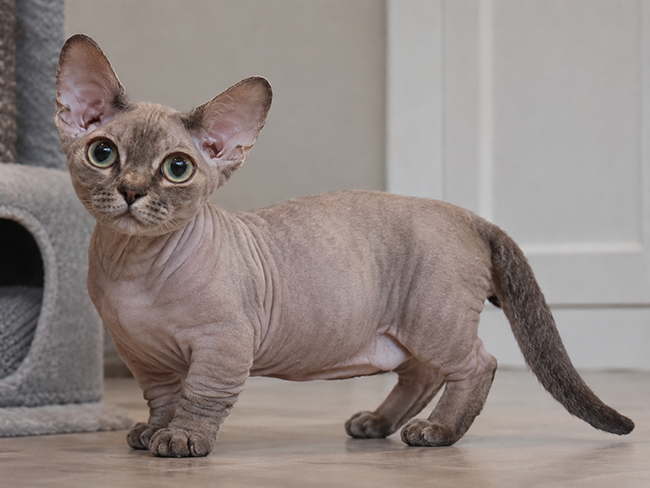 Despite its exotic appearance, the Minskin has no mysterious ancient history. It is a very young American breed whose development began in the late 1990s. That recent origin is useful because much of its early history is documented. It also means, however, that there is far less long-term health data for Minskins than there is for older, widely established breeds. Today, The International Cat Association registers Minskins, but the breed does not have championship status, while several other major registries do not recognize it at all.
Quick Facts
- Breed name: Minskin
- Origin: United States
- Development began: 1998
- Coat: very short and sparse over much of the body, with denser short hair on the face, ears, legs, and tail
- TICA status: Registration Only (RE)
- TICA breed code: MSL
- WCF status: not recognized as a separate breed
- CFA status: not recognized
- FIFe status: not recognized; FIFe rules prohibit breeds based on inherited limb shortening
- Size: small, with a sturdy and muscular body and disproportionately short legs
- Weight: no authoritative universal breed range is currently established
- Lifespan: reliable breed-specific longevity data is not yet available
- Activity level: generally described as playful and active, although physical ability varies between individual cats
- Social behavior: commonly described as friendly, curious, and people-oriented, but large independent behavioral studies have not been conducted
- Grooming: requires attention to the skin, ears, and nails; the sparse coat offers less protection from cold and strong sunlight
- Health: the short-legged trait comes from Munchkin ancestry and is associated with inherited disproportionate dwarfism; long-term health data specifically for Minskins remains limited
Where Did the Minskin Come From?
The Minskin was created by American breeder Paul McSorley, who began developing the breed in 1998. His goal was not simply to produce a hairless cat with short legs. He wanted a small, sturdy cat whose coat would be noticeably sparse across the body while remaining denser on the extremities. In other words, the contrast was meant to involve the distribution of hair rather than just coat color.
Historical TICA documents show that early Minskin breeding programs used Munchkin, Sphynx, Burmese, and non-pedigreed domestic shorthairs. McSorley has also described Devon Rex ancestry as part of the broader development of the breed. Over time, the breeding program changed, and a later version of the proposed standard listed only unrelated domestic shorthairs as permissible outcrosses.
The first cats that McSorley considered standard Minskins were born in 2000. The breed had a TICA standard by 2005, and by early 2007 TICA records showed 59 individually registered Minskins and 51 registered litters. The breed section subsequently applied for advancement within TICA’s developing-breed system.
Is the Minskin a Recognized Cat Breed?
This is one of the most confusing parts of the Minskin story because older websites often repeat recognition information that is no longer current. Historical records show that the breed moved through TICA’s development process during the 2000s, and old articles may describe it as a Preliminary New Breed. That is not its current status.
As of 2026, TICA lists the Minskin under Registration Only, abbreviated RE, with the breed code MSL. Registration Only is part of TICA’s pathway for developing breeds. It means that TICA can register Minskins and maintain their pedigrees, but the breed is not a Championship Breed and is not currently listed among TICA’s active Preliminary or Advanced New Breeds.
The Cat Fanciers’ Association does not include the Minskin among its recognized breeds. The World Cat Federation recognizes the Munchkin but does not list the Minskin as a separate recognized breed. FIFe takes a substantially different approach to short-legged cats: its rules prohibit the recognition and registration of breeds based on inherited dwarfism or shortened limbs and specifically cite the Munchkin as an example. The GCCF likewise states that it has no intention of recognizing the Munchkin or other dwarf breeds.
Why Does the Minskin Have Such Short Legs?
The Minskin inherited its short-legged body type from the Munchkin. In standard short-legged Munchkins, genetic research has identified a structural variant affecting the UGDH gene that is extremely closely associated with disproportionate dwarfism. One copy of the variant is sufficient for the short-legged phenotype to appear, which is consistent with dominant inheritance.
Researchers did not find living cats carrying two copies of the associated variant. Combined with breeding data showing reduced litter sizes in matings between short-legged Munchkins, this led researchers to conclude that the homozygous condition is probably lethal during early embryonic development.
There is an important distinction, however. The detailed genetic study was performed on Munchkins and related short-legged cats, not on a large representative population of modern Minskins. Because the Minskin received the short-leg trait through Munchkin ancestry, the findings are directly relevant to understanding the origin of the trait, but they should not be presented as though every living Minskin has been individually genotyped.
Short Legs Are More Than a Cosmetic Trait
Disproportionately short legs are sometimes described as if they simply make a cat smaller. Anatomically, the situation is more complicated. Imaging and skeletal measurements in short-legged Munchkin cats have documented substantial shortening of the long bones and changes in the shape or alignment of some limb bones and joints. The torso itself remains much closer to ordinary feline proportions, which is why these cats appear low to the ground rather than uniformly miniature.
At the same time, the available research does not establish that every short-legged cat will develop severe arthritis, chronic pain, or major disability. Long-term population studies are still limited, particularly for the Minskin itself. It would therefore be inaccurate to claim either that the dwarfism is completely harmless or that every Minskin is destined to suffer from serious orthopedic disease.
For an owner, the practical approach is to pay attention to mobility throughout the cat’s life. Persistent stiffness, limping, reluctance to move, difficulty climbing, changes in gait, sensitivity when handled, or a noticeable reduction in activity deserve veterinary evaluation.
What Are Fur-Points?
The Minskin’s coat is just as important to its original breed concept as its short legs. The historical TICA standard used the term fur-points for areas covered in short, closely packed, soft hair. These areas include the entire facial mask, ears, legs, and tail. The rest of the body is visibly more sparsely coated.
This should not be confused with the color points seen in Siamese and other colorpoint cats. A color point is a pattern of pigmentation, with darker color on cooler parts of the body. A Minskin fur-point refers primarily to coat density. A cat may have darker coloration on the same areas, but pigmentation and hair density are separate characteristics.
The historical standard described the coat as exceptionally soft, with a texture reminiscent of fine cashmere. Hair from the legs may extend upward onto the shoulders, hips, and hindquarters. The temples in front of the ears should be noticeably sparse, and the neck, chest, and abdomen may look almost hairless while still carrying a very fine layer of down. Whiskers may be normal, sparse, broken, or absent.
Is the Minskin Hairless?
Not in the classic sense. An ideal Minskin under the historical breed concept was not simply a completely bald short-legged Sphynx. The contrast between the sparsely coated body and the denser fur-points was considered an identifying feature of the breed. In fact, the historical TICA standard treated the absence of fur-points as a serious fault.
This is why photographs labeled “Minskin” online can be misleading. The breed is rare, its modern population is small, and visually similar short-legged cats may be described online as Minskins even when they are Bambinos, Munchkins, Sphynx crosses, or cats of uncertain ancestry. A nearly naked short-legged cat is not automatically a Minskin.
Minskin Appearance
The historical standard described the Minskin as noticeably small and stocky, with a strong, muscular body. The torso is moderately compact and may appear longer than it really is because of the shortened legs. The chest should be broad and well muscled, while the bone structure should be sturdy rather than delicate.
The legs are very short. The upper and lower portions of the front legs should be roughly equal in length, and the hind legs may be slightly longer than the front. The feet are round, compact, and strong and should point forward rather than turning noticeably inward or outward. A slight rise from the shoulders toward the hindquarters can therefore be normal in the historical breed type.
The tail is relatively long, historically described as slightly longer than the body, and tapers gradually toward the tip. Because the legs are so short, the tail may look especially long in proportion to the cat’s height.
Head, Ears, and Eyes
The Minskin’s head is rounded and wider than it is long, without the long triangular wedge associated with Oriental breeds. The muzzle is short and broad, with prominent whisker pads and a strong chin. A visible stop is present in profile.
The ears are large, open, and broad at the base, with gently rounded tips. Their placement is partly on the sides of the head rather than entirely on top, contributing to the breed’s distinctive expression. The eyes are large, round, widely spaced, and open-looking. The historical standard did not restrict the breed to a particular eye color.
Minskin Colors and Patterns
The Minskin was historically accepted in all colors and patterns. A cat may therefore be solid, tabby, tortoiseshell, colorpoint, or have white spotting, among many other possibilities. There is no single “Minskin color.”
On cats with extremely sparse coats, pigmentation may be especially visible through the skin, making stripes and patches appear almost painted onto the body. Color should not be confused with the distribution of the fur-points, which refers to coat density rather than pigmentation.
Minskin Personality
Breed materials and owner reports commonly describe Minskins as curious, outgoing, playful, affectionate, and strongly interested in people. The historical standard also emphasized a sweet temperament and willingness to be handled. Many are reported to enjoy following family members around the home and taking part in whatever is happening nearby.
These descriptions should still be treated as tendencies rather than promises. The Minskin population is small, and there are no large independent behavioral studies establishing a unique breed personality. Genetics within a particular line, early socialization, the kitten’s experiences, and the home environment can all have a major influence on adult behavior.
Activity and Exercise
Short legs do not mean that a Minskin should live a sedentary life. Cats need opportunities to stalk, chase, climb, scratch, explore, and solve simple problems regardless of breed. Many short-legged cats can run quickly and climb onto furniture, but their biomechanics differ from those of normally proportioned cats, and very high jumping may be more difficult for some individuals.
A Minskin-friendly home can provide vertical space without requiring repeated large jumps. Stable steps, low platforms, intermediate shelves, ramps where appropriate, and easily accessible resting places give the cat more control over how it moves through the environment. Play sessions can emphasize chasing toys along the floor, short bursts of pursuit, tunnels, puzzle feeders, and other activities that allow the cat to move naturally without forcing uncomfortable jumps.
Skin and Coat Care
A sparse coat changes grooming needs. In a normally coated cat, hair absorbs and distributes some of the oils produced by the skin. On sparsely coated areas, those oils may remain more noticeable on the skin itself. Some Minskins may therefore need occasional bathing or gentle cleaning, but there is no evidence-based rule that every Minskin should be bathed once a week.
Bathing too frequently can dry or irritate the skin, so grooming should be adjusted to the individual cat. Owners should periodically check for redness, persistent greasiness, pimples, crusting, unusual odor, or signs of itching. Recurring skin problems deserve veterinary evaluation instead of simply more frequent washing.
The ears also need regular inspection. Cats with sparse ear hair may accumulate visible wax more readily, but ears should be cleaned only when necessary and nothing should be pushed deep into the ear canal. Nails should be checked routinely, and the skin around the nail beds can also collect oily debris in sparsely coated cats.
Cold Weather and Sun Exposure
Hair is an important part of a cat’s insulation, so a Minskin’s sparse coat provides less protection against cold temperatures. Warm sleeping areas, freedom from drafts, and comfortable indoor temperatures are particularly important. Clothing is not automatically necessary, and some cats dislike wearing it. Poorly fitted garments can also rub the skin or interfere with movement.
Sparse hair also means less natural protection from ultraviolet radiation. Minskins should not spend long periods exposed to intense direct sunlight. Human sunscreen should not be applied casually to cats because products designed for people may contain ingredients that are inappropriate or unsafe when licked. Limiting intense sun exposure is generally the safer approach unless a veterinarian recommends a specific product.
Are Minskin Cats Hypoallergenic?
No cat breed can reliably be described as hypoallergenic simply because it has little hair. Important feline allergens are proteins produced in saliva and skin secretions rather than the hair itself. When a cat grooms, those proteins are distributed across the skin and coat and eventually throughout the home.
A person who reacts to ordinary cats may therefore also react strongly to a Minskin. Anyone with a significant cat allergy should spend time around the individual cat before bringing one home rather than relying on advertising claims about hairless or nearly hairless breeds.
Diet and Weight Management
Minskins do not require a breed-specific diet. They need a complete and balanced cat food appropriate for their age, health, reproductive status, and activity level. Portion size should be adjusted to the individual rather than based only on a feeding chart.
Keeping a Minskin lean is particularly sensible because excess body weight adds additional mechanical load to already shortened limbs. Body condition matters more than a target number on the scale: the ribs should be easy to feel under a light covering of tissue, and the cat should maintain a visible waist when viewed from above.
Minskin Health
The Minskin is young and rare, which makes sweeping claims about its health especially unreliable. There are not yet large, long-term studies establishing an average lifespan or the true prevalence of particular diseases across the breed. Statements that Minskins are completely free of breed-related health concerns should therefore be treated with the same skepticism as unsupported lists claiming that every Minskin will develop multiple serious disorders.
The best-studied issue is inherited short-legged stature. Research in Munchkin cats identified a structural variant involving UGDH that was perfectly associated with the short-legged phenotype in the study population. The researchers described the condition as chondrodysplasia, a developmental alteration of cartilage and long bones. CT imaging also documented substantial shortening of limb bones and, in some animals, changes in bone shape and joint alignment.
Those findings matter to the Minskin because its short-legged trait comes from Munchkin ancestry, but they do not tell us exactly how often an adult Minskin will develop pain, arthritis, or mobility impairment. Good long-term epidemiologic data for the breed does not yet exist. Owners should therefore monitor gait, jumping ability, activity, body weight, and signs of discomfort throughout life rather than assuming either that the anatomy is harmless or that disease is inevitable.
The Minskin’s coat history also includes breeds with unusual hair structure, particularly the Sphynx. Hairlessness in the Sphynx is associated with a recessive variant of KRT71, and another variant in the same gene causes the Devon Rex coat. However, published research has not established the frequency or exact combination of these variants across today’s Minskin population. A Minskin’s genotype should not be guessed from appearance alone.
Why Is Minskin Breeding Controversial?
The Minskin sits at the center of a larger ethical discussion about how far selective breeding should go in emphasizing unusual physical traits. Supporters of the breed point to short-legged cats that run, play, climb, interact normally, and appear to enjoy good quality of life. Critics argue that deliberately perpetuating an inherited skeletal abnormality is difficult to justify when the trait has no functional benefit for the cat and may alter normal movement.
Major cat organizations reflect that disagreement. TICA currently permits Minskin registration, while FIFe prohibits the registration and breeding of cats with inherited forms of dwarfism or shortened limbs and does not allow such cats to be exhibited. The GCCF likewise states that it has no intention of recognizing dwarf breeds. These policies do not prove that every individual Minskin is unhealthy, but they do show that short-legged breeding remains a genuine welfare issue rather than a purely cosmetic debate.
How to Choose a Minskin Kitten
Because the breed is rare, identifying a reputable breeder requires more than finding a kitten with short legs and sparse hair. A cat that looks like a Minskin is not necessarily a registered Minskin. If a breeder advertises TICA-registered kittens, ask to see the registration information and pedigrees rather than relying on the breed name in an online advertisement.
Ask about the health and mobility of the parents and older relatives, not just the kitten in front of you. A thoughtful breeder should be willing to discuss orthopedic health, gait, skin problems, longevity, and any veterinary or genetic testing performed in the line. Claims that “this breed has no health problems” are not a substitute for actual health information.
A kitten should move freely and confidently, bear weight comfortably on all four limbs, and show no obvious persistent lameness or severe limb deformity. The skin should look healthy rather than chronically inflamed, and the kitten should be alert, curious, and appropriately socialized for its age. Unusual appearance should never take priority over basic health and sound movement.
Is a Minskin Right for You?
A Minskin may appeal to someone who enjoys a highly unusual cat and is prepared to accommodate both its skin and its body structure. The home should make important resources easy to reach without requiring constant high jumps, and the owner should be willing to monitor weight, mobility, skin condition, ears, and nails throughout the cat’s life.
The breed is a poor choice for anyone interested primarily in owning a novelty animal. Short legs and sparse hair are inherited biological traits, not decorative accessories. A Minskin still needs everything any other cat needs: opportunities to move, play, scratch, explore, rest undisturbed, interact socially on its own terms, and make meaningful choices within its environment.
Interesting Facts About the Minskin
- The Minskin is a very young breed. Development began in the United States in 1998, and the first cats considered standard Minskins were born in 2000.
- Paul McSorley created the breed. His breeding program was designed to combine short stature with a distinctive distribution of coat density.
- A true Minskin was not originally intended to be completely hairless. The historical standard emphasized denser fur-points on a visibly more sparsely coated body.
- Fur-points are not the same as color points. Fur-points describe denser hair on the face, ears, legs, and tail, while color points describe pigmentation.
- The breed’s TICA abbreviation changed. Historical records used MS; current TICA rules use MSL.
- The Minskin is currently Registration Only with TICA. It does not have championship status.
- Munchkin genetics help explain the breed’s short legs. A structural variant involving UGDH is strongly associated with inherited disproportionate dwarfism in short-legged Munchkins.
- Two copies of the Munchkin-associated variant are believed to be incompatible with normal embryonic survival. Researchers found no living homozygous cats in the study population.
- Not every registry accepts dwarf breeds. FIFe and the GCCF take much stricter positions than TICA on inherited short-legged conformation.
- There is no reliable breed-specific lifespan figure yet. The Minskin population is too small and too young for commonly quoted lifespan ranges to be considered well-established statistics.
The Minskin is one of the most unusual products of modern cat breeding. Its very short legs and distinctive sparse coat make it immediately recognizable when the breed type is expressed correctly, yet those same traits also make accurate identification and responsible breeding especially important. A genuine Minskin is more than a hairless cat on short legs: the historical breed concept included a sturdy, rounded body type and a characteristic contrast between the sparsely coated torso and its soft fur-points.
Because the breed remains rare and long-term health information is limited, the Minskin is best approached without either romanticizing or demonizing it. We know much more today about the genetics and anatomy behind feline short-legged dwarfism than breeders did when the Minskin was first developed, but important questions about lifetime orthopedic health remain unanswered. For anyone considering one of these cats, documented ancestry, responsible breeding, comfortable movement, and lifelong welfare matter far more than novelty alone.
What would you like to see added to meow-cats.com?
- Funny cat videos (20%, 118 Votes)
- Ask a vet online (15%, 87 Votes)
- Classifieds for buying and selling cats (13%, 79 Votes)
- More useful articles on feline topics (13%, 76 Votes)
- Online cat memorial (11%, 63 Votes)
- Forum for cat lovers (8%, 49 Votes)
- Breeder and cattery ads (8%, 48 Votes)
- Veterinary clinic ads (7%, 41 Votes)
- Cat boarding and boarding cattery ads (6%, 38 Votes)
Total Voters: 273
 Loading ...
What are your 3 favorite cat breeds?
- Siamese Cat (11%, 184 Votes)
- Maine Coon (7%, 116 Votes)
- Bengal Cat (7%, 111 Votes)
- American Shorthair (6%, 104 Votes)
- Ragdoll (5%, 81 Votes)
- Persian Cat (5%, 79 Votes)
- Russian Blue (4%, 74 Votes)
- Egyptian Mau (4%, 68 Votes)
- Munchkin (4%, 61 Votes)
- Scottish Fold (4%, 61 Votes)
- Abyssynian (4%, 58 Votes)
- Other... (3%, 56 Votes)
- Norwegian Forest Cat (3%, 55 Votes)
- Turkish Angora (3%, 55 Votes)
- Siberian Cat (3%, 55 Votes)
- Himalayan Cat (3%, 53 Votes)
- British Shorthair (3%, 48 Votes)
- A Breedless Cat (2%, 40 Votes)
- Ocicat (2%, 40 Votes)
- Savannah Cat (2%, 39 Votes)
- Sphynx (2%, 38 Votes)
- Birman Cat (2%, 28 Votes)
- American Bobtail (2%, 25 Votes)
- Bombay Cat (1%, 23 Votes)
- Burmese Cat (1%, 21 Votes)
- Manx Cat (1%, 17 Votes)
- Havana Brown (1%, 16 Votes)
- Balinese Cat (1%, 12 Votes)
- Devonshire Rex (1%, 11 Votes)
- Singapura (1%, 9 Votes)
- Cornish Rex (0%, 7 Votes)
- Thai Cat (0%, 7 Votes)
- Donskoy Cat (0%, 1 Votes)
Total Voters: 661
Loading ...
Leave a Reply