Cherubim Cat: Ragdoll Roots, a Wider Palette, and a Breed of Its Own
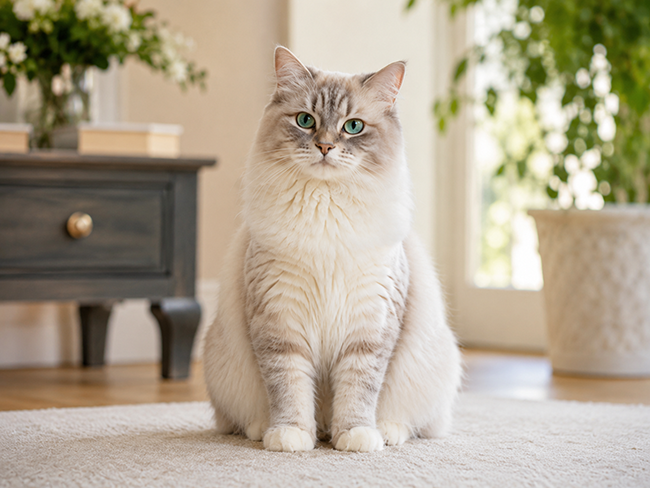 A large, affectionate semi-longhaired cat from the Ragdoll Breed Group, the Cherubim combines the familiar Ragdoll type with Mink, Sepia and Traditional colors and a much broader range of eye colors.
The Cherubim is one of the newest breeds to enter TICA Championship competition, but both the name and the breeding lines behind it have a much longer history. Closely connected with the development of the Ragdoll, the modern Cherubim shares the same basic head, body and coat standard while occupying a different part of the color spectrum. Under the current standard of The International Cat Association (TICA), a Ragdoll is a blue-eyed pointed cat, while a Cherubim belongs to the Mink, Sepia or Traditional color category and may have aqua, green, gold, copper, hazel or several other eye colors depending on its category. This makes the Cherubim especially interesting from a breed-history perspective: it is both a newly established Championship breed and the continuation of breeding lines whose story reaches back into the early history of the Ragdoll itself.
Quick Facts About the Cherubim Cat
- Official name: Cherubim
- TICA breed code: CB
- TICA status: Championship breed
- Breed group: Ragdoll Breed Group
- Historical roots: United States, connected with early Ragdoll breeding lines
- Coat length: Semi-long
- Coat texture: Silky and soft, with minimal undercoat
- Size: Large
- Adult female weight: Approximately 10–15 pounds
- Adult male weight: Approximately 15–20 pounds
- Maturity: Slow; full weight and size may take up to four years
- TICA color categories: Mink, Sepia and Traditional
- Eye colors: Depend on color category and include aqua, gold, green, bronze, copper, yellow and hazel
- Temperament: Affectionate, generally easygoing and calm, with a playful side
- Life expectancy: 10+ years; many live into their mid or high teens
History of the Cherubim
The story of the Cherubim begins with the Ragdoll. Breeder Ann Baker developed the Ragdoll in Riverside, California, during the 1960s. The early breeding program eventually gave rise to the blue-eyed pointed cats that became strongly associated with the Ragdoll name, but Baker also developed additional breeding lines and worked with cats in a broader range of colors and patterns. The name “Cherubim” itself is not a modern invention: historical registration documents connected with Baker’s International Ragdoll Cat Association, or IRCA, carried the phrase “Registrar of Cherubim Cats.” This does not mean that today’s Cherubim already existed as a separate standardized breed at that time, but it does establish genuine historical roots for the name.
When cats from these early lines entered the TICA registry, they were registered within the broader Ragdoll population. Over time, however, a clear division developed between the blue-eyed pointed cats accepted for Ragdoll Championship competition and mink, sepia and non-pointed cats descended from related lines. Breeders of these cats sought a way for them to compete in Championship classes without changing the established blue-eyed pointed identity of the Ragdoll. The solution proposed to TICA was the creation of a Ragdoll Breed Group containing two closely related breeds: blue-eyed pointed cats would remain Ragdolls, while Mink, Sepia and what the current standard calls Traditional cats would become Cherubims. In 2024, the TICA Board approved the advancement of the Cherubim to Championship status and approved the Ragdoll/Cherubim Breed Group standard. The change became effective on May 1, 2025.
Is the Cherubim Really a Separate Breed?
Under the current TICA system, yes. The Cherubim has its own breed code, CB, and competes as a Championship breed. At the same time, its relationship with the Ragdoll remains exceptionally close: the two breeds form the Ragdoll Breed Group and share the same fundamental physical standard. The formal division lies primarily in color category and eye color. A TICA Ragdoll belongs to the Pointed category and has blue eyes, while a TICA Cherubim belongs to the Mink, Sepia or Traditional category and has the eye color appropriate to that category. In other words, the Cherubim is not a newly invented cat that simply happens to resemble a Ragdoll. Its modern breed identity grew directly from cats historically bred and registered within the broader Ragdoll population.
Recognition by Cat Registries
The Cherubim’s current formal breed identity is primarily associated with TICA, where it is a Championship breed with the code CB and a member of the Ragdoll Breed Group. The Cat Fanciers’ Association (CFA) and Fédération Internationale Féline (FIFe) do not currently include the Cherubim among their recognized breeds, while the Governing Council of the Cat Fancy (GCCF) lists it among unrecognized breeds and identifies TICA as the organization recognizing it.
The World Cat Federation (WCF) presents a slightly different situation. The Cherubim does not currently have its own published WCF EMS breed code and is therefore not a separately recognized WCF breed for pedigree purposes. WCF rules, however, allow breeds recognized by another member of the World Cat Congress, including TICA, to participate for Championship titles under WCF rules, subject to the policies of the individual WCF member club. Eligibility to compete should not be confused with formal WCF recognition of the breed. This is a useful reminder that breed recognition is registry-specific: recognition by one international organization does not automatically create identical registration rules or show status in every other organization.
Appearance and Breed Type
The Cherubim is a large, substantial cat with strong bone and solid musculature, but the overall impression should remain balanced and moderate rather than exaggerated. The torso is medium-long to long with a broad chest, the hind legs are slightly longer than the front legs, and the feet are large and round, with toe tufts considered desirable. The long tail is approximately equal to the length of the body, thick at the base and tapering slightly toward the end. These cats can feel surprisingly heavy when picked up, but the standard does not call for an excessively bulky, short or cobby body.
The head is a broad modified wedge with softly rounded contours. It should not form the narrow, sharply triangular wedge seen in some Oriental breeds, nor should it become extremely round or short-faced. When viewed from the front, the area between the ears has the appearance of a relatively flat plane. The ears are medium-sized, broad at the base, rounded at the tips and positioned partly on top of the head and partly toward the sides, with a slight forward tilt. The muzzle is rounded and medium in length, the chin is well developed, and the profile combines a straight nose to the bridge with a gentle concave curve toward the brow and a convex forehead. Because the Cherubim shares its structural standard with the Ragdoll, a change in color should not create a completely different physical type. A well-typed Cherubim should retain the balanced, substantial appearance characteristic of the Ragdoll Breed Group.
Eyes, Mink, Sepia and Traditional Colors
The eyes are large, oval, level-set and moderately wide apart, and their color is one of the clearest ways in which the Cherubim differs from the familiar blue-eyed Ragdoll. There is no single eye color for every Cherubim. Mink Cherubims have aqua eyes, ranging from blue-green to green-blue. Sepia Cherubims may have gold, gold-green, also called chartreuse, or green eyes. Traditional Cherubims have the broadest range, including bronze, copper, gold, yellow, green and hazel. Within each category, deeper and richer eye colors are preferred.
Mink, Sepia and Traditional are not individual colors such as chocolate, blue or red. They describe broader categories of color expression. A Mink Cherubim has a moderately colored body with deeper pigmentation on the face, ears, legs and tail, producing softer contrast than the classic pointed pattern. A Sepia Cherubim has less contrast still, with the body color lying closer to that of the extremities. Traditional is the official category name used by the current TICA Ragdoll Breed Group standard and should not be interpreted as meaning “traditional Ragdoll coloring.” The TICA Ragdoll itself belongs specifically to the Pointed category.
Older material surrounding the creation of the breed often refers to “mink, sepia and solid Ragdolls” or “mink, sepia and solid Cherubims,” and simplified breed descriptions may still use similar wording. The current official TICA standard, however, names the three Cherubim categories Mink, Sepia and Traditional. Traditional is also broader than a single solid coat, since the standard includes solid, tortie and tabby divisions within the Cherubim breed.
Colors and White Patterns
TICA accepts Cherubims in all Mink, Sepia and Traditional colors except solid white. The breed may occur in solid, tortie and tabby divisions, and white spotting is accepted in the mitted and bicolor patterns defined by the standard. In the mitted pattern, the front feet have matching white mittens, while white on the hind legs extends up to and around the hocks and may continue no higher than the middle of the thigh. The chin is white, and a white stripe runs from the chin through the chest and along the belly; a white facial blaze is also permitted within specific limits. In the bicolor pattern, the face has a white inverted V surrounding the pink nose, the chest, stomach and ruff are white, and white feet and legs are preferred.
Coat, Size and Maturity
The Cherubim has a semi-long coat with a silky, soft texture and minimal undercoat. The coat should have enough body to look luxurious while still falling smoothly rather than becoming dense, woolly or cottony. Coat length may vary with the seasons, and unaltered adults may carry somewhat shorter coats. Under the TICA standard, correct texture is more important than sheer length.
The Cherubim is one of the larger pedigreed cats. TICA gives approximate adult weights of 10–15 pounds for females and 15–20 pounds for males, although individual cats may naturally fall outside these ranges. The breed matures slowly and may not reach full adult weight and size until around four years of age, while full coat color can take approximately three years to develop. An adolescent Cherubim may therefore look noticeably different from the same cat at full maturity, as body substance, coat development and color intensity continue to change well beyond kittenhood.
Personality, Activity and Everyday Life
Cherubims are generally described as affectionate, easygoing and calm, but calm does not mean inert. They retain a playful side and benefit from regular interaction with their people. TICA describes them as cats that can fit well into busy modern households and generally get along with children and other pets, including dogs. Individual temperament still matters, of course, and introductions between animals should always be gradual rather than relying on breed reputation alone.
The breed is not usually associated with the relentless activity of some highly energetic cats, but Cherubims still need opportunities to play, climb, scratch and explore. Interactive wand toys, balls, cat trees and sturdy scratching posts provide exercise and mental stimulation, while regular play is particularly useful for such a large adult cat because excessive weight places unnecessary stress on the body. For many households, the Cherubim offers an appealing balance: a substantial, relaxed companion that still enjoys play and interaction rather than spending life as decorative furniture.
Grooming and Care
The semi-long coat benefits from regular brushing to remove loose hair and catch small tangles before they become mats. Particular attention should be paid to areas where longer hair rubs together, including behind the ears, under the front legs, around the chest and along the hindquarters. The exact grooming schedule depends on the individual cat’s coat, shedding and lifestyle, but a few calm, regular grooming sessions are generally preferable to waiting until tangles have already formed.
Routine care should also include checking the claws, teeth and ears and monitoring overall body condition. Because the Cherubim is naturally large and substantial, it is important not to confuse healthy bone and muscle with excess body fat. As with any cat, preventive veterinary care, appropriate nutrition, exercise and attention to changes in behavior or appearance are more important than following a rigid grooming schedule.
Cherubim Health
The Cherubim is very new as a separately named TICA Championship breed, so there is still limited health information published specifically under the Cherubim breed name. Its breeding history, however, is directly connected with Ragdoll lines. One genetic test that may therefore be relevant in Cherubim breeding programs is the test for the Ragdoll-associated R820W variant in the MYBPC3 gene, which is associated with hypertrophic cardiomyopathy, or HCM, in Ragdolls and related lines.
It is important to understand the limits of this test. A negative result means that the cat does not carry this particular Ragdoll-associated R820W variant; it does not guarantee that the cat can never develop HCM from another genetic or non-genetic cause. When choosing a kitten, ask the breeder about the health history of the breeding cats, relevant DNA testing, veterinary screening and how health information is used in the breeding program. Responsible breeding involves much more than producing attractive coat and eye colors.
Cherubim vs. Ragdoll and RagaMuffin
The simplest way to understand the relationship between the Cherubim and Ragdoll is to think of them as two breeds sharing one physical blueprint under TICA. Both belong to the Ragdoll Breed Group and use the same fundamental standard for the head, body and coat. The formal distinction lies primarily in color category and eye color: a TICA Ragdoll belongs to the Pointed category and has blue eyes, while a TICA Cherubim belongs to the Mink, Sepia or Traditional category and has the eye color appropriate to that category. This is why terms such as “mink Ragdoll” can now cause confusion. They may still appear in historical pedigrees, breeder terminology and older articles, but within the current TICA Championship structure, cats of the appropriate Mink or Sepia type in this breed group are registered and shown as Cherubims rather than Championship Ragdolls.
The Cherubim should also not be confused with the RagaMuffin. The histories of all three breeds intersect through breeding programs associated with Ann Baker, but the modern RagaMuffin developed as its own breed with its own standards and registry history. The Cherubim remains structurally tied to the TICA Ragdoll Breed Group and shares the Ragdoll head and body standard, while the RagaMuffin has its own breed type, including a generally rounder expression and different specifications for the head, eyes and coat. Color alone is not enough to identify any of these breeds: Mink and Sepia coloring are not exclusive to the Cherubim and can occur in other pedigreed cats.
Can You Identify a Cherubim From a Photograph?
Not reliably. A semi-longhaired cat with aqua eyes and Mink coloring may resemble a Cherubim, but those characteristics alone do not establish breed identity. The same applies to a solid, tabby or bicolor cat whose appearance happens to fit part of the Cherubim standard. Pedigreed breed identity depends on documented ancestry and registration, not simply on resemblance. A photograph can tell you that a cat looks Cherubim-like; it cannot prove that the cat is a registered Cherubim.
Choosing a Cherubim Kitten
Because the Cherubim is still uncommon under its modern Championship identity, prospective owners should make sure they understand exactly what a breeder is offering. Ask which registry the kitten is registered with and whether the registration identifies it as a Cherubim. Find out whether the kitten belongs to the Mink, Sepia or Traditional category and what eye color is appropriate for that category, and request information about both parents, pedigree, health testing and the breeder’s overall breeding program rather than choosing a kitten based only on an unusual coat or eye color.
A responsible breeder should also care about where the kitten will live, what kind of home it is going to and whether the Cherubim is a suitable match for the buyer. Rarity is interesting, but it should never matter more than health, temperament and responsible breeding.
Interesting Facts About the Cherubim
- The Cherubim became eligible for TICA Championship competition on May 1, 2025.
- Its TICA breed code is CB.
- The Cherubim and Ragdoll belong to the same TICA Ragdoll Breed Group.
- The two breeds share the same basic head, body and coat standard.
- The name Cherubim has roots in Ann Baker’s early breeding programs and predates the modern TICA breed designation by decades.
- Mink Cherubims have aqua eyes ranging from blue-green to green-blue.
- Sepia Cherubims may have gold, gold-green or green eyes.
- Traditional Cherubims may have bronze, copper, gold, yellow, green or hazel eyes.
- The breed may take up to four years to reach full adult size and weight.
- Full color may take approximately three years to develop.
- Solid white is excluded from the current TICA Cherubim standard.
- No outcrosses are permitted under the current TICA Ragdoll Breed Group standard.
Is the Cherubim the Right Cat for You?
The Cherubim may be especially appealing to someone who loves the substantial build, silky semi-long coat and affectionate nature associated with the Ragdoll family but is drawn to a broader range of colors and eye colors. These cats need companionship, play, scratching opportunities, regular coat care and enough space to comfortably accommodate a large adult body. Their relaxed reputation should not be mistaken for passivity: a Cherubim is still a cat, complete with curiosity, playfulness and opinions about how the household should be managed.
Perhaps the most fascinating thing about the Cherubim is the way it combines old and new. Its current TICA Championship identity dates only from 2025, yet the breeding lines behind it and even the Cherubim name reach much further back into Ragdoll history. That makes the breed an unusually clear example of how pedigreed cats continue to evolve. New breed identities do not always begin with the sudden appearance of a completely new kind of cat; sometimes they emerge when long-established breeding lines, genetics, show standards and registry rules are reorganized into a new chapter of a much older story.
What would you like to see added to meow-cats.com?
- Funny cat videos (20%, 118 Votes)
- Ask a vet online (15%, 87 Votes)
- Classifieds for buying and selling cats (13%, 79 Votes)
- More useful articles on feline topics (13%, 76 Votes)
- Online cat memorial (11%, 63 Votes)
- Forum for cat lovers (8%, 49 Votes)
- Breeder and cattery ads (8%, 48 Votes)
- Veterinary clinic ads (7%, 41 Votes)
- Cat boarding and boarding cattery ads (6%, 38 Votes)
Total Voters: 273
 Loading ...
What are your 3 favorite cat breeds?
- Siamese Cat (11%, 184 Votes)
- Maine Coon (7%, 116 Votes)
- Bengal Cat (7%, 111 Votes)
- American Shorthair (6%, 104 Votes)
- Ragdoll (5%, 81 Votes)
- Persian Cat (5%, 79 Votes)
- Russian Blue (4%, 74 Votes)
- Egyptian Mau (4%, 68 Votes)
- Munchkin (4%, 61 Votes)
- Scottish Fold (4%, 61 Votes)
- Abyssynian (4%, 58 Votes)
- Other... (3%, 56 Votes)
- Norwegian Forest Cat (3%, 55 Votes)
- Turkish Angora (3%, 55 Votes)
- Siberian Cat (3%, 55 Votes)
- Himalayan Cat (3%, 53 Votes)
- British Shorthair (3%, 48 Votes)
- A Breedless Cat (2%, 40 Votes)
- Ocicat (2%, 40 Votes)
- Savannah Cat (2%, 39 Votes)
- Sphynx (2%, 38 Votes)
- Birman Cat (2%, 28 Votes)
- American Bobtail (2%, 25 Votes)
- Bombay Cat (1%, 23 Votes)
- Burmese Cat (1%, 21 Votes)
- Manx Cat (1%, 17 Votes)
- Havana Brown (1%, 16 Votes)
- Balinese Cat (1%, 12 Votes)
- Devonshire Rex (1%, 11 Votes)
- Singapura (1%, 9 Votes)
- Cornish Rex (0%, 7 Votes)
- Thai Cat (0%, 7 Votes)
- Donskoy Cat (0%, 1 Votes)
Total Voters: 661
Loading ...
Leave a Reply