Meow-Cats
Minskin Cat: Short Legs, Sparse Coat, and a Rare Modern Breed
The Minskin is a small American cat developed for two distinctive traits: very short legs and an unusual coat that is sparse over much of the body but denser on the face, ears, legs, and tail. It remains a rare developing breed with limited recognition, and its short-legged anatomy is also part of an ongoing debate about feline health and welfare.
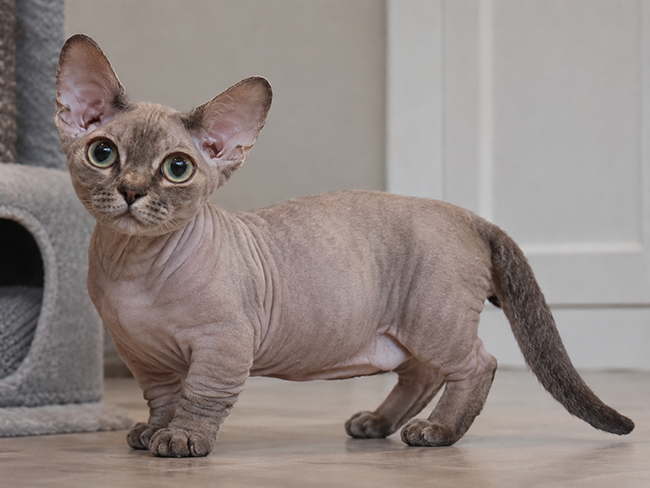
The Minskin has one of the most unusual silhouettes in the cat world. Its body sits close to the ground on dramatically shortened legs, while the coat is intentionally uneven in density. Much of the torso may be covered only by a very fine, soft layer of down, while the outer parts of the body carry short, more closely packed hair. In the historical Minskin standard, these more heavily coated areas were called fur-points.
 Despite its exotic appearance, the Minskin has no mysterious ancient history. It is a very young American breed whose development began in the late 1990s. That recent origin is useful because much of its early history is documented. It also means, however, that there is far less long-term health data for Minskins than there is for older, widely established breeds. Today, The International Cat Association registers Minskins, but the breed does not have championship status, while several other major registries do not recognize it at all.
Quick Facts
- Breed name: Minskin
- Origin: United States
- Development began: 1998
- Coat: very short and sparse over much of the body, with denser short hair on the face, ears, legs, and tail
- TICA status: Registration Only (RE)
- TICA breed code: MSL
- WCF status: not recognized as a separate breed
- CFA status: not recognized
- FIFe status: not recognized; FIFe rules prohibit breeds based on inherited limb shortening
- Size: small, with a sturdy and muscular body and disproportionately short legs
- Weight: no authoritative universal breed range is currently established
- Lifespan: reliable breed-specific longevity data is not yet available
- Activity level: generally described as playful and active, although physical ability varies between individual cats
- Social behavior: commonly described as friendly, curious, and people-oriented, but large independent behavioral studies have not been conducted
- Grooming: requires attention to the skin, ears, and nails; the sparse coat offers less protection from cold and strong sunlight
- Health: the short-legged trait comes from Munchkin ancestry and is associated with inherited disproportionate dwarfism; long-term health data specifically for Minskins remains limited
Where Did the Minskin Come From?
The Minskin was created by American breeder Paul McSorley, who began developing the breed in 1998. His goal was not simply to produce a hairless cat with short legs. He wanted a small, sturdy cat whose coat would be noticeably sparse across the body while remaining denser on the extremities. In other words, the contrast was meant to involve the distribution of hair rather than just coat color.
Historical TICA documents show that early Minskin breeding programs used Munchkin, Sphynx, Burmese, and non-pedigreed domestic shorthairs. McSorley has also described Devon Rex ancestry as part of the broader development of the breed. Over time, the breeding program changed, and a later version of the proposed standard listed only unrelated domestic shorthairs as permissible outcrosses.
The first cats that McSorley considered standard Minskins were born in 2000. The breed had a TICA standard by 2005, and by early 2007 TICA records showed 59 individually registered Minskins and 51 registered litters. The breed section subsequently applied for advancement within TICA’s developing-breed system.
Is the Minskin a Recognized Cat Breed?
This is one of the most confusing parts of the Minskin story because older websites often repeat recognition information that is no longer current. Historical records show that the breed moved through TICA’s development process during the 2000s, and old articles may describe it as a Preliminary New Breed. That is not its current status.
As of 2026, TICA lists the Minskin under Registration Only, abbreviated RE, with the breed code MSL. Registration Only is part of TICA’s pathway for developing breeds. It means that TICA can register Minskins and maintain their pedigrees, but the breed is not a Championship Breed and is not currently listed among TICA’s active Preliminary or Advanced New Breeds.
The Cat Fanciers’ Association does not include the Minskin among its recognized breeds. The World Cat Federation recognizes the Munchkin but does not list the Minskin as a separate recognized breed. FIFe takes a substantially different approach to short-legged cats: its rules prohibit the recognition and registration of breeds based on inherited dwarfism or shortened limbs and specifically cite the Munchkin as an example. The GCCF likewise states that it has no intention of recognizing the Munchkin or other dwarf breeds.
Why Does the Minskin Have Such Short Legs?
The Minskin inherited its short-legged body type from the Munchkin. In standard short-legged Munchkins, genetic research has identified a structural variant affecting the UGDH gene that is extremely closely associated with disproportionate dwarfism. One copy of the variant is sufficient for the short-legged phenotype to appear, which is consistent with dominant inheritance.
Researchers did not find living cats carrying two copies of the associated variant. Combined with breeding data showing reduced litter sizes in matings between short-legged Munchkins, this led researchers to conclude that the homozygous condition is probably lethal during early embryonic development.
There is an important distinction, however. The detailed genetic study was performed on Munchkins and related short-legged cats, not on a large representative population of modern Minskins. Because the Minskin received the short-leg trait through Munchkin ancestry, the findings are directly relevant to understanding the origin of the trait, but they should not be presented as though every living Minskin has been individually genotyped.
Short Legs Are More Than a Cosmetic Trait
Disproportionately short legs are sometimes described as if they simply make a cat smaller. Anatomically, the situation is more complicated. Imaging and skeletal measurements in short-legged Munchkin cats have documented substantial shortening of the long bones and changes in the shape or alignment of some limb bones and joints. The torso itself remains much closer to ordinary feline proportions, which is why these cats appear low to the ground rather than uniformly miniature.
At the same time, the available research does not establish that every short-legged cat will develop severe arthritis, chronic pain, or major disability. Long-term population studies are still limited, particularly for the Minskin itself. It would therefore be inaccurate to claim either that the dwarfism is completely harmless or that every Minskin is destined to suffer from serious orthopedic disease.
For an owner, the practical approach is to pay attention to mobility throughout the cat’s life. Persistent stiffness, limping, reluctance to move, difficulty climbing, changes in gait, sensitivity when handled, or a noticeable reduction in activity deserve veterinary evaluation.
What Are Fur-Points?
The Minskin’s coat is just as important to its original breed concept as its short legs. The historical TICA standard used the term fur-points for areas covered in short, closely packed, soft hair. These areas include the entire facial mask, ears, legs, and tail. The rest of the body is visibly more sparsely coated.
This should not be confused with the color points seen in Siamese and other colorpoint cats. A color point is a pattern of pigmentation, with darker color on cooler parts of the body. A Minskin fur-point refers primarily to coat density. A cat may have darker coloration on the same areas, but pigmentation and hair density are separate characteristics.
The historical standard described the coat as exceptionally soft, with a texture reminiscent of fine cashmere. Hair from the legs may extend upward onto the shoulders, hips, and hindquarters. The temples in front of the ears should be noticeably sparse, and the neck, chest, and abdomen may look almost hairless while still carrying a very fine layer of down. Whiskers may be normal, sparse, broken, or absent.
Is the Minskin Hairless?
Not in the classic sense. An ideal Minskin under the historical breed concept was not simply a completely bald short-legged Sphynx. The contrast between the sparsely coated body and the denser fur-points was considered an identifying feature of the breed. In fact, the historical TICA standard treated the absence of fur-points as a serious fault.
This is why photographs labeled “Minskin” online can be misleading. The breed is rare, its modern population is small, and visually similar short-legged cats may be described online as Minskins even when they are Bambinos, Munchkins, Sphynx crosses, or cats of uncertain ancestry. A nearly naked short-legged cat is not automatically a Minskin.
Minskin Appearance
The historical standard described the Minskin as noticeably small and stocky, with a strong, muscular body. The torso is moderately compact and may appear longer than it really is because of the shortened legs. The chest should be broad and well muscled, while the bone structure should be sturdy rather than delicate.
The legs are very short. The upper and lower portions of the front legs should be roughly equal in length, and the hind legs may be slightly longer than the front. The feet are round, compact, and strong and should point forward rather than turning noticeably inward or outward. A slight rise from the shoulders toward the hindquarters can therefore be normal in the historical breed type.
The tail is relatively long, historically described as slightly longer than the body, and tapers gradually toward the tip. Because the legs are so short, the tail may look especially long in proportion to the cat’s height.
Head, Ears, and Eyes
The Minskin’s head is rounded and wider than it is long, without the long triangular wedge associated with Oriental breeds. The muzzle is short and broad, with prominent whisker pads and a strong chin. A visible stop is present in profile.
The ears are large, open, and broad at the base, with gently rounded tips. Their placement is partly on the sides of the head rather than entirely on top, contributing to the breed’s distinctive expression. The eyes are large, round, widely spaced, and open-looking. The historical standard did not restrict the breed to a particular eye color.
Minskin Colors and Patterns
The Minskin was historically accepted in all colors and patterns. A cat may therefore be solid, tabby, tortoiseshell, colorpoint, or have white spotting, among many other possibilities. There is no single “Minskin color.”
On cats with extremely sparse coats, pigmentation may be especially visible through the skin, making stripes and patches appear almost painted onto the body. Color should not be confused with the distribution of the fur-points, which refers to coat density rather than pigmentation.
Minskin Personality
Breed materials and owner reports commonly describe Minskins as curious, outgoing, playful, affectionate, and strongly interested in people. The historical standard also emphasized a sweet temperament and willingness to be handled. Many are reported to enjoy following family members around the home and taking part in whatever is happening nearby.
These descriptions should still be treated as tendencies rather than promises. The Minskin population is small, and there are no large independent behavioral studies establishing a unique breed personality. Genetics within a particular line, early socialization, the kitten’s experiences, and the home environment can all have a major influence on adult behavior.
Activity and Exercise
Short legs do not mean that a Minskin should live a sedentary life. Cats need opportunities to stalk, chase, climb, scratch, explore, and solve simple problems regardless of breed. Many short-legged cats can run quickly and climb onto furniture, but their biomechanics differ from those of normally proportioned cats, and very high jumping may be more difficult for some individuals.
A Minskin-friendly home can provide vertical space without requiring repeated large jumps. Stable steps, low platforms, intermediate shelves, ramps where appropriate, and easily accessible resting places give the cat more control over how it moves through the environment. Play sessions can emphasize chasing toys along the floor, short bursts of pursuit, tunnels, puzzle feeders, and other activities that allow the cat to move naturally without forcing uncomfortable jumps.
Skin and Coat Care
A sparse coat changes grooming needs. In a normally coated cat, hair absorbs and distributes some of the oils produced by the skin. On sparsely coated areas, those oils may remain more noticeable on the skin itself. Some Minskins may therefore need occasional bathing or gentle cleaning, but there is no evidence-based rule that every Minskin should be bathed once a week.
Bathing too frequently can dry or irritate the skin, so grooming should be adjusted to the individual cat. Owners should periodically check for redness, persistent greasiness, pimples, crusting, unusual odor, or signs of itching. Recurring skin problems deserve veterinary evaluation instead of simply more frequent washing.
The ears also need regular inspection. Cats with sparse ear hair may accumulate visible wax more readily, but ears should be cleaned only when necessary and nothing should be pushed deep into the ear canal. Nails should be checked routinely, and the skin around the nail beds can also collect oily debris in sparsely coated cats.
Cold Weather and Sun Exposure
Hair is an important part of a cat’s insulation, so a Minskin’s sparse coat provides less protection against cold temperatures. Warm sleeping areas, freedom from drafts, and comfortable indoor temperatures are particularly important. Clothing is not automatically necessary, and some cats dislike wearing it. Poorly fitted garments can also rub the skin or interfere with movement.
Sparse hair also means less natural protection from ultraviolet radiation. Minskins should not spend long periods exposed to intense direct sunlight. Human sunscreen should not be applied casually to cats because products designed for people may contain ingredients that are inappropriate or unsafe when licked. Limiting intense sun exposure is generally the safer approach unless a veterinarian recommends a specific product.
Are Minskin Cats Hypoallergenic?
No cat breed can reliably be described as hypoallergenic simply because it has little hair. Important feline allergens are proteins produced in saliva and skin secretions rather than the hair itself. When a cat grooms, those proteins are distributed across the skin and coat and eventually throughout the home.
A person who reacts to ordinary cats may therefore also react strongly to a Minskin. Anyone with a significant cat allergy should spend time around the individual cat before bringing one home rather than relying on advertising claims about hairless or nearly hairless breeds.
Diet and Weight Management
Minskins do not require a breed-specific diet. They need a complete and balanced cat food appropriate for their age, health, reproductive status, and activity level. Portion size should be adjusted to the individual rather than based only on a feeding chart.
Keeping a Minskin lean is particularly sensible because excess body weight adds additional mechanical load to already shortened limbs. Body condition matters more than a target number on the scale: the ribs should be easy to feel under a light covering of tissue, and the cat should maintain a visible waist when viewed from above.
Minskin Health
The Minskin is young and rare, which makes sweeping claims about its health especially unreliable. There are not yet large, long-term studies establishing an average lifespan or the true prevalence of particular diseases across the breed. Statements that Minskins are completely free of breed-related health concerns should therefore be treated with the same skepticism as unsupported lists claiming that every Minskin will develop multiple serious disorders.
The best-studied issue is inherited short-legged stature. Research in Munchkin cats identified a structural variant involving UGDH that was perfectly associated with the short-legged phenotype in the study population. The researchers described the condition as chondrodysplasia, a developmental alteration of cartilage and long bones. CT imaging also documented substantial shortening of limb bones and, in some animals, changes in bone shape and joint alignment.
Those findings matter to the Minskin because its short-legged trait comes from Munchkin ancestry, but they do not tell us exactly how often an adult Minskin will develop pain, arthritis, or mobility impairment. Good long-term epidemiologic data for the breed does not yet exist. Owners should therefore monitor gait, jumping ability, activity, body weight, and signs of discomfort throughout life rather than assuming either that the anatomy is harmless or that disease is inevitable.
The Minskin’s coat history also includes breeds with unusual hair structure, particularly the Sphynx. Hairlessness in the Sphynx is associated with a recessive variant of KRT71, and another variant in the same gene causes the Devon Rex coat. However, published research has not established the frequency or exact combination of these variants across today’s Minskin population. A Minskin’s genotype should not be guessed from appearance alone.
Why Is Minskin Breeding Controversial?
The Minskin sits at the center of a larger ethical discussion about how far selective breeding should go in emphasizing unusual physical traits. Supporters of the breed point to short-legged cats that run, play, climb, interact normally, and appear to enjoy good quality of life. Critics argue that deliberately perpetuating an inherited skeletal abnormality is difficult to justify when the trait has no functional benefit for the cat and may alter normal movement.
Major cat organizations reflect that disagreement. TICA currently permits Minskin registration, while FIFe prohibits the registration and breeding of cats with inherited forms of dwarfism or shortened limbs and does not allow such cats to be exhibited. The GCCF likewise states that it has no intention of recognizing dwarf breeds. These policies do not prove that every individual Minskin is unhealthy, but they do show that short-legged breeding remains a genuine welfare issue rather than a purely cosmetic debate.
How to Choose a Minskin Kitten
Because the breed is rare, identifying a reputable breeder requires more than finding a kitten with short legs and sparse hair. A cat that looks like a Minskin is not necessarily a registered Minskin. If a breeder advertises TICA-registered kittens, ask to see the registration information and pedigrees rather than relying on the breed name in an online advertisement.
Ask about the health and mobility of the parents and older relatives, not just the kitten in front of you. A thoughtful breeder should be willing to discuss orthopedic health, gait, skin problems, longevity, and any veterinary or genetic testing performed in the line. Claims that “this breed has no health problems” are not a substitute for actual health information.
A kitten should move freely and confidently, bear weight comfortably on all four limbs, and show no obvious persistent lameness or severe limb deformity. The skin should look healthy rather than chronically inflamed, and the kitten should be alert, curious, and appropriately socialized for its age. Unusual appearance should never take priority over basic health and sound movement.
Is a Minskin Right for You?
A Minskin may appeal to someone who enjoys a highly unusual cat and is prepared to accommodate both its skin and its body structure. The home should make important resources easy to reach without requiring constant high jumps, and the owner should be willing to monitor weight, mobility, skin condition, ears, and nails throughout the cat’s life.
The breed is a poor choice for anyone interested primarily in owning a novelty animal. Short legs and sparse hair are inherited biological traits, not decorative accessories. A Minskin still needs everything any other cat needs: opportunities to move, play, scratch, explore, rest undisturbed, interact socially on its own terms, and make meaningful choices within its environment.
Interesting Facts About the Minskin
- The Minskin is a very young breed. Development began in the United States in 1998, and the first cats considered standard Minskins were born in 2000.
- Paul McSorley created the breed. His breeding program was designed to combine short stature with a distinctive distribution of coat density.
- A true Minskin was not originally intended to be completely hairless. The historical standard emphasized denser fur-points on a visibly more sparsely coated body.
- Fur-points are not the same as color points. Fur-points describe denser hair on the face, ears, legs, and tail, while color points describe pigmentation.
- The breed’s TICA abbreviation changed. Historical records used MS; current TICA rules use MSL.
- The Minskin is currently Registration Only with TICA. It does not have championship status.
- Munchkin genetics help explain the breed’s short legs. A structural variant involving UGDH is strongly associated with inherited disproportionate dwarfism in short-legged Munchkins.
- Two copies of the Munchkin-associated variant are believed to be incompatible with normal embryonic survival. Researchers found no living homozygous cats in the study population.
- Not every registry accepts dwarf breeds. FIFe and the GCCF take much stricter positions than TICA on inherited short-legged conformation.
- There is no reliable breed-specific lifespan figure yet. The Minskin population is too small and too young for commonly quoted lifespan ranges to be considered well-established statistics.
The Minskin is one of the most unusual products of modern cat breeding. Its very short legs and distinctive sparse coat make it immediately recognizable when the breed type is expressed correctly, yet those same traits also make accurate identification and responsible breeding especially important. A genuine Minskin is more than a hairless cat on short legs: the historical breed concept included a sturdy, rounded body type and a characteristic contrast between the sparsely coated torso and its soft fur-points.
Because the breed remains rare and long-term health information is limited, the Minskin is best approached without either romanticizing or demonizing it. We know much more today about the genetics and anatomy behind feline short-legged dwarfism than breeders did when the Minskin was first developed, but important questions about lifetime orthopedic health remain unanswered. For anyone considering one of these cats, documented ancestry, responsible breeding, comfortable movement, and lifelong welfare matter far more than novelty alone.
Tortoiseshell Cats: Why They’re Almost Always Female and How Their Remarkable Coat Color Works
A tortoiseshell cat is not a breed, but one of the most fascinating coat-color patterns in the feline world. Behind every patch of black, orange, cream, or blue is an extraordinary piece of genetics involving the X chromosome.
Tortoiseshell cats look as if nature started painting with several colors and simply decided not to choose between them. Black and orange may be scattered through the coat in tiny intermingled flecks, gathered into broad patches, or divided across the face in strikingly uneven patterns. Add white spotting, dilution, or tabby markings and the possibilities become even greater. No two torties look exactly alike, because their color pattern is created during early embryonic development rather than copied from a fixed template. Even more remarkable, the genetics behind that patchwork explains one of the best-known facts about tortoiseshell cats: nearly all of them are female.
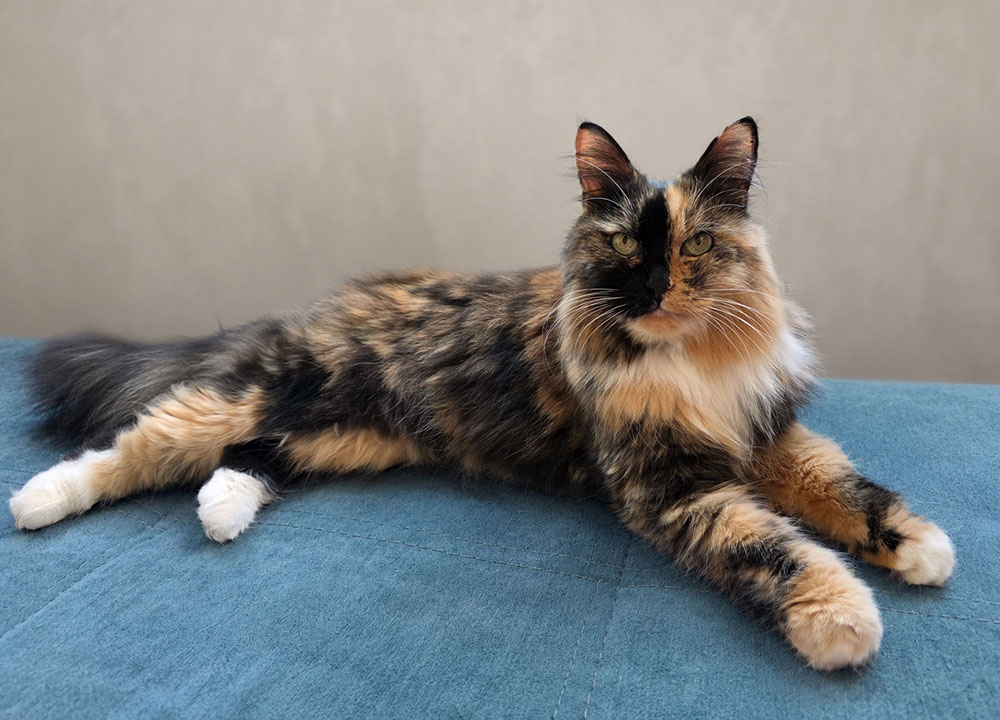
A tortoiseshell cat is not a separate breed. Tortie coloring occurs in ordinary domestic cats as well as in many pedigreed breeds whose standards allow it. A tortoiseshell may be short-haired or long-haired, tiny or substantial, round-faced or elegantly slender. What these cats share is not a common breed ancestry, but a particular way in which orange and non-orange pigmentation are expressed across the body.
What Is a Tortoiseshell Cat?
In the classic tortoiseshell pattern, areas of orange or red pigmentation occur alongside areas based on dark eumelanin, most commonly black. The two colors may be finely blended throughout the coat or separated into larger irregular patches. A tortie does not need to have a perfectly balanced pattern, and symmetry is certainly not required. One side of the face may be almost entirely black while the other is orange, a narrow flame-colored streak may run down the nose, or a single bright patch may appear over one eye.
Black and orange are only the familiar starting point. Other coat-color genes can modify both colors. Black pigment may become chocolate or cinnamon depending on the cat’s genetics, while the dilution gene can turn black into blue-gray and orange into cream. This is how the soft blue-and-cream tortoiseshell pattern arises. White areas have a separate genetic basis and can be added to the tortoiseshell pattern without changing the underlying orange-versus-non-orange mosaic.
Why Can One Cat Be Both Black and Orange?
The answer lies on the X chromosome. Most female cats have two X chromosomes, XX, while most males have one X and one Y, XY. The genetic switch responsible for orange coat color is X-linked. For generations, geneticists knew about this unusual Orange locus because its inheritance could be followed so clearly through cat pedigrees, yet its exact molecular identity remained unresolved.
That changed in 2025, when two independent research teams identified the genetic change responsible for sex-linked orange coloration in domestic cats. Their work connected the Orange phenotype with a small deletion at the X-linked ARHGAP36 locus that alters the gene’s activity in pigment-producing cells. When the orange version is active, melanocytes shift away from producing dark eumelanin and toward the yellow-to-red pigment pheomelanin.
A female cat can inherit the orange-associated version on one X chromosome and the non-orange version on the other. That gives her cells two different sets of color instructions. The reason she does not simply become a uniform mixture of the two is one of the most interesting processes in mammalian genetics.
X-Inactivation Creates the Tortoiseshell Mosaic
Female mammals have two X chromosomes, but having both fully active in every cell would produce roughly twice the normal dose of many X-linked gene products. Early in embryonic development, each cell therefore largely shuts down one of its two X chromosomes. This process is called X-chromosome inactivation.
The important part for a tortoiseshell cat is that different cells may silence different X chromosomes. In one developing cell, the X carrying the orange-associated version remains active, and the descendants of that cell contribute to an orange area of skin and fur. Somewhere else, the other X remains active, allowing dark pigmentation instead. As those cells multiply and spread while the kitten develops, groups of related cells form the visible patches that eventually appear in the coat.
A tortie is therefore a living cellular mosaic. The black and orange regions are not merely different hairs randomly sprinkled together after birth. They reflect populations of cells in which different X chromosomes remained active during very early development.
Why Is Every Tortoiseshell Pattern Different?
X-inactivation takes place while the developing kitten still consists of a relatively small number of cells. Which X chromosome remains active in a particular cell is not laid out in advance as a finished map of the adult coat. Those early cells divide, migrate, and contribute to different regions of the skin as development continues, creating an enormous range of possible arrangements.
This is why tortoiseshell faces can be so spectacular. A cat with a nearly perfect black-and-orange split down the center of the face does not carry a special “split-face gene.” It is simply one dramatic result of how the different cell populations happened to become distributed. Another tortie may have a tiny orange blaze over one eye, a mottled nose, or colors so finely interwoven that no large patches exist at all.
Why Are Tortoiseshell Cats Almost Always Female?
A typical female cat has two X chromosomes, so she can carry the orange-associated version on one X and the non-orange version on the other. A typical male has only one X chromosome. If his single X carries the orange version, he will usually be orange; if it carries the non-orange version, he will usually be non-orange. He normally does not have the two different X-linked versions required to produce the classic tortoiseshell mosaic.
That is why seeing a tortoiseshell or calico cat is a very strong clue that the cat is female. It is not an absolute rule, however. Male tortoiseshell cats do exist, but they are uncommon and usually have an unusual genetic explanation.
Can a Male Cat Be Tortoiseshell?
Yes. One well-known cause is an XXY chromosome complement rather than the typical XY arrangement. With two X chromosomes, such a male can carry different versions of the Orange locus and undergo X-inactivation, allowing both orange and non-orange patches to develop. Many XXY tortoiseshell males are infertile because the chromosome difference interferes with normal sperm production.
But XXY is not the only possibility. Mosaicism and chimerism can also produce tortoiseshell males. In a chimera, for example, genetically distinct cell populations originating from different embryos may coexist in one animal. Rare fertile tortoiseshell males have been documented, including genetically investigated chimeric cats. For that reason, the statement that “all male torties are sterile” is too absolute. Coat color alone cannot reveal the exact chromosome arrangement of an individual cat.
Tortoiseshell vs. Calico: What’s the Difference?
Tortoiseshell and calico cats are closely related genetically, but they usually look quite different. A classic tortoiseshell has orange and dark pigmentation with little or no white, and the colors are often closely intermingled. A tortoiseshell-and-white cat has the same basic mosaic plus genetically separate white spotting.
The word calico is generally used when substantial white areas separate the orange and dark colors into larger, more clearly defined patches. In a typical calico, white may form much of the background, with black and orange islands distributed over it. There is no universal percentage of white that magically turns a tortie-and-white into a calico, however. Terminology varies between registries, breeders, countries, and everyday usage, so some cats may reasonably be described either way.
White spotting is produced by a different genetic mechanism from the orange/non-orange X-linked system. It affects where pigment-producing melanocytes successfully populate the skin during development. The result is that the same basic tortoiseshell genetics can look very different depending on how much white is present and where it appears.
What Is a Torbie?
A torbie combines tortoiseshell coloration with a tabby pattern. The name itself comes from tortie plus tabby. Instead of solid-looking dark tortoiseshell areas, the coat shows recognizable tabby stripes, spots, or other patterning along with the orange patches.
Identifying a torbie can sometimes be trickier than it sounds because orange fur often displays visible tabby markings even in cats that are not genetically described as tabbies in the everyday sense. The more useful clue is whether the non-orange areas also show the underlying tabby pattern.
What Is a Dilute Tortoiseshell?
A dilute tortoiseshell follows the same basic X-linked mosaic as a black-and-orange tortie, but another gene modifies the intensity of the pigment. Cats that inherit two copies of the recessive dilute variant in MLPH distribute pigment granules differently within the hairs. Black then appears blue-gray, while orange becomes cream.
The result can be dramatically softer than the classic tortoiseshell palette: smoky blue patches blend with pale peach or cream rather than deep black and fiery orange. The underlying genetic principle has not changed. The X-linked Orange system determines which areas are orange or non-orange, while the separate dilution gene changes how intense those colors appear.
Is Tortoiseshell a Breed?
No. A cat cannot be identified as a particular breed simply because she is tortoiseshell. The pattern occurs in domestic cats with no documented pedigree and in numerous established breeds. Depending on the breed and registry, tortoiseshell may be accepted in several different color classes or may not be permitted at all.
This distinction is especially important with long-haired torties. A large fluffy tortoiseshell with tufted ears is not automatically a Maine Coon or Norwegian Forest Cat, just as a round-faced short-haired tortie is not automatically a British Shorthair. Breed identity depends on documented ancestry and the breed standard, while tortoiseshell describes coat color.
Do Tortoiseshell Cats Really Have a Special Personality?
Torties have accumulated such a reputation for attitude that English-speaking cat owners even invented the word tortitude. They are often described as bold, opinionated, fiercely independent, intensely affectionate on their own terms, or unusually quick to inform the household when something does not meet feline expectations.
There has been some research into possible associations between coat color and owner-reported behavior, and tortoiseshell and calico cats have occasionally scored somewhat differently in particular situations. That does not establish a simple “tortie personality gene,” however. Owner questionnaires are influenced by perception and expectation, and behavior is shaped by many factors including broader genetics, early socialization, health, environment, learning, and individual temperament. Tortitude is best treated as an affectionate cultural stereotype rather than a reliable way to predict what a particular cat will be like.
Does Tortoiseshell Coloring Affect Health?
For an ordinary XX female, tortoiseshell coloring is a normal genetic variation, not a disease. A female tortie does not require special food, veterinary care, or health monitoring simply because of her coat pattern.
Rare male torties are a different situation because the unusual coloration can sometimes reflect an atypical chromosome complement such as XXY. Those cats may have reproductive abnormalities and, depending on the underlying genetic condition, other developmental differences. A veterinarian or veterinary geneticist can investigate the individual cat when necessary; the coat itself cannot provide a complete diagnosis.
How Are Tortoiseshell Kittens Inherited?
A tortoiseshell female carries different orange-related versions on her two X chromosomes and can pass either X to a kitten. A daughter receives another X from her father, so certain combinations can make her tortoiseshell. A typical son receives a Y chromosome from his father and his only X from his mother, which is why he will usually inherit either the orange or the non-orange version rather than both.
Actual litter colors are much more complicated than that simple example. Tabby pattern, dilution, brown-series genes, white spotting, colorpoint restriction, silver, and other genetic systems can all modify what is ultimately visible. Coat-color genetics is therefore less like mixing two cans of paint and more like several genetic switches operating on top of one another.
Interesting Facts About Tortoiseshell Cats
- Tortoiseshell is a coat color, not a cat breed. Torties occur among domestic cats and in many pedigreed breeds.
- Nearly all tortoiseshell cats are female. The reason is the X-linked genetics of orange coloration.
- A tortie is a cellular mosaic. Different coat regions reflect cells with different active X chromosomes.
- The molecular identity of the famous feline Orange locus was finally clarified in 2025. Independent research groups connected orange coloration with altered regulation of the X-linked ARHGAP36 locus.
- No fixed template determines where the patches will appear. Their distribution develops as cell populations expand during embryonic growth.
- Calico and tortoiseshell are closely related. Calico usually adds extensive white spotting and more clearly separated color patches.
- A torbie is a tortoiseshell cat with tabby patterning.
- Blue-and-cream torties are genetically dilute tortoiseshells. Dilution changes black to blue and orange to cream.
- Male torties really do exist. XXY chromosomes, mosaicism, and chimerism are among the possible explanations.
- Not every male tortie is necessarily infertile. Fertile exceptions associated with other genetic mechanisms have been documented.
- “Tortitude” is a fun reputation, not a scientifically established personality type. Coat color cannot reliably predict an individual cat’s temperament.
Tortoiseshell cats provide one of the clearest examples of genetics becoming visible before our eyes. An orange streak across the nose, a black patch around one eye, or a cream-colored paw can trace its origin back to events that occurred when the future kitten consisted of only a small population of developing cells. In every patch of fur, the history of X-chromosome activity has left a visible mark.
Perhaps that is part of what makes torties so captivating. Their coats are not produced from a rigid pattern that repeats from one cat to another. Each one develops as its own biological mosaic, which means that even before personality enters the picture, every tortoiseshell cat is already unmistakably an individual.
Cherubim Cat: Ragdoll Roots, a Wider Palette, and a Breed of Its Own
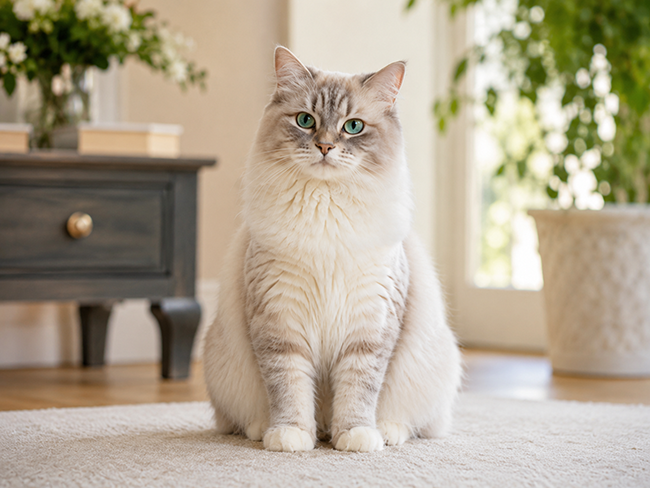 A large, affectionate semi-longhaired cat from the Ragdoll Breed Group, the Cherubim combines the familiar Ragdoll type with Mink, Sepia and Traditional colors and a much broader range of eye colors.
The Cherubim is one of the newest breeds to enter TICA Championship competition, but both the name and the breeding lines behind it have a much longer history. Closely connected with the development of the Ragdoll, the modern Cherubim shares the same basic head, body and coat standard while occupying a different part of the color spectrum. Under the current standard of The International Cat Association (TICA), a Ragdoll is a blue-eyed pointed cat, while a Cherubim belongs to the Mink, Sepia or Traditional color category and may have aqua, green, gold, copper, hazel or several other eye colors depending on its category. This makes the Cherubim especially interesting from a breed-history perspective: it is both a newly established Championship breed and the continuation of breeding lines whose story reaches back into the early history of the Ragdoll itself.
Quick Facts About the Cherubim Cat
- Official name: Cherubim
- TICA breed code: CB
- TICA status: Championship breed
- Breed group: Ragdoll Breed Group
- Historical roots: United States, connected with early Ragdoll breeding lines
- Coat length: Semi-long
- Coat texture: Silky and soft, with minimal undercoat
- Size: Large
- Adult female weight: Approximately 10–15 pounds
- Adult male weight: Approximately 15–20 pounds
- Maturity: Slow; full weight and size may take up to four years
- TICA color categories: Mink, Sepia and Traditional
- Eye colors: Depend on color category and include aqua, gold, green, bronze, copper, yellow and hazel
- Temperament: Affectionate, generally easygoing and calm, with a playful side
- Life expectancy: 10+ years; many live into their mid or high teens
History of the Cherubim
The story of the Cherubim begins with the Ragdoll. Breeder Ann Baker developed the Ragdoll in Riverside, California, during the 1960s. The early breeding program eventually gave rise to the blue-eyed pointed cats that became strongly associated with the Ragdoll name, but Baker also developed additional breeding lines and worked with cats in a broader range of colors and patterns. The name “Cherubim” itself is not a modern invention: historical registration documents connected with Baker’s International Ragdoll Cat Association, or IRCA, carried the phrase “Registrar of Cherubim Cats.” This does not mean that today’s Cherubim already existed as a separate standardized breed at that time, but it does establish genuine historical roots for the name.
When cats from these early lines entered the TICA registry, they were registered within the broader Ragdoll population. Over time, however, a clear division developed between the blue-eyed pointed cats accepted for Ragdoll Championship competition and mink, sepia and non-pointed cats descended from related lines. Breeders of these cats sought a way for them to compete in Championship classes without changing the established blue-eyed pointed identity of the Ragdoll. The solution proposed to TICA was the creation of a Ragdoll Breed Group containing two closely related breeds: blue-eyed pointed cats would remain Ragdolls, while Mink, Sepia and what the current standard calls Traditional cats would become Cherubims. In 2024, the TICA Board approved the advancement of the Cherubim to Championship status and approved the Ragdoll/Cherubim Breed Group standard. The change became effective on May 1, 2025.
Is the Cherubim Really a Separate Breed?
Under the current TICA system, yes. The Cherubim has its own breed code, CB, and competes as a Championship breed. At the same time, its relationship with the Ragdoll remains exceptionally close: the two breeds form the Ragdoll Breed Group and share the same fundamental physical standard. The formal division lies primarily in color category and eye color. A TICA Ragdoll belongs to the Pointed category and has blue eyes, while a TICA Cherubim belongs to the Mink, Sepia or Traditional category and has the eye color appropriate to that category. In other words, the Cherubim is not a newly invented cat that simply happens to resemble a Ragdoll. Its modern breed identity grew directly from cats historically bred and registered within the broader Ragdoll population.
Recognition by Cat Registries
The Cherubim’s current formal breed identity is primarily associated with TICA, where it is a Championship breed with the code CB and a member of the Ragdoll Breed Group. The Cat Fanciers’ Association (CFA) and Fédération Internationale Féline (FIFe) do not currently include the Cherubim among their recognized breeds, while the Governing Council of the Cat Fancy (GCCF) lists it among unrecognized breeds and identifies TICA as the organization recognizing it.
The World Cat Federation (WCF) presents a slightly different situation. The Cherubim does not currently have its own published WCF EMS breed code and is therefore not a separately recognized WCF breed for pedigree purposes. WCF rules, however, allow breeds recognized by another member of the World Cat Congress, including TICA, to participate for Championship titles under WCF rules, subject to the policies of the individual WCF member club. Eligibility to compete should not be confused with formal WCF recognition of the breed. This is a useful reminder that breed recognition is registry-specific: recognition by one international organization does not automatically create identical registration rules or show status in every other organization.
Appearance and Breed Type
The Cherubim is a large, substantial cat with strong bone and solid musculature, but the overall impression should remain balanced and moderate rather than exaggerated. The torso is medium-long to long with a broad chest, the hind legs are slightly longer than the front legs, and the feet are large and round, with toe tufts considered desirable. The long tail is approximately equal to the length of the body, thick at the base and tapering slightly toward the end. These cats can feel surprisingly heavy when picked up, but the standard does not call for an excessively bulky, short or cobby body.
The head is a broad modified wedge with softly rounded contours. It should not form the narrow, sharply triangular wedge seen in some Oriental breeds, nor should it become extremely round or short-faced. When viewed from the front, the area between the ears has the appearance of a relatively flat plane. The ears are medium-sized, broad at the base, rounded at the tips and positioned partly on top of the head and partly toward the sides, with a slight forward tilt. The muzzle is rounded and medium in length, the chin is well developed, and the profile combines a straight nose to the bridge with a gentle concave curve toward the brow and a convex forehead. Because the Cherubim shares its structural standard with the Ragdoll, a change in color should not create a completely different physical type. A well-typed Cherubim should retain the balanced, substantial appearance characteristic of the Ragdoll Breed Group.
Eyes, Mink, Sepia and Traditional Colors
The eyes are large, oval, level-set and moderately wide apart, and their color is one of the clearest ways in which the Cherubim differs from the familiar blue-eyed Ragdoll. There is no single eye color for every Cherubim. Mink Cherubims have aqua eyes, ranging from blue-green to green-blue. Sepia Cherubims may have gold, gold-green, also called chartreuse, or green eyes. Traditional Cherubims have the broadest range, including bronze, copper, gold, yellow, green and hazel. Within each category, deeper and richer eye colors are preferred.
Mink, Sepia and Traditional are not individual colors such as chocolate, blue or red. They describe broader categories of color expression. A Mink Cherubim has a moderately colored body with deeper pigmentation on the face, ears, legs and tail, producing softer contrast than the classic pointed pattern. A Sepia Cherubim has less contrast still, with the body color lying closer to that of the extremities. Traditional is the official category name used by the current TICA Ragdoll Breed Group standard and should not be interpreted as meaning “traditional Ragdoll coloring.” The TICA Ragdoll itself belongs specifically to the Pointed category.
Older material surrounding the creation of the breed often refers to “mink, sepia and solid Ragdolls” or “mink, sepia and solid Cherubims,” and simplified breed descriptions may still use similar wording. The current official TICA standard, however, names the three Cherubim categories Mink, Sepia and Traditional. Traditional is also broader than a single solid coat, since the standard includes solid, tortie and tabby divisions within the Cherubim breed.
Colors and White Patterns
TICA accepts Cherubims in all Mink, Sepia and Traditional colors except solid white. The breed may occur in solid, tortie and tabby divisions, and white spotting is accepted in the mitted and bicolor patterns defined by the standard. In the mitted pattern, the front feet have matching white mittens, while white on the hind legs extends up to and around the hocks and may continue no higher than the middle of the thigh. The chin is white, and a white stripe runs from the chin through the chest and along the belly; a white facial blaze is also permitted within specific limits. In the bicolor pattern, the face has a white inverted V surrounding the pink nose, the chest, stomach and ruff are white, and white feet and legs are preferred.
Coat, Size and Maturity
The Cherubim has a semi-long coat with a silky, soft texture and minimal undercoat. The coat should have enough body to look luxurious while still falling smoothly rather than becoming dense, woolly or cottony. Coat length may vary with the seasons, and unaltered adults may carry somewhat shorter coats. Under the TICA standard, correct texture is more important than sheer length.
The Cherubim is one of the larger pedigreed cats. TICA gives approximate adult weights of 10–15 pounds for females and 15–20 pounds for males, although individual cats may naturally fall outside these ranges. The breed matures slowly and may not reach full adult weight and size until around four years of age, while full coat color can take approximately three years to develop. An adolescent Cherubim may therefore look noticeably different from the same cat at full maturity, as body substance, coat development and color intensity continue to change well beyond kittenhood.
Personality, Activity and Everyday Life
Cherubims are generally described as affectionate, easygoing and calm, but calm does not mean inert. They retain a playful side and benefit from regular interaction with their people. TICA describes them as cats that can fit well into busy modern households and generally get along with children and other pets, including dogs. Individual temperament still matters, of course, and introductions between animals should always be gradual rather than relying on breed reputation alone.
The breed is not usually associated with the relentless activity of some highly energetic cats, but Cherubims still need opportunities to play, climb, scratch and explore. Interactive wand toys, balls, cat trees and sturdy scratching posts provide exercise and mental stimulation, while regular play is particularly useful for such a large adult cat because excessive weight places unnecessary stress on the body. For many households, the Cherubim offers an appealing balance: a substantial, relaxed companion that still enjoys play and interaction rather than spending life as decorative furniture.
Grooming and Care
The semi-long coat benefits from regular brushing to remove loose hair and catch small tangles before they become mats. Particular attention should be paid to areas where longer hair rubs together, including behind the ears, under the front legs, around the chest and along the hindquarters. The exact grooming schedule depends on the individual cat’s coat, shedding and lifestyle, but a few calm, regular grooming sessions are generally preferable to waiting until tangles have already formed.
Routine care should also include checking the claws, teeth and ears and monitoring overall body condition. Because the Cherubim is naturally large and substantial, it is important not to confuse healthy bone and muscle with excess body fat. As with any cat, preventive veterinary care, appropriate nutrition, exercise and attention to changes in behavior or appearance are more important than following a rigid grooming schedule.
Cherubim Health
The Cherubim is very new as a separately named TICA Championship breed, so there is still limited health information published specifically under the Cherubim breed name. Its breeding history, however, is directly connected with Ragdoll lines. One genetic test that may therefore be relevant in Cherubim breeding programs is the test for the Ragdoll-associated R820W variant in the MYBPC3 gene, which is associated with hypertrophic cardiomyopathy, or HCM, in Ragdolls and related lines.
It is important to understand the limits of this test. A negative result means that the cat does not carry this particular Ragdoll-associated R820W variant; it does not guarantee that the cat can never develop HCM from another genetic or non-genetic cause. When choosing a kitten, ask the breeder about the health history of the breeding cats, relevant DNA testing, veterinary screening and how health information is used in the breeding program. Responsible breeding involves much more than producing attractive coat and eye colors.
Cherubim vs. Ragdoll and RagaMuffin
The simplest way to understand the relationship between the Cherubim and Ragdoll is to think of them as two breeds sharing one physical blueprint under TICA. Both belong to the Ragdoll Breed Group and use the same fundamental standard for the head, body and coat. The formal distinction lies primarily in color category and eye color: a TICA Ragdoll belongs to the Pointed category and has blue eyes, while a TICA Cherubim belongs to the Mink, Sepia or Traditional category and has the eye color appropriate to that category. This is why terms such as “mink Ragdoll” can now cause confusion. They may still appear in historical pedigrees, breeder terminology and older articles, but within the current TICA Championship structure, cats of the appropriate Mink or Sepia type in this breed group are registered and shown as Cherubims rather than Championship Ragdolls.
The Cherubim should also not be confused with the RagaMuffin. The histories of all three breeds intersect through breeding programs associated with Ann Baker, but the modern RagaMuffin developed as its own breed with its own standards and registry history. The Cherubim remains structurally tied to the TICA Ragdoll Breed Group and shares the Ragdoll head and body standard, while the RagaMuffin has its own breed type, including a generally rounder expression and different specifications for the head, eyes and coat. Color alone is not enough to identify any of these breeds: Mink and Sepia coloring are not exclusive to the Cherubim and can occur in other pedigreed cats.
Can You Identify a Cherubim From a Photograph?
Not reliably. A semi-longhaired cat with aqua eyes and Mink coloring may resemble a Cherubim, but those characteristics alone do not establish breed identity. The same applies to a solid, tabby or bicolor cat whose appearance happens to fit part of the Cherubim standard. Pedigreed breed identity depends on documented ancestry and registration, not simply on resemblance. A photograph can tell you that a cat looks Cherubim-like; it cannot prove that the cat is a registered Cherubim.
Choosing a Cherubim Kitten
Because the Cherubim is still uncommon under its modern Championship identity, prospective owners should make sure they understand exactly what a breeder is offering. Ask which registry the kitten is registered with and whether the registration identifies it as a Cherubim. Find out whether the kitten belongs to the Mink, Sepia or Traditional category and what eye color is appropriate for that category, and request information about both parents, pedigree, health testing and the breeder’s overall breeding program rather than choosing a kitten based only on an unusual coat or eye color.
A responsible breeder should also care about where the kitten will live, what kind of home it is going to and whether the Cherubim is a suitable match for the buyer. Rarity is interesting, but it should never matter more than health, temperament and responsible breeding.
Interesting Facts About the Cherubim
- The Cherubim became eligible for TICA Championship competition on May 1, 2025.
- Its TICA breed code is CB.
- The Cherubim and Ragdoll belong to the same TICA Ragdoll Breed Group.
- The two breeds share the same basic head, body and coat standard.
- The name Cherubim has roots in Ann Baker’s early breeding programs and predates the modern TICA breed designation by decades.
- Mink Cherubims have aqua eyes ranging from blue-green to green-blue.
- Sepia Cherubims may have gold, gold-green or green eyes.
- Traditional Cherubims may have bronze, copper, gold, yellow, green or hazel eyes.
- The breed may take up to four years to reach full adult size and weight.
- Full color may take approximately three years to develop.
- Solid white is excluded from the current TICA Cherubim standard.
- No outcrosses are permitted under the current TICA Ragdoll Breed Group standard.
Is the Cherubim the Right Cat for You?
The Cherubim may be especially appealing to someone who loves the substantial build, silky semi-long coat and affectionate nature associated with the Ragdoll family but is drawn to a broader range of colors and eye colors. These cats need companionship, play, scratching opportunities, regular coat care and enough space to comfortably accommodate a large adult body. Their relaxed reputation should not be mistaken for passivity: a Cherubim is still a cat, complete with curiosity, playfulness and opinions about how the household should be managed.
Perhaps the most fascinating thing about the Cherubim is the way it combines old and new. Its current TICA Championship identity dates only from 2025, yet the breeding lines behind it and even the Cherubim name reach much further back into Ragdoll history. That makes the breed an unusually clear example of how pedigreed cats continue to evolve. New breed identities do not always begin with the sudden appearance of a completely new kind of cat; sometimes they emerge when long-established breeding lines, genetics, show standards and registry rules are reorganized into a new chapter of a much older story.
RagaMuffin Cat: A Large, Affectionate Breed with a Silky Coat and Expressive Eyes
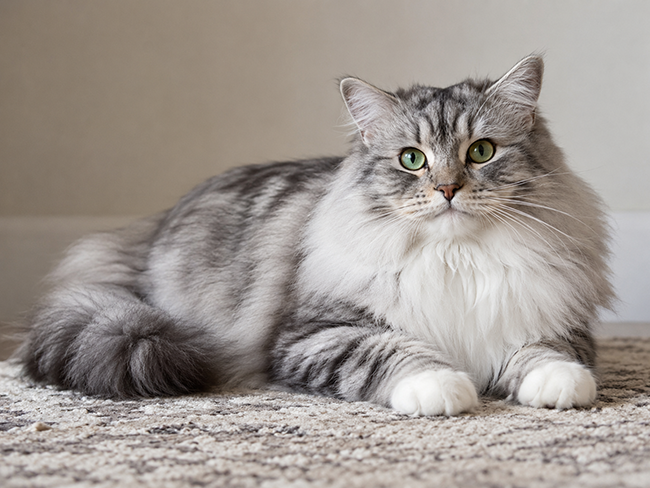 The RagaMuffin is a substantial, soft-coated companion cat known for its gentle temperament, expressive eyes, and almost teddy-bear-like appearance. Although its history is closely connected to the Ragdoll, the RagaMuffin developed into a distinct breed with its own type, a much broader range of colors and patterns, and different rules regarding eye color.
One of the breed’s most appealing features is the contrast between its powerful build and remarkably sweet expression. A mature RagaMuffin should feel solid and muscular, with heavy bone and a broad body, yet its large walnut-shaped eyes, rounded contours, and full whisker pads give the face a soft, approachable look.
Unlike the Ragdoll, the RagaMuffin is not defined by blue eyes. Depending on color and registry, the eyes may be green, gold, aqua, blue, or even two different colors. That variety is one of the details that makes this breed especially distinctive.
RagaMuffin Cat Quick Facts
- International name: RagaMuffin.
- Other names: No current official alternative name. Liebling was briefly considered during the breed’s early development but was not adopted.
- Coat length: Medium to medium-long; generally classified as semi-longhair.
- Country of origin: United States.
- WCF code: RGM.
- WCF group: Semi-Longhair.
- Size: Medium-large to large, with substantial bone and a muscular body.
- Weight: Females are commonly around 10–15 pounds; mature males may approach or exceed 20 pounds.
- Lifespan: Approximately 12–16 years.
- Activity level: Moderate.
- Social nature: Very high; strongly people-oriented and generally comfortable in family settings.
- Affection level: Very high.
- Intelligence and trainability: Good; many enjoy interactive games and can learn simple behaviors.
- Grooming: Moderate; usually one or two thorough combing sessions per week.
- Health: Generally considered a sturdy breed, but responsible breeding programs should still monitor inherited health risks.
- Price: There is no meaningful universal price range; cost varies substantially by breeder, country, pedigree, and purpose.
History of the RagaMuffin Cat
The RagaMuffin shares part of its early history with the Ragdoll. Both trace back to breeding programs developed by Ann Baker in Riverside, California, beginning with free-roaming local cats. Baker eventually established the International Ragdoll Cat Association and placed unusually strict controls on how cats from her program could be bred and registered.
By the early 1990s, some breeders wanted greater independence and the ability to register their cats with established cat associations. In 1994, a group of breeders left Baker’s organization and began developing their cats as a separate breed.
Because they could not use the Ragdoll name, the new group needed something different. Liebling was considered at an early stage, but it was not the name that ultimately survived. Curt Gehm of Liebling Cats in Virginia is credited with suggesting RagaMuffin, a playful reference to the street-cat origins of the original gene pool.
The unusual capital M in RagaMuffin was intentional. Breed history preserves a lighthearted explanation from the early breeders: these cats were big, lovable “Muffins.” The spelling became part of the breed’s identity.
The breeders did more than simply rename part of the Ragdoll population. Limited outcrossing was used to widen the gene pool and help establish a distinct breed. Domestic Longhair cats and later Persians were among the documented outcrosses used during development.
The breed achieved championship recognition with the American Cat Fanciers Association in 2001. CFA began registering RagaMuffins in 2003 and granted championship status in 2011. The GCCF granted championship status in 2015.
Is the RagaMuffin Recognized by Major Cat Registries?
The answer depends on the registry, which is a useful reminder that there is no single worldwide authority that determines whether a cat breed is “real” or recognized.
CFA recognizes the RagaMuffin for championship competition, as does the GCCF. WCF assigns the breed the code RGM and lists it among semi-longhaired cats. FIFe currently lists RGM as a non-recognized breed.
TICA takes a different approach. Under its current rules, the RagaMuffin is accepted for registration only. That means it exists within the TICA registration system but does not have championship breed status there.
What Does a RagaMuffin Look Like?
A mature RagaMuffin should look substantial without appearing exaggerated. This is a heavily boned, muscular cat with a broad chest, broad shoulders, and a rectangular body. The hindquarters should be about as broad as the shoulders, giving the body a solid, balanced outline.
The rear legs are slightly longer than the front legs. The feet are large and round, often with visible tufts of fur between the toes. The tail is long and well furnished, with the appearance of a plume or soft bottlebrush.
One unusual feature mentioned in breed standards is a soft fleshy pad on the lower abdomen. In a healthy adult RagaMuffin, this can be part of normal breed type and should not automatically be mistaken for obesity. Overall body condition still matters, of course, and a large breed should not be deliberately overfed in an attempt to create extra size.
RagaMuffins are slow to mature. Full physical development may take about four years, so young adults can look noticeably less substantial than fully mature cats.
The RagaMuffin Head and Sweet Expression
The head is broad, with rounded contours rather than sharp angles or flat planes. The muzzle is short, rounded, and relatively broad, while the cheeks are full. Puffy whisker pads are especially important because they help create the characteristic sweet expression of the breed.
The ears are medium-sized, rounded, and tilted slightly forward. They should look balanced with the head rather than unusually large, small, or sharply pointed.
The eyes are one of the breed’s most important features. They should be large, expressive, widely spaced, and walnut-shaped rather than perfectly round. Rich, intense eye color is preferred.
What Color Eyes Can a RagaMuffin Have?
RagaMuffins can have a much wider range of eye colors than many people expect. Blue eyes are possible, but they are not a universal breed requirement.
Under the CFA standard, all eye colors are allowed, including odd eyes. There are specific exceptions for certain color groups: mink cats must have aqua eyes, while sepia cats should have eyes ranging from yellow or gold through green.
Other registries use somewhat different rules. WCF, for example, associates particular eye colors with particular coat-color groups and also includes blue-eyed pointed RagaMuffins in its standard.
This is one of the easiest ways to understand why a RagaMuffin should not simply be described as “a Ragdoll in more colors.” The two breeds share ancestry, but their modern standards have developed along different paths.
RagaMuffin Coat and Colors
The RagaMuffin coat is medium to medium-long, dense, soft, and silky. It is often compared to heavily furred rabbit fur because of its plush feel. The coat becomes longer around the neck and outer edges of the face, forming a soft ruff, and it is also fuller on the hind legs.
Despite its luxurious appearance, the coat is relatively easy to maintain because its texture tends to resist severe tangling and matting. That makes the RagaMuffin considerably less demanding to groom than its abundant coat might suggest.
The breed comes in an exceptionally broad range of colors and patterns. Solid colors, tabbies, tortoiseshells, silvers, smokes, and combinations with white can all occur.
There is an important registry difference, however. CFA and GCCF do not allow the classic Siamese-style pointed pattern in championship competition, although pointed cats have had a role in breeding programs. WCF includes pointed, mink, and sepia varieties. White markings do not need to be symmetrical to be acceptable.
RagaMuffin vs. Ragdoll: What Is the Difference?
The RagaMuffin and Ragdoll are closely related historically, but they are not interchangeable names for the same cat.
The Ragdoll is strongly associated with pointed coloration and blue eyes. The RagaMuffin has a much broader color palette and, depending on the registry and coat color, may have green, gold, aqua, blue, or odd-colored eyes.
The head type is also different. RagaMuffins are expected to have broad, rounded contours, large walnut-shaped eyes, full cheeks, and particularly noticeable whisker pads that contribute to the breed’s soft expression.
Appearance alone, however, cannot prove that a cat belongs to either breed. A large, fluffy, affectionate cat with the right coloring is not automatically a RagaMuffin. Pedigree and registration records are what establish breed ancestry.
RagaMuffin Personality
If there is one trait breeders have consistently emphasized, it is temperament. RagaMuffins were developed as affectionate, easygoing companion cats, and their calm nature is considered part of proper breed type rather than an incidental bonus.
Many enjoy being close to their people and will follow family members from room to room simply to stay involved. They tend to be affectionate without needing to spend every waking moment in someone’s lap, although plenty of RagaMuffins are enthusiastic lap cats.
The breed is often described as unusually relaxed when handled. Some cats may become very loose and comfortable in a person’s arms, but this should never be treated as a test of breed identity. It also has nothing to do with reduced sensitivity to pain, an old myth sometimes associated with related breeds.
RagaMuffins can also be playful well into adulthood. Fetching toys, chasing interactive teasers, climbing cat furniture, and learning simple tricks are all well within the breed’s range of interests. CFA notes that some can even learn to wear a harness and walk on a leash.
Are RagaMuffins Good Family Cats?
For many households, yes. Their generally tolerant, people-oriented temperament makes them well suited to family life, including homes with respectful children.
That does not mean a RagaMuffin should be expected to tolerate unlimited handling. Even a famously easygoing breed needs places to sleep undisturbed and the ability to walk away when it has had enough attention.
RagaMuffins often live successfully with other cats and cat-friendly dogs as well. Introductions should still be gradual. A gentle temperament does not guarantee that two unfamiliar animals will immediately become friends.
How Much Grooming Does a RagaMuffin Need?
The impressive coat is surprisingly manageable. For most RagaMuffins, combing once or twice a week is enough to remove loose hair and prevent small tangles from becoming mats.
Areas behind the ears, under the front legs, along the belly, and around the longer fur on the hindquarters deserve extra attention. More frequent grooming may be useful during periods of heavier shedding.
Routine care should also include nail trimming, dental care, and regular checks of the ears and eyes. Because these are large cats, sturdy scratching posts, roomy litter boxes, stable cat trees, and properly sized carriers are especially useful.
RagaMuffin Health
The RagaMuffin is generally regarded as a sturdy breed, but “generally healthy” should never be interpreted as “free from inherited disease.” Individual bloodlines can still carry health risks.
Hypertrophic cardiomyopathy and polycystic kidney disease are among the conditions that have received particular attention in RagaMuffin breeding programs. Genetic screening can help breeders manage known variants where appropriate.
When choosing a kitten, documented health information is far more meaningful than a blanket claim that the breed has no health problems. A responsible breeder should be willing to discuss the health history of the lines being used, relevant testing, and the reasoning behind breeding decisions.
Feeding a RagaMuffin
RagaMuffins do not require a breed-specific diet. They need a nutritionally complete diet appropriate for their age, health, activity level, and individual needs.
Because this is naturally a large, heavy-boned breed, body weight by itself does not tell the whole story. Muscle condition, body fat, and overall proportions are more useful than trying to make a cat reach an impressive number on the scale.
Slow maturation is not an excuse for overfeeding. A young RagaMuffin should be allowed to develop gradually rather than being pushed toward adult size through excess calories.
Interesting Facts About the RagaMuffin Cat
- Liebling was almost the breed’s name. It was considered when the new breed was being established, but RagaMuffin was ultimately chosen instead.
- The capital M is intentional. Early breed history links the spelling to the affectionate idea of these cats being big, lovable “Muffins.”
- RagaMuffins mature slowly. Full physical development may take approximately four years.
- Blue eyes are not required. Depending on color and registry, RagaMuffins may have green, gold, aqua, blue, or odd-colored eyes.
- Odd eyes are allowed. CFA specifically permits heterochromia except where a particular color category requires a specific eye color.
- White markings do not need to be symmetrical. An irregular blaze, white paws, belly spots, or even a white tail tip can be perfectly acceptable.
- The soft lower-abdominal pad is part of breed type. It is mentioned in both CFA and GCCF standards.
- Temperament matters in the show ring. GCCF assigns 15 points specifically to temperament, an unusually clear indication of how important the breed’s easygoing nature is considered.
- Different registries treat the breed differently. CFA and GCCF recognize it for championship competition, while TICA currently lists the RagaMuffin as Registration Only and FIFe lists it as non-recognized.
How to Choose a RagaMuffin Kitten
Because the breed is still relatively uncommon, verifying ancestry is especially important. A large fluffy kitten with a sweet personality may resemble a RagaMuffin without actually belonging to the breed.
Ask about registration, pedigree, the health history of the parents, and any genetic or veterinary screening relevant to the breeder’s lines. A reputable breeder should be comfortable explaining why particular cats were paired and what health information is available.
Do not expect a kitten to look like a fully mature show cat. RagaMuffins develop slowly, and females are generally smaller and more lightly built than males. Adult proportions, coat, muscle, and overall substance take time to develop.
Is a RagaMuffin the Right Cat for You?
The RagaMuffin can be an excellent match for someone who wants a large, affectionate companion without the nonstop intensity of a highly active breed. These cats tend to enjoy being part of everyday household life and often form close relationships with the people around them.
They do need regular grooming, appropriately sized furniture and equipment, interactive play, and plenty of social contact. Their relaxed personality should not be mistaken for a lack of curiosity or a need for enrichment.
What makes the RagaMuffin memorable is the combination rather than any one feature: a powerful body wrapped in a soft, silky coat, large expressive eyes in an unusually broad range of colors, and a temperament deliberately shaped around companionship. The breed may share part of its history with the Ragdoll, but the modern RagaMuffin has a personality and appearance very much its own.
Aphrodite’s Giant: A Large Natural Cat Breed from Cyprus
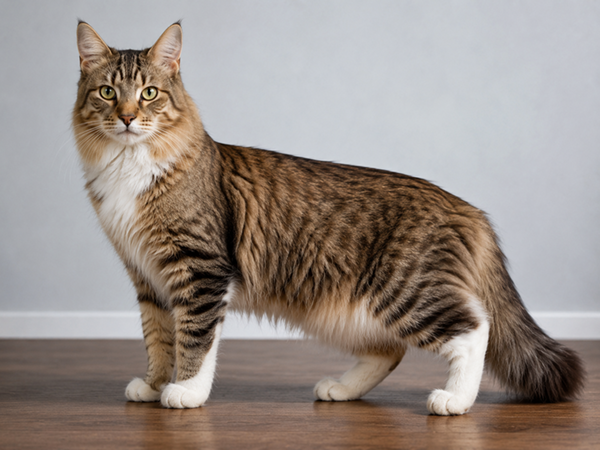
The Aphrodite is a large, strong and elegant cat breed developed from the naturally occurring cat population of Cyprus. It has a long, muscular body, substantial bone structure, hind legs that are slightly longer than the front legs and a distinctive triangular head with a broad, square muzzle. The World Cat Federation uses the official name Aphrodite’s Giant, while The International Cat Association uses the shorter name Aphrodite.
Despite its impressive build, the Aphrodite should not look heavy, clumsy or compact. This is an athletic and agile cat whose appearance combines physical strength with balanced proportions. The word Giant refers to the breed’s large physical type, but neither WCF nor TICA sets an official weight requirement.
Breed at a glance:
- International name: Aphrodite’s Giant
- Alternative name: Aphrodite
- Coat length: shorthaired and semi-longhaired
- Country of origin: Cyprus
- WCF codes: APL for the semi-longhaired variety, APS for the shorthaired variety
- WCF categories: 2 – Semi-Longhair (APL), 3 – Shorthair (APS)
- Size: large
- Weight: no official range is established; males are usually considerably larger than females
- Life expectancy: reliable breed-specific data are not yet available
- Activity level: moderately high, athletic and active
- Sociability: well-socialized cats can be comfortable and confident around people
- Affection level: TICA describes a gentle temperament; attachment and sociability vary among individuals
- Distinctive features: natural Cypriot origin, pronounced size difference between males and females, hind legs slightly longer than the front legs, two coat varieties and slow maturation according to the TICA standard
How the Aphrodite Differs from Other Cats of Cyprus
The terms Cyprus cat and Aphrodite are not interchangeable. Cyprus is home to a large and diverse population of domestic, free-roaming and feral cats that vary in size, coat length, color, body type and ancestry. A cat is not automatically an Aphrodite simply because it was born on the island.
The Aphrodite is a standardized pedigree breed developed through the selection of Cypriot cats with a particular physical type. A pedigreed Aphrodite should have documented ancestry and conform to the standard used by the relevant cat registry. For this reason, not every large or longhaired cat from Cyprus belongs to the breed, and pedigree status cannot be confirmed from appearance or a photograph alone.
The Ancient Cats of Cyprus
Cyprus holds an important place in the early history of the relationship between humans and cats. At the Neolithic settlement of Shillourokambos in southern Cyprus, archaeologists discovered a cat skeleton in a small grave beside a human burial dating back approximately 9,500 years. The position of the remains and the absence of signs that the animal had been butchered led researchers to suggest that the cat may have held special meaning for the person or community involved.
Cats were not part of the original native fauna of Cyprus, so people must have transported them to the island by sea. This suggests that they were already considered useful or significant. The Shillourokambos burial is one of the earliest known signs of a close relationship between humans and cats and predates the familiar artistic representations of domestic cats in ancient Egypt by several thousand years.
The discovery does not establish a direct pedigree connecting the ancient cat with the modern Aphrodite breed. Thousands of years separate the burial from present-day breeding programs, and cats may have been brought to Cyprus from other regions many times during that period.
Development of the Modern Aphrodite Breed
For a long period, cats on Cyprus existed as a naturally breeding island population. They lived around settlements and farms and were also found in mountainous areas. The TICA standard associates the breed type with cats from the mountain regions of Cyprus, while the modern pedigree breed was formed through the deliberate selection of animals with a particular combination of physical traits.
WCF recognizes two coat varieties under separate breed codes:
- APL – Aphrodite’s Giant, the semi-longhaired variety;
- APS – Aphrodite’s Giant Shorthair, the shorthaired variety.
The semi-longhaired variety belongs to WCF Category 2 – Semi-Longhair, while the shorthaired variety belongs to Category 3 – Shorthair. In TICA, the two varieties form the Aphrodite Breed Group and are known as the Aphrodite Longhair and Aphrodite Shorthair.
In January 2024, TICA returned the Aphrodite from Preliminary New Breed status to Registration Only. Aphrodites may therefore be registered with TICA, but they are not currently eligible to compete as a championship breed within the organization.
How the Aphrodite Got Its Name
The name Aphrodite’s Giant reflects the breed’s connection with Cyprus and the island’s long association with the Greek goddess Aphrodite. According to Greek mythology, Aphrodite rose from the sea foam near the coast of Cyprus, and her name remains closely linked with the island’s culture and landmarks.
The word Giant emphasizes the breed’s large and powerful build. It does not mean that every Aphrodite reaches an extraordinary weight. The standards do not set an official weight range, and adult females are usually smaller and lighter than males.
Appearance of the Aphrodite Cat
The Aphrodite is a large, substantial cat with strong bone and well-developed muscles. Its build should suggest strength and excellent physical condition while remaining elegant. The body is long and solid rather than short or rounded, with a relatively long back and neck. The shoulders and hips are muscular and approximately equal in width, giving the cat an elongated, athletic outline.
Sexual dimorphism is pronounced. Adult males are generally larger and more muscular than females, and mature males may develop noticeable jowls. TICA describes the Aphrodite as slow to mature, so kittens and young adults may have less developed muscle, coat and overall substance than fully mature cats.
Legs and Paws
The legs are strong and muscular, with medium to large bone. The hind legs are slightly longer than the front legs, a characteristic included in both the WCF and TICA standards. This structure contributes to the breed’s athletic appearance and ability to jump and climb. Indoor Aphrodites benefit from tall cat trees, securely mounted shelves and stable elevated resting places designed to support a large, powerful cat.
Head and Muzzle
Viewed from the front, the head forms a long triangle, with relatively straight cheek lines widening from the muzzle toward the ears. The muzzle is broad, slightly longer than it is wide and square in outline. It should appear strong and well developed rather than narrow, pointed or excessively short. The chin is full and firm and aligns with the nose.
In profile, the line between the nose and brow forms a gentle concave curve, while the forehead is slightly rounded without an abrupt break. The overall head should combine natural strength with balanced proportions rather than appearing either excessively delicate or coarse.
Ears
The ears are medium to large and broad at the base. Viewed from the front, their placement creates an open V shape, with a softly rounded line between them at the top of the head. Small ears, narrow ear bases or ears placed very close together and pointing straight upward do not represent the preferred type. Semi-longhaired Aphrodites may have longer furnishings inside the ears, but prominent lynx tips are not required.
Eyes
The eyes are olive-shaped, falling between round and oval, and are set at a slight angle. The outer corner of each eye points toward the central area of the ear base, giving the face an alert expression. Eye color is not strictly linked to coat color, and shades may include blue, green, yellow and gold. The color should appear clear and even.
Tail
The tail is medium to long and proportionate to the body. It is thick where it joins the body and gradually tapers toward the tip. The semi-longhaired variety has a full, well-plumed tail, while the coat on the tail of the shorthaired variety is approximately the same length as the coat on the body.
Semi-Longhaired Aphrodite
The semi-longhaired Aphrodite carries the WCF code APL. Its coat is soft, silky and dense, with slightly longer hair around the neck, on the belly and over the hindquarters, where it may form a modest ruff and britches. The tail is full and well plumed. Coat length and undercoat density vary with the seasons, so the winter coat may be considerably fuller than the summer coat.
Shorthaired Aphrodite
The shorthaired Aphrodite carries the WCF code APS. Its coat is soft, dense and semi-plush rather than extremely short or flat. The undercoat may become fuller during colder months and less noticeable in summer. The texture should remain soft and silky rather than coarse or harsh.
Colors and Patterns
WCF and TICA describe the permitted colors differently. TICA lists the Aphrodite in all divisions and accepts all colors under its breed-group standard. WCF permits a wide range of solid, tortoiseshell, tabby, spotted, silver, smoke and bicolor coats but excludes pointed and mink patterns.
Under the WCF standard, a solid-colored cat should not have white markings, while the white and colored areas of a bicolor may be distributed asymmetrically. Color is not the defining feature of the Aphrodite. Body structure, musculature, head shape, coat quality and overall condition carry greater importance in breed evaluation.
Aphrodite Cat Personality
The TICA standard describes the ideal Aphrodite as combining physical strength and power with a gentle temperament. However, the Aphrodite remains a rare breed, and there is limited independent evidence supporting broad claims about the exact level of sociability, affection or independence shared by all members of the breed.
An individual cat’s behavior depends on genetics, early socialization, handling, living conditions and previous experience. A well-socialized Aphrodite can become a calm and affectionate companion, but the desire for constant attention, physical contact or being carried will vary from cat to cat.
Activity and Play
The Aphrodite has a strong, athletic body and benefits from regular physical activity. Tall cat trees, wall-mounted shelves, tunnels, scratching posts and secure climbing routes provide appropriate outlets for movement and exploration. Wand toys, balls, food puzzles and toys that imitate small prey can be used for daily play and mental stimulation.
Regular activity is particularly important for an indoor cat. Too little exercise can contribute to weight gain, frustration and unwanted behavior.
Living with Children and Other Pets
A calm, well-socialized Aphrodite may live successfully with respectful children. Children should be taught not to chase, restrain or pull the cat’s tail and to leave the cat alone while it is sleeping, eating or using the litter box.
Introductions to other cats or cat-friendly dogs should be gradual, with separate food bowls, resting places and opportunities for each animal to withdraw. Like other domestic cats, an Aphrodite may have a hunting instinct, so birds, rodents, fish and other small pets should be kept in secure enclosures.
Is the Aphrodite Cat Right for You?
The Aphrodite may suit someone who appreciates a large, natural-looking cat with an athletic build and a moderately high activity level. A prospective owner should be prepared to:
- provide enough room for a large cat;
- install sturdy climbing and scratching furniture;
- offer interactive play every day;
- groom the coat more frequently during seasonal shedding;
- monitor the cat’s weight and body condition;
- secure windows and balconies;
- respect the individual cat’s temperament and preferences.
The breed may not suit someone looking for a very small or sedentary pet or anyone unable to accommodate the size and activity of a powerful adult cat.
Grooming
A shorthaired Aphrodite usually needs brushing about once a week with a soft brush or grooming glove. The semi-longhaired variety may need brushing once or twice a week, with particular attention to the underarms, belly, neck and fur around the hind legs. More frequent grooming may be necessary during seasonal shedding to remove loose undercoat and prevent tangles.
Regular bathing is usually unnecessary. The nails should be checked and trimmed as needed, and routine care should also include inspection of the ears and attention to dental health.
Home Safety and Outdoor Access
Windows and balconies should be fitted with strong pet-safe screens because a standard insect screen may not withstand the weight or force of a large cat. Unsupervised outdoor access exposes cats to traffic, infectious disease, poisoning, theft and attacks by other animals.
Safer alternatives include a secure cat enclosure, an enclosed garden, a protected balcony or supervised walks in a properly fitted harness. Harness training should begin gradually indoors before the cat is taken outside.
Feeding an Aphrodite Cat
The Aphrodite needs a complete and balanced diet appropriate for its age, activity level and health. A large frame does not mean that the cat should be fed without limits, since excess body fat places additional strain on the joints, spine, heart and other organs.
Portion size should be adjusted according to the body condition of the individual cat rather than breed size alone. The ribs should be easy to feel beneath a light layer of tissue, and a visible waist should remain when the cat is viewed from above. Fresh drinking water should always be available.
Aphrodite Cat Health
The Aphrodite remains a rare breed, and large scientific studies establishing the prevalence of breed-specific inherited diseases are not yet available. It would therefore be inaccurate either to declare the breed free from hereditary problems or to assign it a list of disorders without reliable evidence.
The health of a kitten depends on its bloodline, genetic diversity, breeding practices, early care and living conditions. A responsible breeder should consider health problems found among parents and other relatives and select screening tests based on the documented history of the particular bloodline.
Before buying an Aphrodite kitten, ask the breeder for:
- the pedigrees of both parents;
- the results of any genetic tests performed;
- information about veterinary screening of breeding cats;
- the kitten’s veterinary and vaccination records;
- details of parasite prevention;
- a written sales contract and health guarantee.
There is no single universal panel of tests that applies to every Aphrodite bloodline. Screening decisions should be based on documented family history and veterinary advice. Like all cats, an Aphrodite needs regular veterinary examinations, vaccination, parasite control, dental care and weight monitoring.
Interesting Facts About the Aphrodite Cat
- The breed has two WCF codes. The semi-longhaired variety is APL and belongs to Category 2 – Semi-Longhair, while the shorthaired variety is APS and belongs to Category 3 – Shorthair.
- Body structure carries considerable weight in both standards. WCF assigns 35 points to the body, while TICA assigns 40 points to the body, legs and tail.
- TICA permits no outcrosses. The Aphrodite breed-group standard lists permissible outcrosses as “None.”
- The color rules differ between registries. TICA accepts all colors, while WCF excludes pointed and mink patterns.
- The breed’s status depends on the registry. Aphrodite varieties appear in the WCF breed system, while TICA returned the breed to Registration Only status in January 2024.
The Aphrodite’s Giant is a rare Cypriot breed distinguished by its large athletic body, strong bone, triangular head and shorthaired and semi-longhaired varieties. Anyone considering an Aphrodite kitten should focus on documented ancestry, parental health, responsible breeding and correct physical type rather than size alone.
Serengeti: A Long-Legged Cat with the Look of the African Savanna
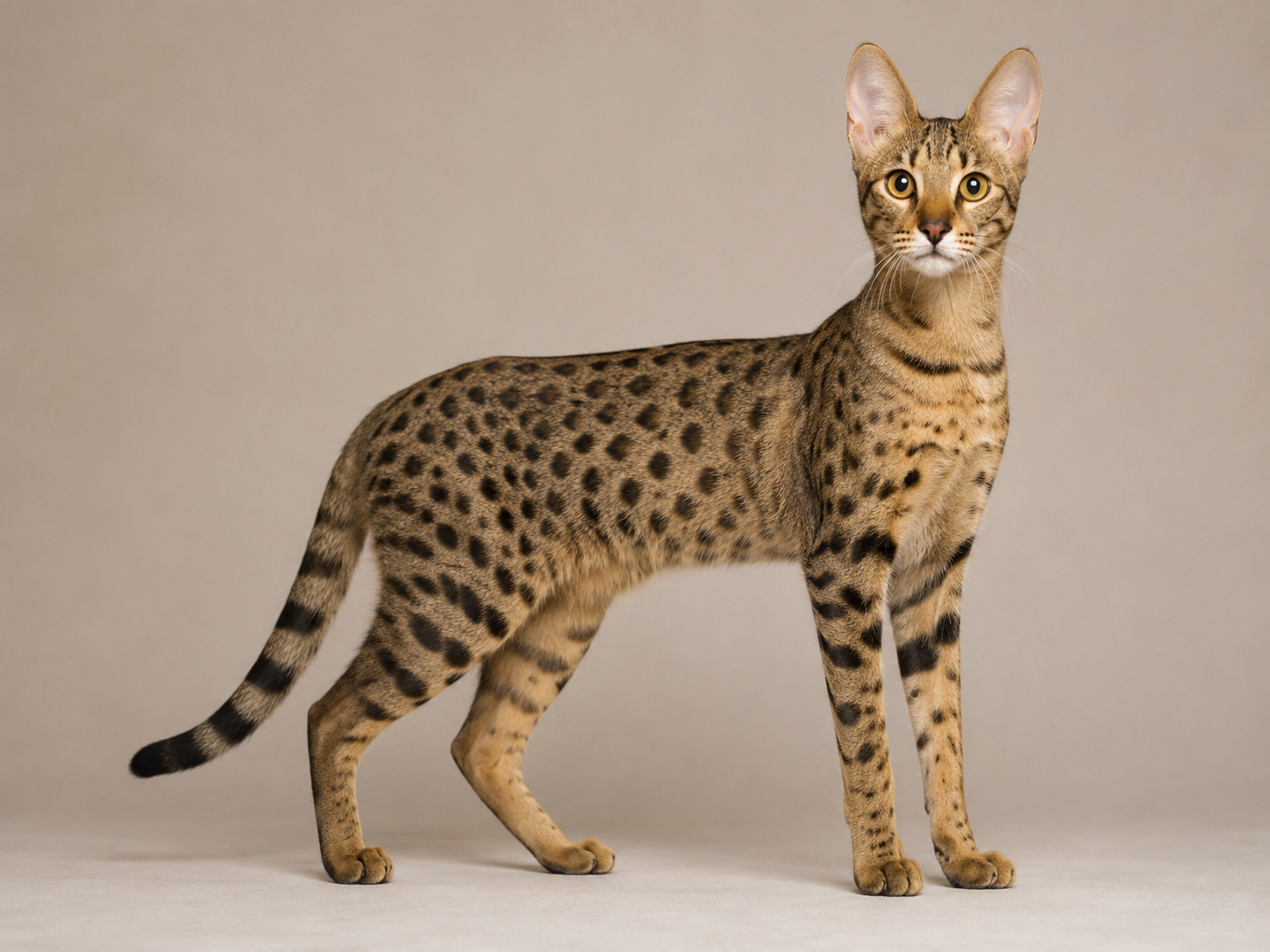
The Serengeti looks as though a small African wildcat has quietly stepped into the living room. Its exceptionally long legs, enormous rounded ears, spotted coat, and alert expression were deliberately developed to resemble the serval. Despite this wild appearance, the Serengeti is a domestic breed and was created without breeding domestic cats directly to servals.
Behind the exotic looks is an energetic, social, and highly inquisitive companion. Serengeti cats enjoy running, jumping, climbing, and taking part in whatever their people are doing. Many become closely attached to their families, follow them from room to room, and express themselves through an impressive range of sounds.
Quick facts:
- Coat: short, dense, and even in length
- Activity level: very high
- Social nature: outgoing and people-oriented
- Affection: devoted, although not every Serengeti enjoys being held for long periods
- Female weight: commonly about 8-12 pounds, or 3.6-5.4 kilograms
- Male weight: commonly about 10-15 pounds, or 4.5-6.8 kilograms
- Life expectancy: reliable breed-specific statistics are still limited
- Coat pattern: spotted or solid, depending on the color
- Breed status: Advanced New Breed in TICA
Males are generally larger than females, but the Serengeti should never appear heavy, stocky, or low to the ground. The ideal cat combines a strong body, lean muscle, exceptionally long legs, and a tall, upright stance.
History of the Serengeti Cat
The Serengeti is a young American breed developed in California during the mid-1990s. The breeding program was established by Karen Sausman, a conservation biologist and the owner of Kingsmark Cattery.
Sausman’s goal was to produce a domestic cat with the visual drama of an African serval without using the serval itself in the breeding program. She wanted the long-legged silhouette, large ears, spotted coat, and watchful expression of a wild savanna cat combined with the temperament and manageability of a domestic companion.
The foundation of the breed came primarily from Bengal cats and Oriental Shorthairs. Bengals contributed the spotted pattern, athletic build, and substantial body. Oriental Shorthairs contributed long legs, elongated lines, large ears, high activity levels, and a tendency to communicate vocally with their people.
No serval was used to create the Serengeti. This is the most important distinction between the Serengeti and the Savannah. Savannah cats descend from crosses between servals and domestic cats, while the Serengeti was developed entirely from domestic breeds.
The Bengal itself has distant hybrid ancestry involving the Asian leopard cat. For that reason, the most precise statement is that the Serengeti has no serval ancestry and was never produced through direct breeding to servals.
Development of the breed began around 1995. Over time, Serengeti cats appeared not only in the United States but also in the United Kingdom, continental Europe, Australia, New Zealand, Russia, and several other countries.
The breed entered TICA’s Preliminary New Breed program in 2002. On May 1, 2013, it advanced to the Advanced New Breed category.
This status allows Serengeti cats to be registered and exhibited in special new-breed classes at TICA shows. They have not yet reached full championship status and do not compete for the same titles and annual awards as fully recognized championship breeds.
Origin of the Name
The name Serengeti refers to the famous East African region known for its vast grasslands and extraordinary wildlife.
The name reinforces the breed’s savanna-inspired appearance and its resemblance to the African serval. It does not describe the actual place where the breed originated. The Serengeti cat was developed in California, not in Africa.
In English, the breed is usually called the Serengeti or the Serengeti cat.
Serengeti, Serval, and Savannah: What Is the Difference?
The serval is a wild African cat species. It is known for extremely long legs, oversized ears, a relatively small head, and a golden coat covered with dark spots and stripes.
The Serengeti was created to suggest the appearance of a serval through selective breeding among domestic cats. Its resemblance to the serval does not come from direct serval ancestry.
The Savannah, by contrast, originated through hybridization between servals and domestic cats. Early-generation Savannahs are described with designations such as F1, F2, and F3, indicating how closely they are related to a serval.
Serengeti cats do not have serval-generation labels. They are domestic pedigree cats, even though their proportions and coloring were intentionally developed to evoke the look of an African wildcat.
The breed standard calls for a confident, friendly, and outgoing temperament. Aggression toward people is not considered acceptable.
General Appearance
The Serengeti is a medium-sized cat whose structure should create an impression of height, athletic power, and agility.
The body is strong and fairly deep without appearing bulky. The shoulders and rump should remain approximately level, creating a straight topline. Combined with the long legs, this gives the cat a tall and almost vertical appearance.
The body may appear nearly square because the height of the legs visually balances the length of the torso. A Serengeti should not be excessively long-bodied, delicate, or fragile.
Muscle should be well developed but lean rather than thick. The cat should look fit and athletic, not massive.
Legs and Paws
Exceptionally long legs are one of the defining features of the Serengeti. In the TICA standard, the legs receive more points than any other single feature of the body.
The legs should have moderate bone and long, firm muscle. They must not appear either fragile and spindly or thick and heavy.
The paws are medium in size and oval in shape.
Those long legs make the Serengeti an impressive jumper. A high shelf, tall cabinet, or upper platform of a cat tree may look inaccessible to a person while appearing perfectly reasonable to the cat.
Head and Profile
The Serengeti’s head is longer than it is wide and forms a modified wedge. The lines begin at the nose and widen gradually toward the bases of the ears, creating a soft triangular outline.
The cheekbones should not be prominent. The muzzle is medium in length, with moderately full and rounded whisker pads. The chin should be firm without looking oversized or square.
The nose is moderately broad and remains close to the same width along most of its length.
In profile, the line rises straight from the nose to the brow and then curves gently toward the top of the skull. The head flows into a long, arched neck without a narrow or pinched appearance.
The Serengeti’s Ears
The enormous ears are among the breed’s most recognizable characteristics. They should be broad and deep at the base, with rounded rather than sharply pointed tips.
The height of each ear may be close to the length of the head. The ears are carried upright and placed fairly close together on top of the head.
Small ears are a serious fault. Long, sharply pointed ears with pronounced lynx tips are also incorrect for the breed. The Serengeti’s ear tips should appear rounded and clean.
These ears give the cat a permanently attentive expression. Even while waiting beside an empty food bowl, a Serengeti can look as though it has just detected movement somewhere beyond the tall grass.
Eyes
The eyes are large, round, and set widely apart. They should not appear bulging or deeply recessed.
The broad nose and generous distance between the eyes contribute to the breed’s wild, alert expression.
Gold and yellow are preferred eye colors. Hazel and light green are also accepted.
Blue eyes are not accepted in the TICA Serengeti standard.
Tail
The tail is thick at the base and tapers slightly toward the end. It is medium in length, although it can appear relatively short when compared with the cat’s unusually tall body.
When laid carefully along the body, the ideal tail should not reach the shoulder.
Spotted Serengeti cats usually have dark rings around the tail. The tip should be dark. A white tail tip is not accepted.
Coat Texture
The Serengeti has a short coat that remains even in length across the body. The hair is fine, dense, and may stand slightly away from the skin without becoming fluffy.
The coat can feel soft and silky. Its short length emphasizes the cat’s musculature and long, clean body lines.
Grooming requirements are simple, but coat quality still depends on balanced nutrition, healthy skin, and the cat’s overall condition.
Spotted Pattern
On spotted Serengeti cats, the markings should be dark, distinct, and clearly separated from one another. The spots are scattered freely across the body and should not form regular vertical stripes.
The pattern continues over the shoulders, thighs, and legs. Dark rings are normally visible on the tail.
Unlike the Bengal, the Serengeti is expected to have solid-colored spots. Two-tone spots known as rosettes are considered a fault in the Serengeti standard.
Heavy ticking is also undesirable. Ticking divides individual hairs into several bands of color and can make the spotted pattern appear less distinct.
Serengeti Colors
The TICA standard recognizes four main color varieties:
- brown spotted tabby;
- solid black;
- black silver spotted tabby;
- black smoke.
The background color of a brown spotted Serengeti may range through shades of brown, beige, tan, and gold. Clear contrast should remain between the background and the dark spots.
The chin, muzzle, and belly may be considerably lighter than the rest of the body. A pale mark on the back of the ears is desirable.
A silver Serengeti has black spots on a clean, cool silver background.
A solid black cat may appear completely dark, although faint ghost markings can sometimes be seen in certain lighting.
In a black smoke coat, the base of each hair is pale while the upper portion is black. When the cat is resting, the coat may look almost solid black. As the cat moves and the hair separates, the lighter roots become visible.
Temperament
Serengeti cats are generally described as confident, friendly, attentive, and highly social. Many form strong bonds with their families and want to participate in daily life.
In an unfamiliar place, a Serengeti may initially behave with caution. Once comfortable, the cat often begins following family members from room to room and supervising every activity.
Many Serengeti cats do not enjoy being left alone for long periods. They benefit from regular human interaction or the company of a compatible animal companion.
A Serengeti may be affectionate without wanting to remain in someone’s arms for hours. Many prefer to stay nearby, follow their people, play, and investigate whatever is happening.
Every cat has an individual personality. Temperament is shaped not only by breed tendencies but also by genetics, early socialization, training, and the environment in which the kitten was raised.
Activity and Play
The Serengeti is a highly active cat. It enjoys fast running, powerful jumps, chasing toys, and watching the household from the highest available position.
A tall, sturdy, multi-level cat tree is essential. High platforms, wall-mounted shelves, tunnels, and secure climbing routes can help satisfy the breed’s need for movement.
Good toys include wand toys, balls, lightweight objects that can be carried, food puzzles, and games that imitate hunting.
One short play session in the evening may not be enough. Several periods of activity throughout the day are usually more appropriate.
Without suitable entertainment, a Serengeti may design its own activity program. Curtains, open cabinets, houseplants, and objects that were supposedly placed out of reach may all become part of the curriculum.
How Vocal Is the Serengeti?
The breed’s tendency toward vocal communication probably comes in part from its Oriental Shorthair ancestry.
Some Serengeti cats use a wide range of meows, chirps, trills, short calls, and expressive changes in tone. They may answer their people or repeatedly announce what they want.
Vocal behavior varies considerably, however. Not every Serengeti will be loud or constantly interested in conversation.
Children and Other Pets
With proper socialization, a Serengeti can live successfully with children who understand how to handle animals gently and respect a cat’s personal space.
An active cat may enjoy playing with a child, but toys such as wands and balls should be used instead of hands.
Serengeti cats can also live with other cats and cat-friendly dogs. Introductions should be gradual, controlled, and free of pressure.
The best companion is usually an animal with a similar activity level. An elderly, quiet cat may find life difficult beside a young Serengeti that issues repeated invitations to race through the house.
The hunting instinct may be well developed. Birds, rodents, fish, and other small animals should be protected in secure enclosures or covered aquariums.
Who Is the Serengeti Best Suited For?
The Serengeti is best suited to someone who wants an intelligent, active, and social companion and is prepared to spend time interacting with the cat every day.
A suitable owner should be willing to:
- provide daily interactive play;
- create safe places for climbing and jumping;
- accept a high level of activity;
- offer regular companionship;
- secure windows and balconies;
- remove fragile and dangerous objects;
- provide puzzle toys and new activities.
The breed may not be the best choice for someone who wants a quiet, low-energy cat that can remain alone for most of the day.
A Serengeti should not be chosen solely for its appearance. The long-legged domestic serval look arrives with a generous supply of energy, curiosity, and personal opinions about how the home should be arranged.
Grooming and Routine Care
The Serengeti’s short coat is easy to maintain. Brushing once a week with a soft brush or rubber grooming mitt is usually sufficient.
During seasonal shedding, brushing can be done more often to remove loose hair.
Frequent bathing is unnecessary. The cat should be washed only when needed, using products made specifically for cats.
The claws should be checked and trimmed regularly. Several sturdy scratching posts should be available, including a tall vertical model that allows the cat to stretch its long body fully.
The ears, eyes, and teeth should also be monitored. Kittens are easier to manage as adults when they are gently introduced to tooth brushing, paw handling, and routine examinations from an early age.
Tall climbing structures must be stable and securely attached. A lightweight, wobbling scratching tower may have a dramatic but extremely brief career when challenged by a running Serengeti.
Safety and Outdoor Access
Windows and balconies should be protected with strong pet-safe screens. Standard insect screens are not designed to withstand the weight and force of an active cat.
Unrestricted outdoor access carries risks from traffic, dogs, infectious diseases, toxins, theft, and the possibility that the cat may travel far from home.
Safer options include leash walks, a fully enclosed yard, a protected balcony, or a secure outdoor cat enclosure.
Harness training should begin gradually indoors. Even a confident house cat may panic at a sudden noise outdoors and attempt to escape.
Feeding the Serengeti
A Serengeti needs a complete and balanced diet appropriate for its age, activity level, reproductive status, and health.
An exotic appearance does not require an exotic, African, or raw-food diet. An improperly balanced meat-based diet can cause serious nutrient deficiencies, while raw products may contain harmful bacteria and parasites.
High activity increases energy needs, but food should not automatically be available in unlimited quantities. Portions should be adjusted according to the individual cat’s body condition.
Fresh drinking water must always be available. Many cats prefer wide bowls or pet fountains that keep the water moving.
Serengeti Health
The Serengeti is a young and still relatively rare breed. Large scientific studies have not yet established a reliable list of breed-specific diseases or their prevalence.
Claims that every Serengeti is predisposed to a particular condition should therefore be treated carefully. At the same time, limited published data does not mean that hereditary disorders are impossible.
A responsible breeder should consider the health of individual breeding lines, the cats’ pedigrees, and the screening results of related animals.
Because Bengal and Oriental Shorthair cats have been used in the development of the breed, appropriate genetic and clinical screening should be selected according to the actual ancestry of each breeding cat rather than the breed name alone.
When purchasing a kitten, ask the breeder to provide:
- pedigrees for both parents;
- results of relevant DNA tests;
- information about clinical screening of the breeding cats;
- the kitten’s veterinary records;
- vaccination and parasite-control information;
- a written sales contract and health guarantee.
No single test panel can guarantee that a cat is free from every hereditary disease. Screening results should be interpreted in the context of the pedigree and the specific lines used in the breeding program.
Like every cat, a Serengeti needs routine veterinary examinations, vaccination, parasite prevention, dental care, weight monitoring, and prompt medical attention when its behavior or condition changes.
Interesting Facts About the Serengeti Cat
The Serengeti was created as a domestic alternative to cats with direct serval ancestry. Servals were never used in the breeding program.
Breed founder Karen Sausman was a conservation biologist. Developing a domestic cat with a wild appearance was consistent with her interest in protecting wild animals and reducing demand for exotic pets.
The ears are among the most important features in the breed standard. TICA assigns 12 points to the ears, more than it gives to the eye shape, tail, coat texture, or any individual feature of the head.
The legs are almost as important. They receive 10 points in the standard, and short legs are considered a significant fault.
Rosettes are not desirable in the Serengeti. While two-tone rosettes are highly valued in Bengal cats, the Serengeti standard prefers solid dark spots.
A completely black Serengeti is an accepted variety. Faint ghost spots may still become visible under certain lighting.
The breed advanced to TICA’s Advanced New Breed category in 2013. Serengeti cats can appear in special TICA classes but have not yet reached championship status.
The TICA standard lists Bengal and Oriental Shorthair cats as permitted outcrosses. These outcrosses help support the development of a breed that remains relatively rare.
The name sounds African, but the breed is American. The first Serengeti cats were developed in California.
White toes and a white tail tip are not accepted. Blue eyes also fall outside the recognized Serengeti standard.
The Serengeti is an excellent choice for someone who appreciates the combination of unusual looks, intelligence, affection, and nearly inexhaustible energy.
With the right home and care, the result is not an African wild animal but a devoted domestic companion on exceptionally long legs. It will follow its people, inspect the highest shelves, and make certain that no important household event takes place without the supervision of the resident representative of the savanna.
Suphalak (Thong Daeng): Thailand’s Copper-Coated Heritage Cat
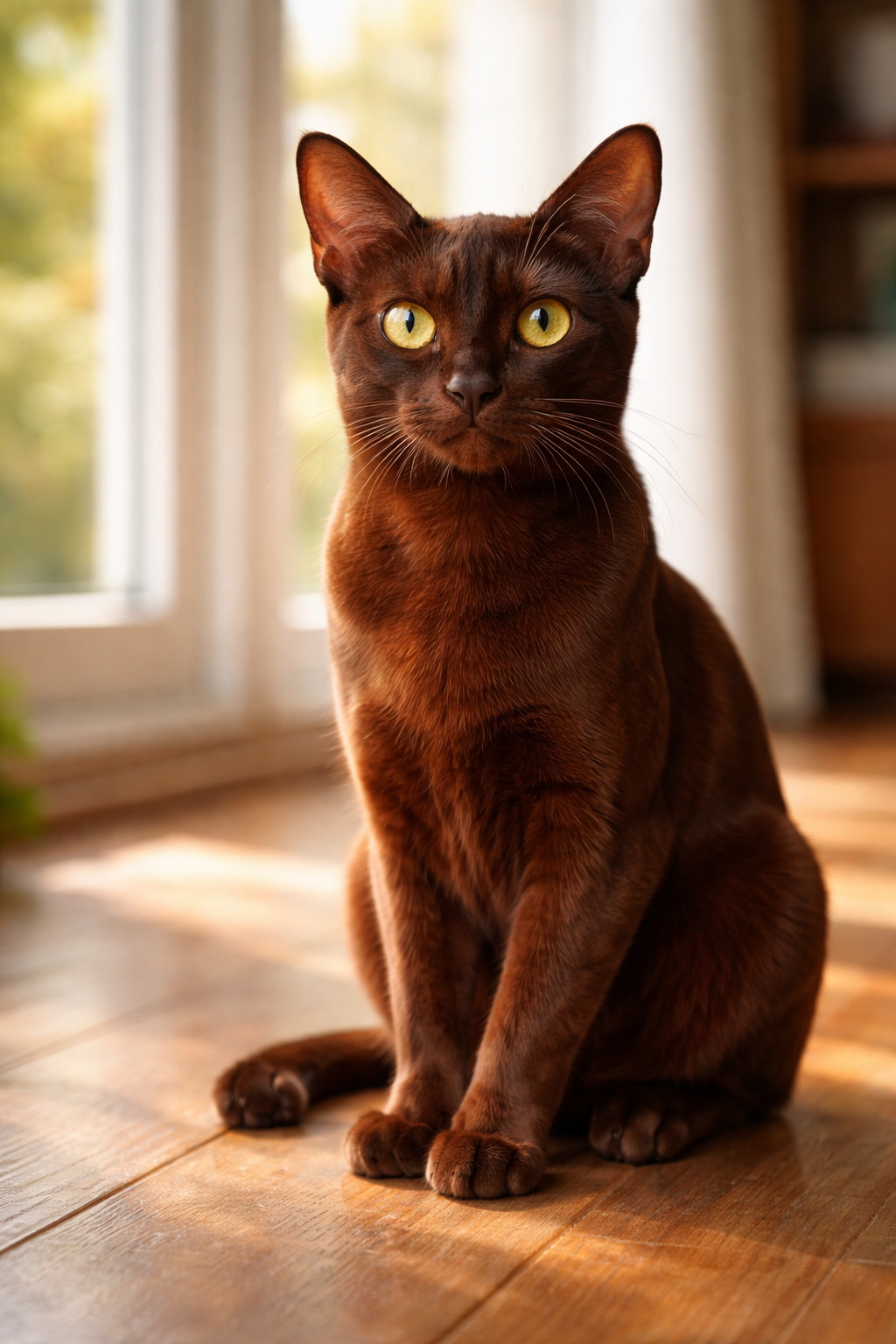 From palm-leaf poems to modern registries — a traceable Thai timeline
The Suphalak, also called Thong Daeng (meaning “copper”), is a natural Thai cat described in the historic Tamra Maew (Cat-Book Poems) compiled during the Ayutthaya era, circa 1351–1767. Surviving manuscripts are held in Thai and overseas collections. A Thai legend attached to 1767 — the year Ayutthaya fell — helps explain the breed’s rarity but is regarded as folklore rather than documented history.
In the 2000s–2010s, Thai preservationists organized to revive a solid, red-brown “whole-body copper” cat matching the old description; The International Maew Boran Association (TIMBA) formalized its program in 2014. In 2024, the World Cat Federation (WCF) published a distinct Suphalak breed standard under the code SUP. Breed overviews also report that on September 6, 2015, a female named Thonga — exported to the United States in 2013 for the Thai Dee Maew program — was recorded by the American Cat Association (ACA) as “Suphalak,” often cited as the first such registry entry (noting that ACA’s primary registry is not publicly searchable).
One color, subtle shades — how varieties work
Coat color: one self color — a warm, glossy chocolate that reads as reddish copper (thong daeng). Slight “ghost” markings may appear in kittens and fade with maturity.
Eye color: golden or yellow preferred; greenish tones permitted; blue eyes are not permitted.
Nose, pads, whiskers: chocolate-brown nose leather; warm cinnamon paw pads; brown whiskers to harmonize with the coat.
Physical profile — copper sheen, moderate Thai type
Body and build: medium, semi-foreign, muscular and balanced; neither cobby nor extreme.
Head and face: moderate wedge with gently rounded contours and a slightly heart-shaped impression; high, rounded cheekbones; slight profile dip below eye level; fine, well-developed muzzle.
Ears: moderately large, wide at the base, set well apart with rounded tips, giving an alert, open look.
Eyes: large, wide-open, slightly slanted; golden to rich gold preferred, greenish allowed.
Tail and legs: tail medium to moderately long and tapering; legs long, slender and muscular; oval paws.
Coat and feel: very short, close-lying, fine and silky with notable luster; above the eyes the coat can appear sparse, enhancing the bright, alert expression.
Size and weight: no official weight is set in standards. Breeder profiles commonly describe a medium cat around 8–12 lb (3.6–5.4 kg). Treat this strictly as guidance — judges assess type, balance and condition rather than weight.
What makes it unique: a solid, warm copper-chocolate coat (not pointed and not sable), matching brown whiskers and chocolate nose leather — a look anchored in Thai manuscripts and formalized by WCF.
Personality and daily habits — people-focused like many Thai natives
Reports from Thai lines and preservation groups describe the Suphalak as social, inquisitive, communicative and playful — a follow-you, talk-to-you companion similar in people-orientation to other native Thai breeds such as the Korat and Khao Manee. Interactive play and human time rank high.
How it compares — close cousins, clear differences
Not Burmese: the Suphalak is a full-color self chocolate; Burmese type derives from the Burmese color-restriction allele and produces darker mask and points, which the Suphalak must not show.
Within Thai cats: Suphalak is the copper self within the native Thai population (Maew Boran); WCF provides a distinct Suphalak show standard.
Lifespan and health — what owners realistically see
Lifespan: typical of healthy, medium domestic cats; many profiles cite roughly 10–12 years with good care.
Health focus: no breed-specific disorders are established. Maintain routine preventive care (dental hygiene, vaccinations as advised by your veterinarian, parasite control). Color-genetics testing helps avoid mismatches that would produce disqualifying patterns.
Care tips for owners — diet, grooming, environment and show notes
Diet: feed a complete, high-protein diet appropriate for life stage and activity; adjust calories to keep a firm, athletic body. Provide fresh water at all times.
Grooming: a weekly rubber brush or grooming glove lifts dead hair and polishes the coat; a soft chamois wipe can enhance shine. Trim nails and brush teeth routinely.
Environment and enrichment: provide vertical space, puzzle feeders and at least two interactive play sessions daily. These cats thrive on people time, so plan for companionship.
Sun and coat color: the copper sheen can warm in bright sun; sensible exposure is fine, but avoid prolonged harsh midday sun in hot climates.
Show specifics (WCF): avoid white lockets or medallions, kinked tails or incorrect eye colors — these are penalized or disqualifying. Maintain the rich, glossy red-brown coat and correct cinnamon-toned pads.
At a glance — essentials to remember
Status: distinct WCF standard (SUP, 2024).
Origins: described in Ayutthaya-era Tamra Maew; modern preservation via TIMBA since 2014.
Color and features: solid warm chocolate with a copper cast; brown whiskers; chocolate nose leather; cinnamon paw pads; golden eyes preferred, greenish allowed.
Build: medium, semi-foreign, muscular with a very short, lustrous coat.
Temperament: social, communicative, active and people-oriented.
Typical weight: commonly around 8–12 lb (3.6–5.4 kg) — guidance rather than a standard.
Khao Manee Cats: Thailand’s “White Gem” With Diamond Eyes
From royal manuscripts to modern rings – a verified origin story
Khao Manee is a natural Thai breed whose name means “white gem.” Historic Thai cat poems (Tamra Maew) mention an auspicious solid-white cat called Khao Plort. Western development began in 1999 when Colleen Freymouth imported a cat named Sripia from Thailand and produced the first North American litter; soon after, Janet Poulsen (Odyssey cattery) exported the first Khao Manee to the UK. In TICA the timeline is precise: Registration Only in May 2009, Preliminary New Breed effective May 2012, Advanced New Breed on August 30, 2013, and advancement to Championship on January 24, 2015 (effective May 1, 2015). In CFA, the breed has been in the Miscellaneous Class since May 1, 2018. In the UK, GCCF granted the breed name on September 8, 2010, with Khao Manee Cat Club pre-affiliation on October 26, 2011.
Varieties within the breed – what “white only” allows
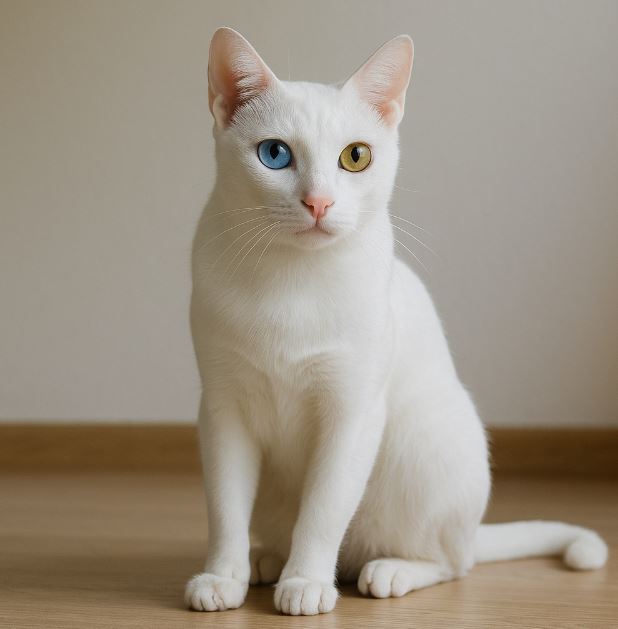 Color: solid white only for the breed standard and shows; non-white kittens can occur but are not showable as Khao Manee.
Eyes: blue, gold (copper through amber), green, or odd-eyed; odd-eyed cats are permitted and traditionally prized.
Hearing note: as with many white, blue-eyed cats, congenital deafness can occur; responsible breeders use BAER hearing tests.
Physical profile – size, build, head, ears, eyes, nose, tail, coat
Size and weight: females typically 6–8 lb (2.7–3.6 kg), males 8–11 lb (3.6–5.0 kg).
Body: medium, athletic, semi-foreign type; agile and springy rather than heavy.
Head and face: characteristic Thai heart-shaped head with high cheekbones; medium-length nose.
Ears: large, upright, open at the base for an alert expression.
Eyes: large and jewel-like in any allowed color or odd-eyed.
Nose leather and paw pads: must be pink; any other color is grounds to withhold awards under show rules.
Coat: short, smooth, close-lying white coat; a naturally moderate undercoat can vary by climate.
What makes a Khao Manee unique: the combination of a pure white coat, brilliant gemstone-like eyes (often odd-eyed), and the Thai heart-shaped head type.
Personality and everyday habits – engaging, intelligent, people-centered
Khao Manee cats are typically curious, playful, communicative, and highly social. Many enjoy fetch-style games and follow-you-around companionship. Expect an interactive cat that appreciates daily engagement and enrichment.
Lifespan and health – realistic expectations and proactive care
Lifespan: often around 10–12 years with good preventive care.
Deafness risk: white cats, especially with one or both blue eyes, can have unilateral or bilateral congenital deafness; BAER testing is the gold standard for screening.
General care: routine wellness exams, vaccinations, and dental care; grooming needs are low due to the short coat.
Quick comparisons – how Khao Manee differs from close cousins
Not a Foreign White Siamese: Foreign White is a Siamese derivative; Khao Manee is a separate Thai natural breed with distinct standards and bloodlines.
Not simply a white Thai/Siamese: standards specify type, head shape, coat rules, and permitted eye colors unique to Khao Manee.
Fun facts – name, legends, and show status
Name meaning: “Khao Manee” translates to “white gem,” echoing Thai lore that prized auspicious white cats and bright, gem-like eyes.
Today’s status: TICA Championship since 2015; CFA Miscellaneous since 2018; GCCF name and club pre-affiliation granted in 2010–2011.
Care tips for owners – food, grooming, environment, and vet care
Diet: feed a complete, high-quality diet appropriate for life stage and activity; fresh water available at all times.
Grooming: weekly brushing typically suffices; keep nails trimmed and teeth brushed; clean ears gently as needed.
Enrichment: provide vertical space, interactive play, and daily engagement to match their athletic, inquisitive nature.
Hearing and safety: discuss BAER screening with your vet if your cat has blue or odd eyes; keep cats indoors and supervise outdoor time to protect their rare, high-value look.
At a glance – essentials for quick reference
Status: TICA Championship (since 2015); CFA Miscellaneous (since 2018).
Origins: Thailand; first U.S. import in 1999 (Colleen Freymouth); early UK export by Janet Poulsen.
Defining traits: solid white coat; jewel-toned or odd eyes; heart-shaped head.
Size and weight: females 6–8 lb (2.7–3.6 kg); males 8–11 lb (3.6–5.0 kg).
Temperament: social, intelligent, playful, people-oriented.
Dwelf Cats Unwrapped: The Tiny, Curly-Eared, Hairless Charmers
From Idea to Experimental Status – A documented mid-2000s origin
The Dwelf is a purposeful blend of three breeds: Munchkin for short legs, Sphynx for hairlessness, and American Curl for the backward ear curl. The concept took shape in the United States in the mid-2000s. In 2006, TICA referenced Dwelf for the Experimental Registry rather than championship recognition. The project follows the 2004 creation of the Elf cat by Kristen Leedom and Karen Nelson, which combined Sphynx and American Curl without the short legs. Major registries such as TICA and CFA do not recognize the Dwelf for championship classes.
Varieties within the type – What can vary from litter to litter
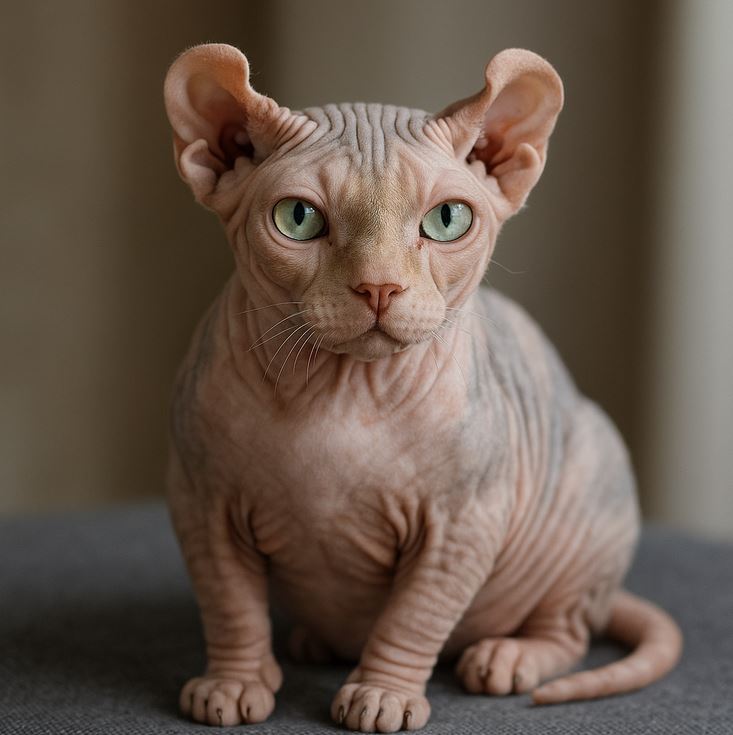 Ear curl: as in American Curl, kittens are born with straight ears that curl back as they mature, ranging from mild to pronounced.
Leg length: litters may include short-leg (standard) and normal-leg (non-standard) kittens depending on inheritance.
Skin feel and appearance: from nearly hairless to a fine peach-fuzz down; all colors and patterns are possible because pigmentation shows on the skin rather than a full coat.
Physical profile – Size, build, head, ears, eyes, tail, skin
Size and weight: typically 4-9 lb (1.8-4.1 kg) and about 6-7 inches tall.
Body: long, low-slung, muscular, with a solid torso for a small cat.
Head and face: slightly longer than wide with pronounced cheekbones and a short, strong muzzle; whiskers and eyebrows may be sparse or absent.
Ears: large with rounded tips that curl backward; firm cartilage at the base with flexible tips.
Eyes: large, almond-shaped, in many colors.
Tail: long and tapering, sometimes with a small hair tuft at the tip.
Skin colors and patterns: any solid or pattern, including tabby, tortoiseshell, bicolor, and pointed or mink expressions.
What makes a Dwelf unique: the three-way signature of hairless feel, short legs, and back-curled ears in one cat.
Personality and everyday habits – Brainy, busy, and people-focused
Dwelfs are typically social, inquisitive, and playful. Expect a follow-you-around companion that enjoys interactive play, climbing, and puzzle toys. Compared with a typical domestic shorthair, many owners report a higher play drive and stronger desire for human interaction, traits commonly seen in Sphynx and American Curl lines.
Lifespan and health – What to watch and how to be proactive
Estimated lifespan is similar to other small companion cats when responsibly bred and well cared for.
Cardiac: from the Sphynx side, breeders often screen for hypertrophic cardiomyopathy with periodic echocardiograms.
Orthopedic/structural: from the Munchkin side, veterinarians discuss lordosis and pectus excavatum; responsible programs avoid problematic matings and monitor kittens closely.
Ears and skin: curled ears benefit from gentle, regular checks; hairless skin needs routine hygiene and protection from cold and sun.
Quick comparisons – Dwelf versus close cousins
Bambino: Sphynx × Munchkin – short legs, hairless, no ear curl.
Elf: Sphynx × American Curl – curled ears, hairless, normal legs.
Kinkalow: Munchkin × American Curl – short legs and curled ears, typically with fur.
Dwelf: combines hairless feel, short legs, and curled ears.
Fun facts – Name and rarity
The name blends “dwarf” and “elf.” As an experimental type, Dwelfs are rare and typically sourced from specialized catteries that document health testing and pedigrees.
Care tips for owners – Food, grooming, environment, and vet care
Diet: hairless cats often need slightly higher calories to stay warm; feed a complete, high-protein diet appropriate for life stage and activity level, with fresh water always available.
Skin care: wipedowns between baths and occasional gentle baths help manage natural skin oils; avoid over-bathing to prevent dryness.
Ear and nail care: check and clean ears regularly without forcing the curl; trim nails frequently to protect delicate skin.
Temperature and sun: keep indoors with warm resting spots and moderate sun exposure; use shade and common-sense protection for UV-sensitive skin.
Enrichment: provide vertical space, scratching options, wand play, and puzzle feeders for daily mental and physical stimulation.
Preventive vet care: schedule annual exams, discuss cardiac screening, and monitor posture and gait as the cat grows.
At a glance – Essentials for quick reference
Status: experimental type – not a championship breed with major registries.
Origins: United States, mid-2000s, following the 2004 Elf project.
Defining traits: hairless feel, short legs, curled ears.
Size and weight: about 6-7 inches tall, 4-9 lb (1.8-4.1 kg).
Temperament: social, intelligent, playful, people-oriented.
Owner focus: proactive health screening, skin-ear care, warm indoor lifestyle, and daily engagement.
Cheetoh Cats: The Wild Beauty in a Domestic Companion
Origins and Development: A Historical Overview
 The Cheetoh cat is the result of intentional crossbreeding between the Bengal and Ocicat. In 2001, American breeder Carol Drymon of Wind Haven Ranch set out to create a cat with the exotic appearance of a wild feline but the affectionate nature of a domestic companion. By combining Bengals, known for their leopard-like spots and high energy, with Ocicats, which have a striking spotted coat and friendly disposition, Drymon aimed to develop a breed that showcased the best of both worlds. The Cheetoh was officially introduced in 2003, marking the beginning of its journey as a distinct breed.
Variations Within the Breed: Coat Colors and Patterns
While all Cheetoh cats share a signature spotted coat reminiscent of a cheetah, their coloration can vary. The main coat colors include:
- Brown, chocolate, and cinnamon (warm-toned variations)
- Blue, lilac, and fawn (diluted, softer versions of the above colors)
Cheetohs can have either a spotted or marbled pattern, with well-defined contrast between the base color and markings. These variations give each Cheetoh a truly unique and striking appearance.
Physical Characteristics: A Balance of Strength and Elegance
Cheetohs are large, muscular cats, weighing between 15–23 pounds (6.8–10.4 kg). Their athletic build allows for impressive agility and strength. Some defining features include:
- Body: Long, powerful, and well-proportioned
- Head: Slightly wedge-shaped with high cheekbones
- Eyes: Large, almond-shaped, usually green or gold
- Ears: Medium-sized with rounded tips
- Tail: Long, tapering, often ringed with dark markings
- Coat: Short, soft, and sleek with a distinctive shine
One of the most recognizable traits of the Cheetoh is its wild-looking spotted or marbled coat, which gives it an exotic aesthetic while maintaining a purely domestic temperament.
Personality and Behavior: Active, Affectionate, and Social
 Despite their wild appearance, Cheetohs are highly social, affectionate, and people-oriented. They inherit the intelligence and playfulness of Bengals while also displaying the gentle, family-friendly nature of Ocicats. Key personality traits include:
- Highly intelligent: They quickly learn commands and tricks
- Energetic and playful: Need interactive toys and climbing structures
- Affectionate and friendly: Love human interaction and bond closely with their owners
- Good with children and other pets: They adapt well to multi-pet households
Cheetohs are ideal for families who want an active, intelligent, and engaging feline companion.
Lifespan and Health: What to Expect
With proper care, Cheetoh cats have a lifespan of 12 to 15 years. They are generally healthy but can be prone to common feline health issues such as:
- Obesity: Due to their large size and appetite, portion control is important
- Dental issues: Regular dental care helps prevent problems
- Joint concerns: Their muscular build means they need plenty of exercise to maintain mobility
Routine veterinary check-ups, a balanced diet, and a stimulating environment contribute to their overall well-being.
Fun Facts: What Makes Cheetohs Unique?

- The name “Cheetoh” comes from a blend of cheetah (due to their spotted coat) and a playful suffix, making them sound unique and exotic.
- Not an officially recognized breed (yet!) – While Cheetohs are gaining popularity, they are still considered an experimental breed by major feline associations.
- Love for water: Unlike most cats, many Cheetohs enjoy water and may even dip their paws into the sink or shower.
- Rare and exclusive: Due to their unique breeding, finding a purebred Cheetoh can be challenging.
Care Tips: Keeping Your Cheetoh Happy and Healthy
Owning a Cheetoh means understanding their needs and providing proper care:
- Diet: High-protein food to maintain muscle mass and energy
- Grooming: Weekly brushing to keep their coat sleek and reduce shedding
- Exercise: Plenty of playtime, climbing structures, and interactive toys
- Health care: Regular vet visits for preventive care and vaccinations
By meeting their physical and mental needs, you’ll ensure your Cheetoh thrives as a happy, healthy companion for years to come.
What would you like to see added to meow-cats.com?
- Funny cat videos (20%, 118 Votes)
- Ask a vet online (15%, 87 Votes)
- Classifieds for buying and selling cats (13%, 79 Votes)
- More useful articles on feline topics (13%, 76 Votes)
- Online cat memorial (11%, 63 Votes)
- Forum for cat lovers (8%, 49 Votes)
- Breeder and cattery ads (8%, 48 Votes)
- Veterinary clinic ads (7%, 41 Votes)
- Cat boarding and boarding cattery ads (6%, 38 Votes)
Total Voters: 273
 Loading ...
What are your 3 favorite cat breeds?
- Siamese Cat (11%, 184 Votes)
- Maine Coon (7%, 116 Votes)
- Bengal Cat (7%, 111 Votes)
- American Shorthair (6%, 104 Votes)
- Ragdoll (5%, 81 Votes)
- Persian Cat (5%, 79 Votes)
- Russian Blue (4%, 74 Votes)
- Egyptian Mau (4%, 68 Votes)
- Munchkin (4%, 61 Votes)
- Scottish Fold (4%, 61 Votes)
- Abyssynian (4%, 58 Votes)
- Other... (3%, 56 Votes)
- Norwegian Forest Cat (3%, 55 Votes)
- Turkish Angora (3%, 55 Votes)
- Siberian Cat (3%, 55 Votes)
- Himalayan Cat (3%, 53 Votes)
- British Shorthair (3%, 48 Votes)
- A Breedless Cat (2%, 40 Votes)
- Ocicat (2%, 40 Votes)
- Savannah Cat (2%, 39 Votes)
- Sphynx (2%, 38 Votes)
- Birman Cat (2%, 28 Votes)
- American Bobtail (2%, 25 Votes)
- Bombay Cat (1%, 23 Votes)
- Burmese Cat (1%, 21 Votes)
- Manx Cat (1%, 17 Votes)
- Havana Brown (1%, 16 Votes)
- Balinese Cat (1%, 12 Votes)
- Devonshire Rex (1%, 11 Votes)
- Singapura (1%, 9 Votes)
- Cornish Rex (0%, 7 Votes)
- Thai Cat (0%, 7 Votes)
- Donskoy Cat (0%, 1 Votes)
Total Voters: 661
Loading ...