Meow-Cats
The Devonshire Rex Cat (Devon Rex)
Characteristics of the Devon Rex Cat Breed
- It has curly, short fur
- It is a very active and playful cat
- It thrives on affection and is quite clever
Where did the Devon Rex breed originate from?
The Devon Rex cat breed first originated through an accidental mating process between a straight-haired female and a curly-coated male. This kitten, Kirlee, was eventually bred with Cornish Rex female cats, resulting in all straight-haired kittens. It was thought that a genetic mutation caused Kirlee’s distinctive curly coat, and that this was separate to the gene that caused the Cornish Rex to have a curly coat.

The name of this breed of cat was called Devon Rex (Devonshire Rex) because the very first cat born to this breed, Kirlee, was born in Devon, England. Eventually, when these cats were taken to the USA, and bred there the American Cat Fanciers Association recognized them in 1972.
Traits Of The Devon Rex Cat Breed
Devon Rex cats are quite smart and are extremely active and playful. They are affectionate, and will love spending lots of quality time with their owners. They love attention and can often be found showing off. They can become easily bored and therefore you need to keep them occupied so they don’t get into trouble while they explore their surroundings. They are best kept as indoor pets.
Characteristics Of The Devon Rex
These cats have a slim yet muscular body. It has a wedge shaped head and big ears. The cats are mostly medium in size, but a few have a small appearance.
 The most unique characteristic of the Devon Rex cat is its curly fur that comes in many colors and patterns. The short fur that this cat has, means that is needs little grooming, and is less likely to bring about allergies in people.
Siamese Cat Facts
The History of Siamese Cats
It is believed though it is not exactly known that this breed of cats is descendant of the sacred temple cats in Siam now called Thailand. They were called “Moon diamond” in Siam. Legend has it that they keep away evil spirits and bring good luck to their owners and was often seen around in temples and Royal households. They made their appearance in the United States in 1878 when a gift of “Siam” from the American Consul in Bangkok was made to the American President. In 1884 a breeding pair of Siamese cats was brought to the UK by the British Consul-General in Bangkok as a gift for his sister. The breed of cat then soon spread to other parts of Europe and Asia.
Types of Siamese Cats
Siamese cats are of two types. The traditional Siamese cat is apple headed and has a robust, compact body, while the modern Siamese cat has a more triangular shaped head and has a lithe and slender body.
Physical attributes of the Siamese Cats
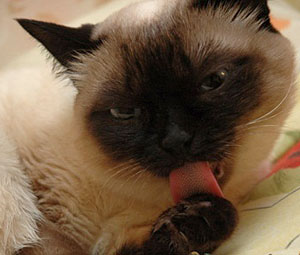
This breed of cat is the most popular of all the short haired cats, and is made distinctive by its long, slender body and triangular face. They also tend to have blue eyes and an unusual coat pattern. Their coat tends to become lighter around their neck and body but then darkens on the points of the cat, which are the ears, face, paws and tail.
When Siamese cats are born, they are only black and white. As they grow older, their coat color changes into the dark and light regions. Most Siamese cats are usually black due to a specific gene, and only the points appear in a different color. The points of this breed of cats comes in several colors, such as the blue point, the chocolate point, the seal point, the lilac point, the tabby point and the fawn point.
Siamese Cats – The cats with the most personality
Siamese cats are very temperamental and have outgoing personalities. They are the most social and friendly of all cat breeds. They are very talented at communication with humans. If you are looking for a quiet cat, then Siamese cats are not the way to go. They are extremely vocal and express themselves using their voices. While being affectionate their voices are easy on the ears but when feeling neglected they become quite loud.


Most Siamese cats are very playful and active. They are strangely curious and can be very intelligent. They get easily bored and therefore you should not leave them alone for significant periods of time because they will likely snooping around the house in search of something to play with. Pamper them with affection and lots of attention and they will be happy for your company. Their constant need for attention and admiration makes them great pets for a household with many people or with children.
Siamese cats are an affectionate but feisty breed. They will cuddle up with their owner while being aggressive toward anyone that they see as a threat. This can include other cats if they see that cat as a threat to their relationship with its owner. Even with their owner, they can be a little aggressive when in a playful mood.
Caring for a Siamese Cat
The only maintenance these breed of cats require physically is that they need to be bathed from time to time and their coats need to be brushed at least twice a month. Gentle brushing is sufficient as their hair is not very long. Siamese cats can live to be fifteen or twenty years old if they are well taken care of.
The History of Siamese Cats | Types of Siamese Cats | Physical attributes of the Siamese Cats | Siamese Cats – The cats with the most personality | Caring for a Siamese Cat
Manx Cat – the breed of cat from the Isle of Man
Tailless Breed Of Cat
Manx cat breeds were originally from the Isle of Man, off the coast of Great Britain, in the Irish Sea. The distinctive feature about this cat is that it does not have a tail, making it a unique breed of cat.
Manx – The Rounded Cat
These cats have round qualities, as they tend to have round faces, round bodies, round eyes, and can sometimes even be round pawed. The maturing of this cat takes place only very slowly, and they come in many patterns and colors.
Coat Of The Manx
A Manx cat has a thick coat which is actually a double coating, and thus it looks padded. The hair is very soft on the bottom coat, while the top coat is glossy. Their coat has to be brushed two or more times a week so that is stays shiny and glossy.
Body Structure Of Manx Cat Breed

The Manx has a solid compact body structure and is short backed with short and powerful legs to complement their rounded shape. Large headed and round, their nose is short and the widely spaced ears are set slightly outwards. They can weigh around eight to twelve pounds.
Different Types Of Manx Cat Breeds
These are the different types of Manx cat breeds…
- Rumpies – have no tails but just a dimple at the base of their spines. These are the show cats of the Manx cat breeds.
- Stumpies – these are short tailed Manx cats and their friendly demeanor makes them ideal pets
- Tailies – have naturally slightly kinked tails

Manx cats have a long lifespan as they can live up to fifteen years of age. The age factor in this breed of cat is known to be extended to twenty years with the best care and nutrition.
Manx cats don’t enjoy being left alone and prefer the company and attention of their owners. They get along well with other cats and children for this reason.
History And Progress of the Abyssinian Cat
History of the Abyssinian Cat
As far back as four thousand years ago, Abyssinian cats were a very original breed of cat in ancient Egypt. Zula was the first Abyssinian cat that was brought to Europe by a British soldier. This was quite after Britain’s victory over Abyssinia in 1868 during the Abyssinian war.
Arrival of the Abyssinian Cat in the USA
Although the Aby was brought to the United States in the 1900s, it only became popular around the 1930s. All around the world today, cat breed registries, such as The International Cat Association and The Cat Fanciers Association, recognize the Abyssinian cat. It is among the top five most popular cat breeds of the world.

Appearance and Characteristics of the Abyssinian Cat
The main characteristic that makes the Abyssinian different is due to a single gene that is present in the Abyssinian cat, which gives their coat a translucent effect. Their fur is a very fine texture rather than being of a soft quality which bears several dark bands over a lighter shade marking the coat evenly giving it a ticked coat pattern.
They are muscular cats with very long bodies and can weigh from around nine to about seventeen pounds. The Abyssinian’s eyes are large and they sport dark rims round their eyes over a background of a light shade of hair. The Aby’s large ears are cupped with tufts of fur at the tips. The Aby possesses slender legs with small paws. They also have long tails that can measure up to its entire length.
Abyssinians Are Curious And Athletic Cats!
Abyssinian cats are extremely motivated and curious. It is a good idea to child proof your cupboards and cabinets if you want to keep your inquisitive Abyssinian cats out of your belongings. They require a lot of attention, and prefer to be shown off by being perched high on your shoulder than curled up in your lap.
This breed of cat is extremely athletic and is capable of soaring to heights of six feet in the air and can sprint at an exceedingly fast pace. Unlike most cats, they enjoy climbing up onto things, so you’ll need to keep any breakable items out of harms way.
Attention Seekers

Abyssinian cats require lots of attention and care, as when they become bored you can find them climbing things and snooping around the house. Always keep them occupied if you wish to avoid such instances. These cats can be extremely loving and gentle. They love to perch on the owner’s shoulder rather than lay still curled up on your lap. They are very talkative and vociferous. They do not take well to being caged, and prefer being left to roam and explore. They can live to about ten or twelve years of age.
Abyssinian Cat Colors
Abyssinians are a special type of tabby cat by their beautiful ticked coat that makes them so unique. There are four colors of abyssinian breed wich recognized for championship by CFA: Ruddy, Red (Sorrel), Blue and Fawn.
Ruddy – this color of Abyssinian cat is most popular. Orange-brown, each hair ticked with two or three bands of either black or dark brown with a vibrant burnt orange color closest to the skin. Coat is warm brown ticked with black. Base color is deep orange. Tail tipped to black, paw pads are black, eyes are pure amber, green or gold, nose leather is brick red, outlined with black.
Red (Sorrel or Cinnamon) – warm copper red ticked with chocolate red-brown. Base color is deep apricot. Tail tipped with chocolate brown, nose leather and paw pads are rosy pink, eyes are pure amber, green or gold.
Blue – A warm soft blue-gray ticked with deeper blue. Base color is pale cream. Tail tipped with a deep shade of blue, paw pads are blue-grey, nose leather is dark pink, eyes are pure amber, green or gold.
Fawn – soft pinkish-cream color of coat, nose leather and paw pads are pink, eyes are pure amber, green or gold.
Abyssinian color types pictures


Facts about the Maine Coon Cat
Characteristics Of The Maine Coon Cat
- They have bunched paws and bushy tails.
- They can be as friendly as dogs are.
- They are very relaxed cats.
- They are fond of people and like being in their company.
- They are big-boned and have a barrel chest.
Where Did The Maine Coon Cat Come From?
There are several legends about how this cat breed came into being. The most popular one is that a British captain was sailing along the coast of New England and finally came into port. This was in the early 1800s, and the cats on board the ship mated with those on land, thereby resulting in the Maine Coon Cats being born.

It is also said that these cats originally belonged to Marie Antoinette. There is also a strong theory that they came with the Vikings and mated in the wilds with raccoons from which the name is derived.
However these cats came into being, what is obvious is that they are rising in popularity. They became included in professional cat shows and are now the second most popular cat breed. The breed is also recognized officially by the International Cat Association.
Do Maine Coon Cats Make Good Pets?

Maine coon cats are clever, energetic and playful.
They love being in families that have lots of other pets as well as children. They possess much more dexterity than regular cats, and are capable of scooping up objects, toys and food using their paws, almost like raccoons. This breed of cat can stretch themselves up and use their flexible paws to open doors using door knobs.
Physical Appearance Of The Maine Coon Cat
This breed of cat has a shaggy coat of fur that is weatherproof along with a full, puffy tail and ear tufts. All these traits help protect it during harsh winters. They have three different coats. – guard coats, fawn coats or down coats. Their heads are mostly square in shape, with large ears and expressive eyes that are wide set.
Main Coons are one of the most interesting breeds in the cat family. Considered the largest cat breed besides the hybrid Savannah Cat (which is the largest breed) the heaviest Maine Coon Cat was an astounding 34 pounds.
When compared to the typical housecat, which may weigh around 10 pounds, these surprisingly gentle cats are gentle giants in the land of felines.

Description Of A Siberian Cat
The History Of The Siberian Cat
The Siberian cat is a Russian cat that originated in Russia. The cat adapted to living in cities and urban areas when people migrated to the cities. The Siberian is Russia’s national cat. The Siberians first arrived in 1990 to the United States. In cities where the Siberian cat is found, it’s possible to mix with other feral cats. The Siberian has been accepted by the Feline registries.
Siberian Cats Profile
The Siberian cat is an agile jumper, and is very strongly built, big and powerful. It has rounded paws which are large and strong hindquarters. The Siberian cat has ears of medium size, barrel chest, broad foreheads and are built stockier which differentiates them from the Maine Coon and the Forrest cart breeds. It weighs between eleven to fifteen pounds in males and in female cats the weight is 9 to 12 pounds. Its main characteristics are being barrel chested and heavy boned cats. The Siberian cat takes as much as five years to become a full grown mature cat.
Attributes Of Siberian Cat Breed

Siberian cats possesses dog like devotion attributes such as being loyal, affectionate, playful and intelligent. It is called a gentle giant and enjoys the company of other pets and people. Siberians love to purr, they are quiet and mellow and extremely personable in nature. They are energetic and athletic creatures and very gentle around children.
Three Types Of Fur Of Siberian Cat
The Siberian cat has three types of fur known as guard hairs, awe hairs and down. Since it was initially a Russian cat these hairs provided protection during cold times while having a coat easy to care for. The fur is glossy and textured and matting of fur is rare. The Siberian too is of many colors such as Tabby, colorpoint and tortoiseshell. Their fur coat is not made up of unusual colorations and patters. Siberians of color point are known as Neva-Masquerade. Neva means the river which they originated from, and masquerade is for the mask.
Is The Siberian Cat Hypoallergenic?
The Siberian is reputed to be hypoallergenic, but unproven and it has been commented on for at least ten years. Scientific evidence is little in this regard, and female felines tend to affect allergy sufferers. Siberian cats tend to reproduce in as young as five months. Feral cats tend to die young. A Siberian cat litter includes between 5 and 6 kittens in comparison to a litter of three kittens on average. The Siberian cat father assists with kitten care as it is commonly known and makes excellent parents.
Ragdoll Cat: History, Personality, Colors, Care and Interesting Facts
The Ragdoll is a large, affectionate, semi-longhaired cat known for its striking blue eyes, pointed coloring, and calm, easygoing personality. Ragdolls are generally quiet, relaxed cats that enjoy being close to their people. Many like being held and carried, although the famous tendency to go completely limp in someone’s arms is not something every Ragdoll does.

Despite their gentle appearance and laid-back temperament, Ragdolls are substantial cats. They have long, muscular bodies, sturdy bone, broad chests, and silky coats that require much less grooming than their luxurious appearance might suggest.
History of the Ragdoll Cat
The Ragdoll is a relatively young American breed. It was developed during the 1960s by breeder Ann Baker in Riverside, California. The foundation of her breeding program was a white domestic longhaired cat named Josephine.
Josephine was not a documented Persian, Angora, or other established breed, despite stories that are sometimes repeated about her ancestry. Ann Baker selected descendants of Josephine and other domestic longhaired cats for their appearance and temperament, gradually creating the cats that became known as Ragdolls.
Among the important early cats were a seal mitted male named Daddy Warbucks, a black female named Buckwheat, and a seal bicolor female named Fugianna. In 1965, Raggedy Ann Kyoto and Raggedy Ann Tiki, offspring of Daddy Warbucks and Buckwheat, became the first registered Ragdolls.
Baker eventually created her own registry, the International Ragdoll Cat Association, and imposed strict rules on breeders working with her cats. During the 1970s, other breeders, particularly Denny and Laura Dayton, worked to gain wider recognition for the Ragdoll and helped establish the breed standard that formed the basis of its acceptance by major cat registries.
Why Are They Called Ragdolls?
The name Ragdoll came from reports that some cats in the original breeding lines became unusually relaxed when picked up, almost like a soft rag doll. This trait became one of the best-known stories associated with the breed. Many modern Ragdolls are certainly relaxed and comfortable with handling, and some do become very loose in a person’s arms. However, this is not a requirement of the breed and should never be used as a test of whether a cat is a “real” Ragdoll. An old myth also claimed that Ragdolls had an unusually high tolerance for pain. This is false and potentially dangerous. Ragdolls experience pain just like other cats and should always be handled with the same care and respect.
Ragdoll Colors and Patterns
Ragdolls are pointed cats, which means the face, ears, legs, feet, and tail are darker than the body. The contrast develops because the gene responsible for the pointed pattern affects pigment production according to temperature. Cooler areas of the body develop more color than warmer areas. This is also why Ragdoll kittens are born white or nearly white. Their points begin to darken after birth, and the coat continues developing in color for several years.
The three classic Ragdoll patterns are colorpoint, mitted, and bicolor.
Colorpoint: The ears, mask, legs, feet, and tail are clearly darker than the body. There are no white markings in the classic colorpoint pattern.
Mitted: The cat is pointed but has white mittens on the front feet, white on the hind legs, a white chin, and a white stripe running along the underside of the body. A small white blaze on the face may also occur.
Bicolor: The face has a characteristic white inverted V. The chest, belly, legs, and much of the underside are white, while the ears, tail, and portions of the face retain the point color.
There is one registry difference worth knowing. CFA also recognizes the Van pattern, in which most of the body and legs are white and the point color is largely restricted to the head and tail. Other major standards generally describe the traditional Ragdoll through the three patterns of colorpoint, mitted, and bicolor. Common point colors include seal, blue, chocolate, lilac, red, and cream. Lynx and tortie variations are also recognized in various combinations, depending on the registry.
Ragdoll Eyes Are Always Blue
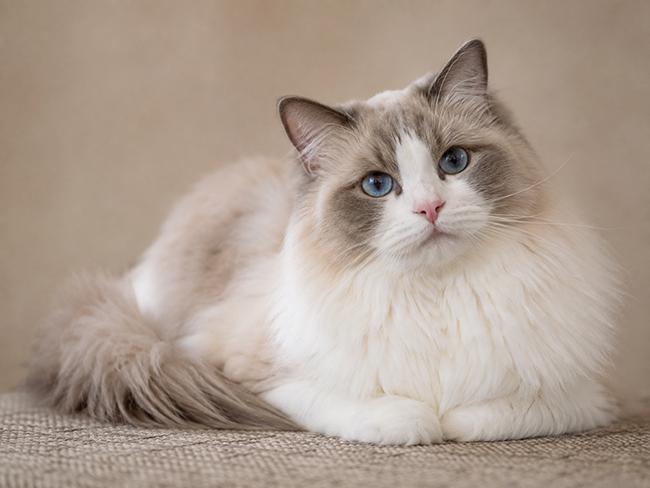
One of the most important characteristics of the Ragdoll is its blue eye color. The eyes should be large and oval, with a rich blue shade preferred.
Blue eyes are not simply a common feature that appears in some Ragdolls. They are part of the breed standard. Major registries including CFA, TICA, FIFe, and WCF define the modern Ragdoll as a blue-eyed pointed cat.
This distinction matters because cats are sometimes advertised as “Ragdolls” with green, gold, aqua, or other eye colors. Such cats may have Ragdoll ancestry or belong to related breeding programs, but they do not meet the standard definition of the Ragdoll in these registries.
Ragdoll, Cherubim and RagaMuffin Are Different Breeds
The Ragdoll is not another name for either the Cherubim or the RagaMuffin. The RagaMuffin developed from breeding lines historically related to the Ragdoll but became a separate breed with its own standard, broader range of colors, and different eye-color requirements.
Cherubim has a different relationship with the Ragdoll. Under the current TICA standard, the two belong to the same Ragdoll Breed Group and share the same general body and head type. However, the Ragdoll is the blue-eyed pointed breed, while Cherubim includes mink, sepia, and traditional-colored cats.
This distinction is especially useful when encountering terms such as “mink Ragdoll,” “sepia Ragdoll,” or “solid Ragdoll” in advertisements. Breed terminology can vary outside the show world, but under the current TICA standard those color categories belong to Cherubim rather than Ragdoll.
Physical Characteristics of the Ragdoll Cat
Ragdolls tend to be large cats with long, muscular bodies and substantial bone. The chest is broad, and the body should look powerful without appearing coarse or overweight. Adult males are usually noticeably larger than females. The head is a broad modified wedge with gently rounded contours rather than a completely round head. The ears are medium-sized, wide at the base, and slightly tilted forward. The eyes are large, oval, and blue. The paws are large and round, often with tufts of fur between the toes. The hind legs are slightly longer than the front legs, and the tail is long, bushy, and well furnished. The coat is semi-long, soft, and silky. A heavy woolly undercoat is not desirable. The fur is generally longer around the neck and on the hindquarters, where mature cats may develop a noticeable ruff and fluffy “britches.”
How Big Do Ragdoll Cats Get?
Ragdolls are among the larger pedigreed domestic cats. Females commonly weigh around 10 to 15 pounds, while adult males often reach 15 to 20 pounds and may occasionally exceed that range. They mature very slowly. A Ragdoll may not reach its full size and weight until around four years of age. Coat color also develops gradually during the first few years of life, and older cats commonly become darker while retaining contrast between the body and points.
Ragdoll Personality
Ragdolls are very quiet animals and often prefer a calm environment. They are known for being loving, trusting, and affectionate, and they usually enjoy spending time with their owners. Many Ragdolls follow their favorite people from room to room and like to settle nearby rather than remain alone in another part of the house. Their voices tend to be relatively soft, although every cat has an individual personality.
Ragdolls are intelligent and playful as well as calm. Kittens and young adults can be surprisingly energetic, while mature cats generally settle into a more moderate activity level. Many can learn to play fetch, come when called, or walk on a harness with patient training.
Are Ragdolls Good Pets?
Ragdoll cats are popular family companions because of their beautiful appearance, gentle nature, and affectionate personality. They are generally friendly and sociable, and many get along well not only with their owners but also with visitors, children, other cats, and cat-friendly dogs.
Ragdolls often enjoy being held and carried and are usually happiest when they can spend plenty of time with their people. Their relaxed temperament does not mean they should be treated like toys, however. Even the gentlest cat needs the freedom to walk away, rest undisturbed, and choose when it wants physical contact. Their size should also be taken into account around young children. A large adult male can weigh close to 20 pounds, so children should be taught how to handle the cat safely rather than trying to carry it without support.
How Much Grooming Does a Ragdoll Need?
Despite their semi-long coats, Ragdolls need relatively little maintenance compared with many heavily coated breeds. The silky coat has relatively little woolly undercoat, which helps reduce severe matting. Combing once or twice a week is usually enough to remove loose hair and small tangles. More frequent grooming can be helpful during seasonal shedding. Pay particular attention to areas under the front legs, around the belly, and on the hindquarters. Regular nail trimming, dental care, and routine checks of the ears and eyes should also be part of normal care.
Ragdoll Health
Ragdolls are generally robust cats, but the breed has an important inherited health concern: hypertrophic cardiomyopathy, or HCM. This disease causes abnormal thickening of the heart muscle and can vary greatly in severity. A specific variant in the MYBPC3 gene associated with HCM has been identified in Ragdolls, and a DNA test is available. Responsible breeders use genetic testing as one tool for reducing the risk of producing affected cats. A negative result for the known Ragdoll mutation does not guarantee that a cat can never develop HCM. Heart disease can have other genetic or non-genetic causes, so veterinary screening and responsible breeding decisions remain important. Ragdolls can also gain excess weight if their calm lifestyle is combined with too many calories and too little activity. Their natural large size and the small fatty pad permitted on the lower abdomen should not be confused with obesity.
Choosing a Ragdoll Kitten
Blue eyes, a pointed coat, and a fluffy appearance are not enough to prove that a kitten is a pedigreed Ragdoll. Breed ancestry should be supported by registration and pedigree records. A responsible breeder should be able to explain the health history of the parents, provide relevant documentation, and discuss genetic testing for the known Ragdoll HCM mutation. Kittens should be well socialized, active, and raised in a clean environment with appropriate veterinary care.
Do not judge a young Ragdoll by how dark its points are. Kittens are born very pale, and the final coat color develops gradually. Body size, coat, and overall maturity also continue changing for several years.
Interesting Facts About Ragdoll Cats
- The breed originated in California. Ann Baker developed the Ragdoll in Riverside during the 1960s.
- The foundation cat was named Josephine. She was a white domestic longhaired cat rather than a documented member of another pedigreed breed.
- The first registered Ragdolls appeared in 1965. They were Raggedy Ann Kyoto and Raggedy Ann Tiki.
- The name comes from the “rag doll” story. Some of the original cats reportedly relaxed dramatically when held.
- Not every Ragdoll goes limp. This behavior is not required by the breed standard.
- Ragdolls do not have reduced sensitivity to pain. Claims that they tolerate pain unusually well are a dangerous myth.
- Ragdoll kittens are born very pale. Their point color develops after birth.
- They have blue eyes. Blue eye color is a defining feature of the modern breed standard.
- Ragdolls mature slowly. Full adult size may not be reached until around four years of age.
- Their coats are easier to maintain than they look. The silky texture and limited woolly undercoat usually make weekly combing sufficient.
- They are often compared with dogs. Many Ragdolls follow their people around and can learn games such as fetch.
- RagaMuffin is not another name for Ragdoll. It is a separate breed with a related history.
- TICA now distinguishes Ragdoll from Cherubim. The Ragdoll remains blue-eyed and pointed, while mink, sepia, and traditional colors belong to Cherubim within the same breed group.
Is a Ragdoll Cat Right for You?
A Ragdoll can be an excellent choice for someone looking for a large, affectionate cat with a calm personality and a beautiful semi-long coat. They generally enjoy human company, adapt well to family life, and remain playful without usually becoming excessively demanding or hyperactive. They do need regular interaction, play, grooming, appropriate veterinary care, and enough space and equipment for a large cat. A sturdy cat tree, roomy litter box, and properly sized carrier are much more practical for an adult Ragdoll than equipment designed for a small cat.
What makes the Ragdoll distinctive is the combination of substantial size, silky fur, pointed coloring, vivid blue eyes, and a gentle temperament. The breed’s famous name may come from its tendency to relax in human arms, but a modern Ragdoll is much more than a cat that “goes limp.”

About the Sphynx Cat
Characteristics possessed by the Sphynx Cat
- Sphynx is a very inquisitive cat.
- Sphynx can be playful and naughty.
- Sphynx is a clever breed of cat that shows intelligent characteristics.
- Their devotion to their owners have dubbed them to be called “Love Mooch’
The Origins Of The Sphynx Cat
Sphynx cats came from Toronto, Canada, after a domestic pet cat gave birth to a kitten that was hairless. Eventually the cats were taken to America, Europe and they grew in popularity. This breed of cats is the seventh most popular cat breed based on Cat Fanciers Association.
What Makes Sphynx Cats So Unique?
The Sphynx cat is unique because it has very little or no hair on its body. It is often referred to as the ‘feline alien’ for its strange, small face, large bat-like ears, wrinkled skin, a potbelly and almost no hair. Some types of Sphynx cats have no whiskers or eyebrows as well.

The hairless appearance of this breed of cats is so unusual that people feel the need to touch the cat upon seeing it to see what it feels like to touch them. Touching the body of this cat usually feels similar to touching some warm leather. There is always a soft layer of light down found on its coat. Female Sphynx cats weigh around seven to nine pounds while the males weight around eight to nine pounds.
Do Sphynx Cats Make Good Pets?
Sphynx cats have a large amount of energy and love being admired. They are very friendly to all people, new and familiar. When sleeping they will usually find a warm place such as under the bedcovers or near a heater. They have voracious appetites and are known for their high metabolism. It is not uncommon for them to eat large portions of food. Sphynx cats also need care to make sure their ears do not have oil deposits. Although hairless, their dander can bring allergic reactions about in some people who are allergic to cats.
Caring for a Sphynx Cat
Since Sphynx cat breed have no coat of fur, they need to ensure that they do not lose too much heat. As a result Sphynx cats tend to curl up under blankets and clothes, and many feline stores sell clothing meant especially to keep these cats warm and cozy. You obviously don’t need a brush to maintain these cats’ appearance, but sponging their bodies daily is recommended to keep their natural oils off your furniture. Their bodies are susceptible to sunburn, so make sure they do not go out into the sun often, or without cat-safe sunscreen.
About the Russian Blue Cat (Archangel Cat)
Russian Blue (Archangel Cat): The Silver-Blue Cat with Emerald Eyes

The Russian Blue combines a shimmering silver-blue coat, vivid green eyes, and a graceful, athletic body with a quiet but deeply affectionate personality. These cats often appear reserved when meeting someone new, yet they form strong bonds with the people they trust. Intelligent, observant, and playful, the Russian Blue tends to study a situation before joining in, as though every household event requires a brief feline security review.
Russian Blue at a Glance
- International name: Russian Blue
- Historical name: Archangel Cat
- Coat length: short
- Country of origin: Russia; the modern breed was further developed in Britain, Scandinavia, and North America
- WCF code: RUS
- WCF category: 3 – Shorthair
- Size: medium
- Weight: approximately 5–11 pounds, with males generally larger than females
- Life expectancy: approximately 12–16 years, sometimes longer
- Activity level: moderate; athletic, agile, and energetic during play
- Social behavior: devoted to family, often cautious with unfamiliar people
- Affection level: affectionate and loyal without usually being demanding
- Notable traits: dense double coat with silver tipping, vivid green eyes, quiet voice, high intelligence, and a preference for familiar routines
Origin of the Russian Blue
The exact origin of the Russian Blue has never been fully documented. The breed is generally believed to descend from blue cats found in northern Russia, particularly around the port city of Arkhangelsk on the White Sea. Their unusually dense double coat may have helped local cats tolerate the region’s cold climate, although there is no continuous pedigree connecting today’s show cats to a particular early Russian population.
Stories sometimes claim that these cats lived in the Russian imperial court, were treasured by czars, or were presented to European royalty. Russian folklore has also associated blue cats with good luck and healing. These accounts add color to the breed’s history, but they should be treated as legends rather than proof of royal ancestry.
More reliable records begin in Britain during the late nineteenth century, when blue cats believed to have arrived from northern Russia appeared at early cat shows. Sailors traveling from Arkhangelsk may have brought some of them to England. They were known as Archangel Cats, a name derived from the English form of Arkhangelsk, and initially competed alongside other solid blue shorthaired cats.
In 1912, the slender blue cats of foreign type were given their own show class under the name Foreign Blue. The breed was also known at different times as Russian Shorthair or simply Russian, but Russian Blue eventually became the internationally established name.
Why Is It Called the Archangel Cat?
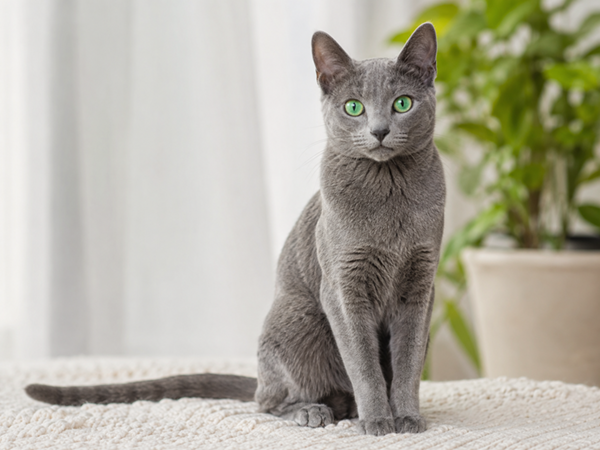
Archangel Cat is a historical English name connected to Arkhangelsk, whose name was traditionally rendered as Archangel in English. It does not refer to the cat’s temperament, eye color, or an association with angels, although the silver coat and serene expression make the interpretation tempting.
Today, major registries use Russian Blue as the official breed name. Archangel Cat remains a useful historical alternative and a meaningful part of the breed’s identity, especially when discussing its presumed northern Russian origins.
Development of the Modern Breed
The two world wars severely reduced pedigreed cat populations in Europe. After World War II, breeders working to preserve the Russian Blue used other cats with compatible traits. In Britain, some breeding programs introduced blue British Shorthairs to reinforce the pale, dense coat and physical strength. Other breeders used blue-point Siamese cats to restore the long body, fine legs, large ears, and elegant head shape.
These crossings helped the breed survive, but they also changed its appearance. Some lines became too slender and Siamese-like, while others developed heavier bodies and rounder heads. Scandinavian breeders developed cats with darker coats, triangular heads, and especially vivid green eyes.
North American breeders later combined English and Scandinavian lines, selecting for a balanced cat with an elegant but muscular body, a dense silver-tipped coat, large ears, and bright green eyes. The modern Russian Blue is therefore a carefully developed international breed founded on cats believed to be of Russian origin, not an unchanged relic preserved since the time of the czars.
Not Every Blue Cat Is a Russian Blue
Blue is the feline term for a diluted form of black. This color occurs in many pedigreed breeds and in countless domestic cats without pedigrees. A gray-blue coat, greenish eyes, or a slender body alone does not identify a cat as a Russian Blue.
A pedigreed Russian Blue is defined by documented ancestry and a specific combination of traits, including body structure, head shape, ear placement, eye color, coat texture, and silver tipping. A rescued or stray blue cat may be beautiful and may resemble the breed closely, but without registration records it is more accurate to describe it as a blue domestic shorthair or a possible Russian Blue mix.
Russian Blue Compared With Other Blue Cat Breeds
The Russian Blue is often confused with the Chartreux, British Shorthair, and Korat. All may have solid blue-gray coats, but their structures and coat types are distinctly different.
The British Shorthair has a heavier, more compact body, a broad round head, smaller widely spaced ears, and usually copper or orange eyes. Its coat is dense and plush, but the cat lacks the elongated, fine-boned outline and vivid green eyes expected in a Russian Blue.
The Chartreux is a robust French breed with full cheeks, a trapezoidal head, a slightly woolly coat, and gold, amber, or copper eyes. It is heavier and more powerfully built than the Russian Blue.
The Korat has a muscular body, a heart-shaped head, large green eyes, and a close-lying single coat. The Russian Blue has a particularly dense double coat that stands away from the body and creates a softer, more plush outline.
Russian Blue Appearance
The Russian Blue is a medium-sized cat with a slightly elongated, graceful body and firm, well-developed muscles. It should look refined without appearing fragile, underweight, or excessively narrow. The body is lithe and athletic rather than heavy or compact.
The neck is long and slender, although the dense coat and high shoulder blades may make it look shorter. The legs are long and fine-boned but strong, ending in small, slightly rounded or oval paws. The tail is long and proportionate to the body, tapering gradually from a moderately thick base.
Males are generally larger and more substantial than females, but even an adult male should retain the breed’s characteristic elegance. A heavy, broad-chested cat with a round head would resemble a British Shorthair more than a correct Russian Blue.
Head and Characteristic Smile
The head forms a smooth medium wedge with clean, straight lines. It is neither long and sharply tapering nor short and massive. The top of the skull is long and relatively flat, flowing into a straight nose without a pronounced break or stop.
High cheekbones and the meeting of the muzzle and facial planes create the Russian Blue’s famous subtle smile. The expression is enhanced by widely spaced eyes and a firm chin. The face should appear alert, intelligent, and gently amused rather than narrow, pinched, or severe.
Breed standards vary slightly in how they describe the exact planes of the head, but they agree on the overall impression: sculpted straight lines, a medium wedge, and harmonious proportions without Siamese exaggeration or British roundness.
Ears
The ears are large and broad at the base, with tips that are more pointed than rounded. They are set far apart and may angle slightly outward or forward, depending on the registry’s preferred type.
The ear leather is thin, and the inner surface has very little hair. This can make the ears look almost translucent when light passes through them. Their size and placement contribute strongly to the breed’s attentive, alert expression.
Emerald-Green Eyes
The eyes of an adult Russian Blue should be vivid green. Depending on the registry, their shape may be described as rounded, oval, or almond-shaped, but they are always set widely apart and should appear large and expressive.
Green eyes are not a recent novelty, and yellow eyes are not the usual adult standard. Kittens are born with blue eyes that gradually change through yellowish or yellow-green stages. A green ring normally begins to develop around the pupil during kittenhood, while the final intensity of the eye color may continue to improve as the cat matures.
Adult yellow, orange, or copper eyes are characteristic of other blue breeds and do not meet the principal Russian Blue standards.
The Dense Double Coat
The Russian Blue’s coat is one of its defining features. It is short, fine, soft, and unusually dense. The undercoat and guard hairs are approximately equal in length, producing a true double coat that stands away from the body rather than lying flat.
When a finger is drawn through the coat, the impression may remain visible until the hair is smoothed again. This plush resilience distinguishes the Russian Blue from breeds with a sleek, close-lying coat.
The coat should feel silky rather than coarse or woolly. It must remain short and should not form a ruff, long tufts, or flowing sections. A sparse, flat, or noticeably long coat does not match the traditional breed type.
Blue Color and Silver Tipping
The traditional Russian Blue has an even blue coat of medium intensity. In cat terminology, blue is a cool gray color produced by dilution of black pigment. The preferred shade is clear and uniform, without rusty patches, brown tones, white hairs, or visible markings.
The tips of the guard hairs are lightly silvered. These pale ends reflect light and create the breed’s characteristic shimmer, especially when the cat moves or stands in sunlight. The effect is silver tipping on a blue coat, not a separate silver tabby or shaded color pattern.
The nose leather is blue-gray, while the paw pads are typically lavender-pink or dark lavender. Faint tabby markings may be visible in young kittens but should disappear as the adult coat develops. White lockets or spots are not accepted in the traditional Russian Blue.
Are There Black and White Russian Cats?
Recognition depends on the registry. CFA, TICA, and FIFe recognize the Russian Blue only in blue and only with short hair. In these organizations, a black or white cat cannot compete as a Russian Blue.
WCF and GCCF recognize a broader Russian group that includes blue, black, and white varieties. These may be called Russian Black and Russian White. The differences reflect registry policy rather than disagreement about the appearance of the traditional Russian Blue.
For readers in the United States, the name Russian Blue almost always means the blue, silver-tipped cat with green eyes recognized by CFA and TICA.
Russian Blue Personality
Russian Blues are usually intelligent, observant, and devoted to their families. Many prefer to watch unfamiliar people from a safe place before approaching. This reserve is sometimes described as shyness or aloofness, but a well-socialized Russian Blue is often affectionate and playful once it feels secure.
These cats commonly follow their people from room to room, settle nearby during quiet activities, and seek attention without demanding it continuously. Some enjoy laps or riding on a trusted person’s shoulder, while others prefer to remain close without being held.
Individual temperament depends on genetics, early socialization, and experience. A confident kitten raised with gentle handling may welcome visitors after a short introduction, while a poorly socialized cat may remain fearful. No personality trait should be treated as guaranteed simply because of breed.
Routine, Order, and Change
Many Russian Blues appreciate predictable routines. They quickly learn feeding times, play schedules, and the sound of a familiar person returning home. Some will wait near the food bowl several minutes before dinner, just in case the human clock requires correction.
A preference for routine does not mean the breed cannot adapt to moving, visitors, children, or another pet. Changes are simply easier when introduced gradually, with familiar beds, hiding places, food dishes, and litter boxes kept available.
Russian Blues are often fastidious about their surroundings. A dirty litter box may be rejected, especially in a multi-cat home, so regular scooping and an adequate number of boxes are important.
Intelligence and Play
The Russian Blue is a capable problem solver. These cats watch people closely and may learn how drawers, cabinets, doors, or treat containers work. Food puzzles and interactive toys provide useful mental exercise and give that mechanical curiosity a safer destination.
Many Russian Blues enjoy retrieving toys, chasing teaser wands, climbing to high observation points, and learning simple cues. They may appear calm while resting, then transform into swift athletes as soon as an interesting toy moves across the floor.
A tall, stable cat tree, scratching posts, window perches, tunnels, and several short daily play sessions help maintain muscle tone and prevent boredom. Scratching is normal feline behavior, so even a notably well-mannered Russian Blue needs appropriate scratching surfaces.
Can a Russian Blue Be Left Alone?
A Russian Blue can generally spend part of the day alone in a safe, enriched home. Many are less demanding than highly vocal or intensely social breeds and will use quiet time to sleep or observe the world from a favorite perch.
That independence should not be mistaken for emotional detachment. Russian Blues form close bonds and need daily play, affection, and interaction. Regularly leaving any cat alone for very long periods without companionship or enrichment can lead to boredom and stress.
Children and Other Pets
A well-socialized Russian Blue can live successfully with considerate children, other cats, and cat-friendly dogs. The breed often does best with children who understand that a cautious cat should be allowed to approach on its own terms.
Rough handling, chasing, and forced cuddling may cause the cat to hide or avoid interaction. Children should learn to respect the cat’s resting places and leave it alone while eating or using the litter box.
New pets should be introduced gradually. Each animal needs separate food and water bowls, resting areas, litter boxes, and opportunities to retreat. Breed reputation cannot guarantee that two individual animals will immediately become friends.
Who Is the Russian Blue Best Suited For?
The Russian Blue may be an excellent match for someone seeking a graceful, intelligent, affectionate cat that does not constantly demand attention. The breed can adapt to apartments and larger homes as long as it receives play, climbing opportunities, and regular human companionship.
It often suits individuals, couples, families with respectful older children, and people who work outside the home for part of the day. A quieter environment may help a cautious cat settle more quickly, although well-socialized Russian Blues can also thrive in active households.
The breed may be less suitable for someone expecting a cat to greet every stranger immediately or tolerate being carried whenever a person chooses. Trust is one of the Russian Blue’s treasures, and the cat generally prefers to award it rather than have it requisitioned.
Grooming
The Russian Blue’s short coat is relatively easy to maintain. Gentle brushing or combing once a week is usually sufficient to remove loose hair and keep the dense coat in good condition. During seasonal shedding, slightly more frequent grooming may be useful.
Aggressive deshedding tools can remove too much undercoat and alter the coat’s characteristic texture. Bathing is rarely necessary unless the coat becomes unusually oily or contaminated with something the cat should not lick.
Nails should be trimmed regularly, ears checked for debris, and teeth brushed with toothpaste made for cats. Routine coat care also provides an opportunity to notice lumps, skin irritation, parasites, or changes in body condition.
Is the Russian Blue Hypoallergenic?
The Russian Blue is frequently promoted as a hypoallergenic breed or as a cat that produces unusually little Fel d 1, the major feline allergen. There is no reliable evidence that every Russian Blue consistently produces less allergen than other cats.
Cat allergens occur in saliva, skin particles, and other secretions, not simply in the fur. All cats produce allergens, and individual allergen levels can vary considerably within the same breed. A short coat and limited visible shedding do not make a cat allergy-free.
Someone with cat allergies should spend time with the specific cat before making a commitment and discuss the risks with an allergist. A mild reaction during one short visit does not guarantee that symptoms will remain mild after continuous exposure at home.
Feeding and Weight Management
Russian Blues are often enthusiastic about food and can gain excess weight when portions are not controlled. Their elegant outline should be supported by firm muscle, not hidden under a soft layer of body fat.
Feed a complete and balanced diet appropriate for the cat’s age, health, and activity level. Measure portions, include treats in the daily calorie total, and monitor body condition rather than relying only on the number shown by a scale.
The ribs should be easy to feel beneath a thin layer of tissue, and a waist should remain visible from above. Daily play helps maintain muscle and reduces the health risks associated with obesity. Fresh drinking water should always be available.
Russian Blue Health
The Russian Blue is generally regarded as a healthy breed, and major registries do not identify a single genetic disorder known to affect a large proportion of the breed. This does not mean that every Russian Blue is immune to inherited or acquired disease.
The breed’s relatively limited gene pool makes careful pedigree management important. Responsible breeders track the health and longevity of related cats, avoid excessive inbreeding, and arrange appropriate veterinary examinations for their breeding animals.
Obesity is one of the most practical health concerns because many Russian Blues have strong appetites. Excess weight increases the risk of diabetes, joint problems, and other disorders and may shorten a cat’s healthy lifespan.
Every Russian Blue needs routine veterinary examinations, vaccination, parasite prevention, dental care, and monitoring of appetite, weight, mobility, urination, and behavior. The absence of a required breed-specific DNA test does not make preventive care optional.
Choosing a Russian Blue Kitten
Choose a breeder who registers litters, provides a pedigree and veterinary records, and discusses health and temperament openly. Ask about the health and longevity of the parents and close relatives, the breeder’s approach to genetic diversity, and how the kittens have been socialized.
A healthy kitten should be active, curious, and able to move freely. The eyes and ears should be clean, breathing should be quiet, and the coat should be dense and well maintained. Some caution around a stranger is acceptable, but a kitten should not remain panicked, unreachable, or completely unaccustomed to human contact.
The final green eye color may not be fully developed in a young kitten. Look for the beginning of green around the pupil and evaluate the entire cat rather than choosing only by eye color or the palest possible coat.
Be cautious when a seller labels any gray kitten a Russian Blue without documentation. A blue coat is common in domestic cats. Breed identity is established by pedigree, not by a photograph, a shelter label, or an especially persuasive shade of gray.
Interesting Facts About the Russian Blue
- Archangel Cat is a historical name. It refers to Arkhangelsk, the northern Russian port associated with the breed’s presumed origin.
- The breed was once called Foreign Blue. In 1912, blue cats of the foreign type received a separate British show class.
- The modern Russian Blue combines several European lines. North American breeders blended English and Scandinavian cats to establish today’s balanced type.
- The coat is blue, not genetically silver. Its sparkling appearance comes from pale silver tipping on the ends of blue hairs.
- The undercoat and guard hairs are nearly the same length. This produces the dense texture that stands away from the body.
- The coat can retain temporary finger marks. Patterns drawn through the fur may remain visible until the coat is smoothed again.
- Green eyes develop gradually. Kittens pass through changing eye colors before reaching the vivid green expected in adults.
- Faint kitten stripes may disappear with age. Temporary ghost tabby markings can be visible before the mature coat develops.
- The subtle smile comes from facial structure. The angles of the cheekbones and muzzle create the breed’s characteristic expression.
- Not all registries recognize the same colors. CFA, TICA, and FIFe accept only blue, while WCF and GCCF also recognize Russian Black and Russian White.
- The Nebelung is a related longhaired breed. It shares the blue color and silver tipping but has a semi-long coat.
- The Russian Blue is not proven hypoallergenic. All cats produce allergens, regardless of coat length or breed reputation.
The Russian Blue, historically known as the Archangel Cat, is much more than a beautiful gray cat. Its silver-tipped double coat, emerald-green eyes, sculpted head, and graceful body belong to a carefully preserved breed with a complex international history. Given time to build trust, the Russian Blue becomes an affectionate, playful, and quietly devoted companion whose presence is elegant without ever fading into the background.
What would you like to see added to meow-cats.com?
- Funny cat videos (20%, 118 Votes)
- Ask a vet online (15%, 87 Votes)
- Classifieds for buying and selling cats (13%, 79 Votes)
- More useful articles on feline topics (13%, 76 Votes)
- Online cat memorial (11%, 63 Votes)
- Forum for cat lovers (8%, 49 Votes)
- Breeder and cattery ads (8%, 48 Votes)
- Veterinary clinic ads (7%, 41 Votes)
- Cat boarding and boarding cattery ads (6%, 38 Votes)
Total Voters: 273
 Loading ...
What are your 3 favorite cat breeds?
- Siamese Cat (11%, 184 Votes)
- Maine Coon (7%, 116 Votes)
- Bengal Cat (7%, 111 Votes)
- American Shorthair (6%, 104 Votes)
- Ragdoll (5%, 81 Votes)
- Persian Cat (5%, 79 Votes)
- Russian Blue (4%, 74 Votes)
- Egyptian Mau (4%, 68 Votes)
- Munchkin (4%, 61 Votes)
- Scottish Fold (4%, 61 Votes)
- Abyssynian (4%, 58 Votes)
- Other... (3%, 56 Votes)
- Norwegian Forest Cat (3%, 55 Votes)
- Turkish Angora (3%, 55 Votes)
- Siberian Cat (3%, 55 Votes)
- Himalayan Cat (3%, 53 Votes)
- British Shorthair (3%, 48 Votes)
- A Breedless Cat (2%, 40 Votes)
- Ocicat (2%, 40 Votes)
- Savannah Cat (2%, 39 Votes)
- Sphynx (2%, 38 Votes)
- Birman Cat (2%, 28 Votes)
- American Bobtail (2%, 25 Votes)
- Bombay Cat (1%, 23 Votes)
- Burmese Cat (1%, 21 Votes)
- Manx Cat (1%, 17 Votes)
- Havana Brown (1%, 16 Votes)
- Balinese Cat (1%, 12 Votes)
- Devonshire Rex (1%, 11 Votes)
- Singapura (1%, 9 Votes)
- Cornish Rex (0%, 7 Votes)
- Thai Cat (0%, 7 Votes)
- Donskoy Cat (0%, 1 Votes)
Total Voters: 661
Loading ...