Ragdoll Cat
Ragdoll Cat: History, Personality, Colors, Care and Interesting Facts
The Ragdoll is a large, affectionate, semi-longhaired cat known for its striking blue eyes, pointed coloring, and calm, easygoing personality. Ragdolls are generally quiet, relaxed cats that enjoy being close to their people. Many like being held and carried, although the famous tendency to go completely limp in someone’s arms is not something every Ragdoll does.

Despite their gentle appearance and laid-back temperament, Ragdolls are substantial cats. They have long, muscular bodies, sturdy bone, broad chests, and silky coats that require much less grooming than their luxurious appearance might suggest.
History of the Ragdoll Cat
The Ragdoll is a relatively young American breed. It was developed during the 1960s by breeder Ann Baker in Riverside, California. The foundation of her breeding program was a white domestic longhaired cat named Josephine.
Josephine was not a documented Persian, Angora, or other established breed, despite stories that are sometimes repeated about her ancestry. Ann Baker selected descendants of Josephine and other domestic longhaired cats for their appearance and temperament, gradually creating the cats that became known as Ragdolls.
Among the important early cats were a seal mitted male named Daddy Warbucks, a black female named Buckwheat, and a seal bicolor female named Fugianna. In 1965, Raggedy Ann Kyoto and Raggedy Ann Tiki, offspring of Daddy Warbucks and Buckwheat, became the first registered Ragdolls.
Baker eventually created her own registry, the International Ragdoll Cat Association, and imposed strict rules on breeders working with her cats. During the 1970s, other breeders, particularly Denny and Laura Dayton, worked to gain wider recognition for the Ragdoll and helped establish the breed standard that formed the basis of its acceptance by major cat registries.
Why Are They Called Ragdolls?
The name Ragdoll came from reports that some cats in the original breeding lines became unusually relaxed when picked up, almost like a soft rag doll. This trait became one of the best-known stories associated with the breed. Many modern Ragdolls are certainly relaxed and comfortable with handling, and some do become very loose in a person’s arms. However, this is not a requirement of the breed and should never be used as a test of whether a cat is a “real” Ragdoll. An old myth also claimed that Ragdolls had an unusually high tolerance for pain. This is false and potentially dangerous. Ragdolls experience pain just like other cats and should always be handled with the same care and respect.
Ragdoll Colors and Patterns
Ragdolls are pointed cats, which means the face, ears, legs, feet, and tail are darker than the body. The contrast develops because the gene responsible for the pointed pattern affects pigment production according to temperature. Cooler areas of the body develop more color than warmer areas. This is also why Ragdoll kittens are born white or nearly white. Their points begin to darken after birth, and the coat continues developing in color for several years.
The three classic Ragdoll patterns are colorpoint, mitted, and bicolor.
Colorpoint: The ears, mask, legs, feet, and tail are clearly darker than the body. There are no white markings in the classic colorpoint pattern.
Mitted: The cat is pointed but has white mittens on the front feet, white on the hind legs, a white chin, and a white stripe running along the underside of the body. A small white blaze on the face may also occur.
Bicolor: The face has a characteristic white inverted V. The chest, belly, legs, and much of the underside are white, while the ears, tail, and portions of the face retain the point color.
There is one registry difference worth knowing. CFA also recognizes the Van pattern, in which most of the body and legs are white and the point color is largely restricted to the head and tail. Other major standards generally describe the traditional Ragdoll through the three patterns of colorpoint, mitted, and bicolor. Common point colors include seal, blue, chocolate, lilac, red, and cream. Lynx and tortie variations are also recognized in various combinations, depending on the registry.
Ragdoll Eyes Are Always Blue
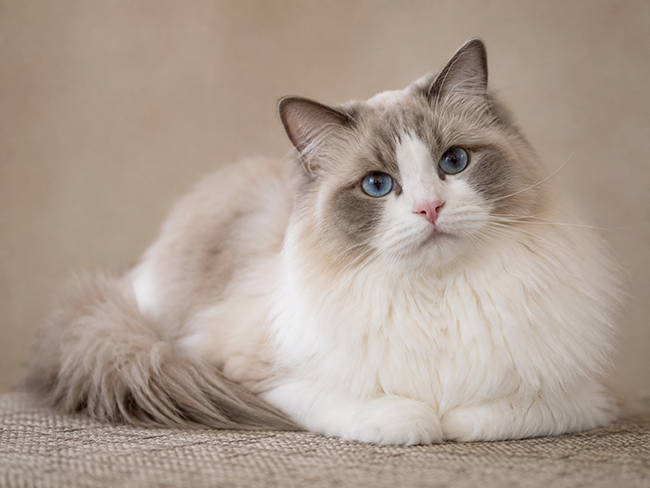
One of the most important characteristics of the Ragdoll is its blue eye color. The eyes should be large and oval, with a rich blue shade preferred.
Blue eyes are not simply a common feature that appears in some Ragdolls. They are part of the breed standard. Major registries including CFA, TICA, FIFe, and WCF define the modern Ragdoll as a blue-eyed pointed cat.
This distinction matters because cats are sometimes advertised as “Ragdolls” with green, gold, aqua, or other eye colors. Such cats may have Ragdoll ancestry or belong to related breeding programs, but they do not meet the standard definition of the Ragdoll in these registries.
Ragdoll, Cherubim and RagaMuffin Are Different Breeds
The Ragdoll is not another name for either the Cherubim or the RagaMuffin. The RagaMuffin developed from breeding lines historically related to the Ragdoll but became a separate breed with its own standard, broader range of colors, and different eye-color requirements.
Cherubim has a different relationship with the Ragdoll. Under the current TICA standard, the two belong to the same Ragdoll Breed Group and share the same general body and head type. However, the Ragdoll is the blue-eyed pointed breed, while Cherubim includes mink, sepia, and traditional-colored cats.
This distinction is especially useful when encountering terms such as “mink Ragdoll,” “sepia Ragdoll,” or “solid Ragdoll” in advertisements. Breed terminology can vary outside the show world, but under the current TICA standard those color categories belong to Cherubim rather than Ragdoll.
Physical Characteristics of the Ragdoll Cat
Ragdolls tend to be large cats with long, muscular bodies and substantial bone. The chest is broad, and the body should look powerful without appearing coarse or overweight. Adult males are usually noticeably larger than females. The head is a broad modified wedge with gently rounded contours rather than a completely round head. The ears are medium-sized, wide at the base, and slightly tilted forward. The eyes are large, oval, and blue. The paws are large and round, often with tufts of fur between the toes. The hind legs are slightly longer than the front legs, and the tail is long, bushy, and well furnished. The coat is semi-long, soft, and silky. A heavy woolly undercoat is not desirable. The fur is generally longer around the neck and on the hindquarters, where mature cats may develop a noticeable ruff and fluffy “britches.”
How Big Do Ragdoll Cats Get?
Ragdolls are among the larger pedigreed domestic cats. Females commonly weigh around 10 to 15 pounds, while adult males often reach 15 to 20 pounds and may occasionally exceed that range. They mature very slowly. A Ragdoll may not reach its full size and weight until around four years of age. Coat color also develops gradually during the first few years of life, and older cats commonly become darker while retaining contrast between the body and points.
Ragdoll Personality
Ragdolls are very quiet animals and often prefer a calm environment. They are known for being loving, trusting, and affectionate, and they usually enjoy spending time with their owners. Many Ragdolls follow their favorite people from room to room and like to settle nearby rather than remain alone in another part of the house. Their voices tend to be relatively soft, although every cat has an individual personality.
Ragdolls are intelligent and playful as well as calm. Kittens and young adults can be surprisingly energetic, while mature cats generally settle into a more moderate activity level. Many can learn to play fetch, come when called, or walk on a harness with patient training.
Are Ragdolls Good Pets?
Ragdoll cats are popular family companions because of their beautiful appearance, gentle nature, and affectionate personality. They are generally friendly and sociable, and many get along well not only with their owners but also with visitors, children, other cats, and cat-friendly dogs.
Ragdolls often enjoy being held and carried and are usually happiest when they can spend plenty of time with their people. Their relaxed temperament does not mean they should be treated like toys, however. Even the gentlest cat needs the freedom to walk away, rest undisturbed, and choose when it wants physical contact. Their size should also be taken into account around young children. A large adult male can weigh close to 20 pounds, so children should be taught how to handle the cat safely rather than trying to carry it without support.
How Much Grooming Does a Ragdoll Need?
Despite their semi-long coats, Ragdolls need relatively little maintenance compared with many heavily coated breeds. The silky coat has relatively little woolly undercoat, which helps reduce severe matting. Combing once or twice a week is usually enough to remove loose hair and small tangles. More frequent grooming can be helpful during seasonal shedding. Pay particular attention to areas under the front legs, around the belly, and on the hindquarters. Regular nail trimming, dental care, and routine checks of the ears and eyes should also be part of normal care.
Ragdoll Health
Ragdolls are generally robust cats, but the breed has an important inherited health concern: hypertrophic cardiomyopathy, or HCM. This disease causes abnormal thickening of the heart muscle and can vary greatly in severity. A specific variant in the MYBPC3 gene associated with HCM has been identified in Ragdolls, and a DNA test is available. Responsible breeders use genetic testing as one tool for reducing the risk of producing affected cats. A negative result for the known Ragdoll mutation does not guarantee that a cat can never develop HCM. Heart disease can have other genetic or non-genetic causes, so veterinary screening and responsible breeding decisions remain important. Ragdolls can also gain excess weight if their calm lifestyle is combined with too many calories and too little activity. Their natural large size and the small fatty pad permitted on the lower abdomen should not be confused with obesity.
Choosing a Ragdoll Kitten
Blue eyes, a pointed coat, and a fluffy appearance are not enough to prove that a kitten is a pedigreed Ragdoll. Breed ancestry should be supported by registration and pedigree records. A responsible breeder should be able to explain the health history of the parents, provide relevant documentation, and discuss genetic testing for the known Ragdoll HCM mutation. Kittens should be well socialized, active, and raised in a clean environment with appropriate veterinary care.
Do not judge a young Ragdoll by how dark its points are. Kittens are born very pale, and the final coat color develops gradually. Body size, coat, and overall maturity also continue changing for several years.
Interesting Facts About Ragdoll Cats
- The breed originated in California. Ann Baker developed the Ragdoll in Riverside during the 1960s.
- The foundation cat was named Josephine. She was a white domestic longhaired cat rather than a documented member of another pedigreed breed.
- The first registered Ragdolls appeared in 1965. They were Raggedy Ann Kyoto and Raggedy Ann Tiki.
- The name comes from the “rag doll” story. Some of the original cats reportedly relaxed dramatically when held.
- Not every Ragdoll goes limp. This behavior is not required by the breed standard.
- Ragdolls do not have reduced sensitivity to pain. Claims that they tolerate pain unusually well are a dangerous myth.
- Ragdoll kittens are born very pale. Their point color develops after birth.
- They have blue eyes. Blue eye color is a defining feature of the modern breed standard.
- Ragdolls mature slowly. Full adult size may not be reached until around four years of age.
- Their coats are easier to maintain than they look. The silky texture and limited woolly undercoat usually make weekly combing sufficient.
- They are often compared with dogs. Many Ragdolls follow their people around and can learn games such as fetch.
- RagaMuffin is not another name for Ragdoll. It is a separate breed with a related history.
- TICA now distinguishes Ragdoll from Cherubim. The Ragdoll remains blue-eyed and pointed, while mink, sepia, and traditional colors belong to Cherubim within the same breed group.
Is a Ragdoll Cat Right for You?
A Ragdoll can be an excellent choice for someone looking for a large, affectionate cat with a calm personality and a beautiful semi-long coat. They generally enjoy human company, adapt well to family life, and remain playful without usually becoming excessively demanding or hyperactive. They do need regular interaction, play, grooming, appropriate veterinary care, and enough space and equipment for a large cat. A sturdy cat tree, roomy litter box, and properly sized carrier are much more practical for an adult Ragdoll than equipment designed for a small cat.
What makes the Ragdoll distinctive is the combination of substantial size, silky fur, pointed coloring, vivid blue eyes, and a gentle temperament. The breed’s famous name may come from its tendency to relax in human arms, but a modern Ragdoll is much more than a cat that “goes limp.”

What would you like to see added to meow-cats.com?
- Funny cat videos (20%, 118 Votes)
- Ask a vet online (15%, 87 Votes)
- Classifieds for buying and selling cats (13%, 79 Votes)
- More useful articles on feline topics (13%, 76 Votes)
- Online cat memorial (11%, 63 Votes)
- Forum for cat lovers (8%, 49 Votes)
- Breeder and cattery ads (8%, 48 Votes)
- Veterinary clinic ads (7%, 41 Votes)
- Cat boarding and boarding cattery ads (6%, 38 Votes)
Total Voters: 273
 Loading ...
What are your 3 favorite cat breeds?
- Siamese Cat (11%, 184 Votes)
- Maine Coon (7%, 116 Votes)
- Bengal Cat (7%, 111 Votes)
- American Shorthair (6%, 104 Votes)
- Ragdoll (5%, 81 Votes)
- Persian Cat (5%, 79 Votes)
- Russian Blue (4%, 74 Votes)
- Egyptian Mau (4%, 68 Votes)
- Munchkin (4%, 61 Votes)
- Scottish Fold (4%, 61 Votes)
- Abyssynian (4%, 58 Votes)
- Other... (3%, 56 Votes)
- Norwegian Forest Cat (3%, 55 Votes)
- Turkish Angora (3%, 55 Votes)
- Siberian Cat (3%, 55 Votes)
- Himalayan Cat (3%, 53 Votes)
- British Shorthair (3%, 48 Votes)
- A Breedless Cat (2%, 40 Votes)
- Ocicat (2%, 40 Votes)
- Savannah Cat (2%, 39 Votes)
- Sphynx (2%, 38 Votes)
- Birman Cat (2%, 28 Votes)
- American Bobtail (2%, 25 Votes)
- Bombay Cat (1%, 23 Votes)
- Burmese Cat (1%, 21 Votes)
- Manx Cat (1%, 17 Votes)
- Havana Brown (1%, 16 Votes)
- Balinese Cat (1%, 12 Votes)
- Devonshire Rex (1%, 11 Votes)
- Singapura (1%, 9 Votes)
- Cornish Rex (0%, 7 Votes)
- Thai Cat (0%, 7 Votes)
- Donskoy Cat (0%, 1 Votes)
Total Voters: 661
Loading ...