Exotic Shorthair Cat
The Affectionate and Loyal Exotic Shorthair
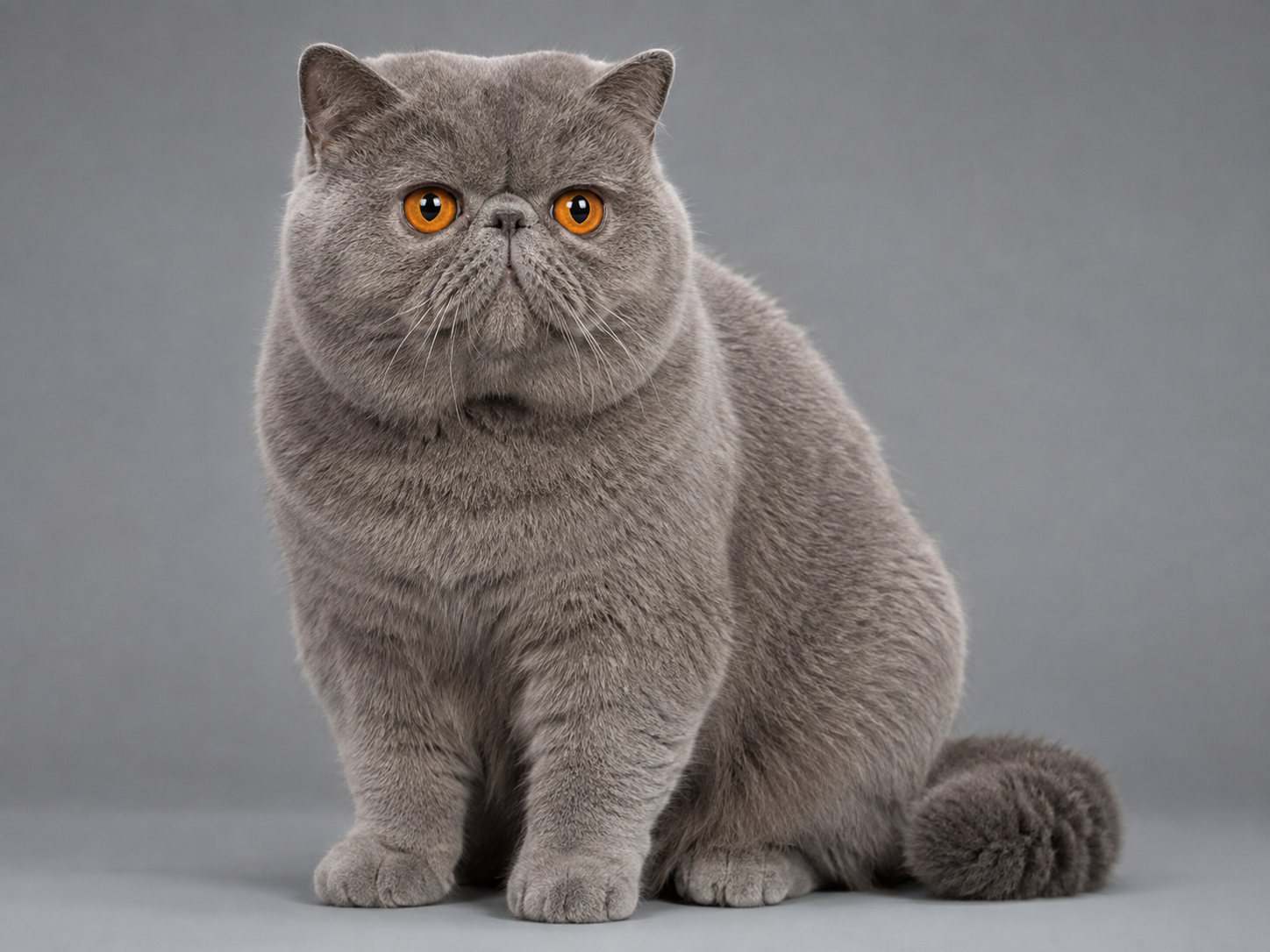
The Exotic Shorthair combines the round face, sturdy body, and gentle personality of the Persian with a short, exceptionally dense coat. Large expressive eyes, full cheeks, small rounded ears, and a plush teddy-bear appearance make this breed instantly recognizable. Beneath that soft exterior is a muscular cat that is usually calm and affectionate but still curious, playful, and interested in family life.
Exotic Shorthair at a Glance
- International name: Exotic Shorthair; officially called Exotic by CFA
- Coat length: short
- Country of origin: United States
- WCF code: EXO
- WCF category: 3 – Shorthair
- Size: medium
- Weight: approximately 7–14 pounds, with males generally larger than females
- Life expectancy: approximately 12–15 years or more
- Activity level: moderate; calm but curious and playful
- Social behavior: people-oriented and happiest when included in family life
- Affection level: affectionate, gentle, and often fond of sitting beside or on their owners
- Notable traits: Persian-type appearance, short plush coat, large round eyes, quiet voice, cobby body, and the need for careful attention to breathing and eye health
History of the Exotic Shorthair
The Exotic Shorthair was developed in the United States during the 1950s and 1960s. Some breeders of the American Shorthair crossed their cats with silver Persians in an attempt to introduce the Persian’s silver coat color, green eyes, and more substantial build. The kittens had short hair, but their rounded heads, full faces, dense coats, and compact bodies no longer matched the established American Shorthair type.
Cat breeder and judge Jane Martinke recognized both the problem these unrecorded crosses created for the American Shorthair and the potential of the resulting cats as a breed of their own. In 1966, she proposed the creation of a new breed to the Cat Fanciers’ Association. The original suggested name was Sterling because many of the early cats were silver, but all Persian colors were accepted from the beginning, so the broader name Exotic Shorthair was adopted.
American Shorthairs, Burmese cats, and a small number of Russian Blues were used in some early breeding programs to introduce short hair, sturdy bodies, and dense coats. Once the shorthaired gene had been established, breeders repeatedly crossed the descendants back to Persians. The goal was not to create a mixed-looking cat, but a cat with authentic Persian head and body type covered by a short plush coat.
CFA established the Exotic as a breed in 1966, and the first cats competed during the 1967–1968 show season. The word Shorthair was later dropped from CFA’s official breed name, which is now simply Exotic. TICA and WCF continue to use the name Exotic Shorthair.
Why Is It Called an Exotic?
The word exotic does not mean that the breed came from a tropical country or has wild ancestry. The Exotic was created entirely from domestic cat breeds in the United States. At the time, the combination of a Persian face and body with short hair was unusual enough to appear genuinely exotic to breeders and show visitors.
The breed is sometimes informally described as a shorthaired Persian. This nickname explains the appearance well, but the Exotic is a recognized breed with its own registration code and coat requirements.
Relationship to the Persian and Himalayan
The Exotic Shorthair belongs to the Persian breed group. TICA describes it as the shorthaired equivalent of the Persian and Himalayan, differentiated primarily by coat length. The three share the same basic head shape, compact body, heavy bone, short legs, and gentle expression.
The Exotic is nevertheless more than a Persian that happened to be born with short hair. Its coat must have a distinctive texture and density. It is longer and fuller than the coat of most shorthaired cats, yet not long enough to flow over the body in the manner of a Persian coat.
Can Exotic Shorthairs Have Longhaired Kittens?
Short hair is genetically dominant, while long hair is recessive. A shorthaired Exotic can therefore carry a hidden longhair gene. When two carriers are bred together, some kittens may inherit long hair from both parents and develop a Persian-like coat.
How these kittens are registered depends on the rules of the particular cat association. They may be registered as longhaired Exotics, Persians, or in another registry-specific division. A kitten’s official breed designation therefore depends on both its coat and its documented pedigree.
Exotic Shorthair Appearance
The Exotic is a medium-sized cat with heavy bone, strong muscles, and a compact, cobby body. The chest is broad and deep, the shoulders and hindquarters are substantial, and the back is short and level. The cat should look solid and powerful rather than overweight. Males are usually noticeably larger and may develop broader heads and fuller cheeks as they mature.
The legs are short, straight, and sturdy, ending in large round paws. The tail is short and thick but proportionate to the body, with a rounded tip. All parts of the cat should form a balanced whole, without one feature appearing exaggerated or out of proportion.
Head and Facial Structure
 The head is round, broad, and massive, with a smoothly domed forehead, full cheeks, strong jaws, and a well-developed chin. The neck is short and thick. The overall expression should be open, gentle, and alert rather than distressed or angry.
The nose is short and broad, with a clearly defined break between the eyes. However, a shorter nose is not automatically a better nose. The nostrils should be visibly open, the face should be reasonably symmetrical, and the cat must be able to breathe comfortably and quietly with its mouth closed. A severely recessed nose, extremely deep break, pinched nostrils, or chronic breathing difficulty is not a desirable breed characteristic.
Ears and Eyes
The ears are very small, rounded at the tips, and set low and wide apart. They fit within the rounded contour of the head rather than standing high or appearing pointed. Dense ear furnishings can make them look even smaller.
The eyes are large, round, open, and widely spaced, creating the breed’s characteristic sweet and slightly surprised expression. Eye color depends on coat color. Many Exotics have brilliant copper or orange eyes. Silver and golden cats may have green eyes, while pointed Exotics have blue eyes. White cats and some cats with white may have blue eyes or eyes of two different colors.
The Plush Coat
The Exotic Shorthair has a short, dense, soft coat with a rich undercoat. It stands slightly away from the body instead of lying flat, which adds to the cat’s rounded teddy-bear appearance. The texture should be fine and silky rather than harsh, woolly, or limp.
The coat is somewhat longer than that of a typical shorthaired cat, but it should not form flowing locks, a neck ruff, or a long plume. Its density can make the cat appear larger and rounder than it really is.
Exotic Shorthair Colors and Patterns
Exotic Shorthairs occur in an extensive range of colors and patterns associated with the Persian breed group. Solid colors include white, black, blue, red, cream, chocolate, and lilac. Tortoiseshell and blue-cream cats are also recognized, along with smoke, shaded, silver, golden, and chinchilla varieties.
Tabby patterns may be classic, mackerel, spotted, or ticked. Exotics also appear as bicolors, vans, harlequins, and calicos. Pointed cats have pale bodies with darker color on the face, ears, legs, and tail. Exact terminology and accepted combinations vary slightly among registries, but the breed as a whole has one of the widest color ranges in the cat fancy.
Exotic Shorthair vs. British Shorthair
The Exotic is sometimes confused with the British Shorthair because both breeds have round heads, sturdy bodies, and dense plush coats. Their facial structures and overall proportions are nevertheless quite different.
The British Shorthair has a longer nose, a less pronounced break in profile, and a broad but more naturally proportioned face. Its ears are generally larger and set higher, and the body is powerful without being as short and cobby as that of the Exotic. The Exotic has a more domed skull, smaller lower-set ears, larger rounder eyes, and a distinctly shorter nose. Its coat is also slightly longer and softer than the typical British coat.
Exotic Shorthair Personality
Exotics are generally gentle, affectionate, and people-oriented. Many follow their owners from room to room, settle nearby while the family relaxes, and enjoy quiet physical contact. Some are enthusiastic lap cats, while others prefer to sit beside their people. Individual personality always depends on genetics, early socialization, and experience.
The breed is usually less demanding and vocal than many highly active breeds. Exotics often communicate through their eyes, body language, purring, and soft occasional meows. Their quiet nature should not be mistaken for indifference. Most form close attachments and enjoy being included in everyday life.
Although closely related to the Persian, the Exotic is often described as somewhat more playful and inquisitive. Many retain an interest in balls, teaser toys, running water, and household investigations well into adulthood.
Activity and Enrichment
The Exotic Shorthair has a moderate activity level. These cats are unlikely to spend the entire day racing through the house, but they still need regular play to maintain muscle tone, protect joint health, and prevent obesity. Several short play sessions are often more suitable than one long and exhausting session.
Fishing-rod toys, soft balls, tunnels, food puzzles, and sturdy low or medium-height cat trees work well. Because Exotics are compact and heavily built, climbing furniture should be stable and easy to access. Play should stop if the cat begins breathing loudly, panting, or showing unusual fatigue, especially in warm weather.
Living With Children and Other Pets
A well-socialized Exotic can usually live peacefully with respectful children, other cats, and calm dogs. The breed’s easygoing temperament often suits a family household, but no cat should be expected to tolerate rough handling. Children should be taught not to chase, squeeze, or carry the cat against its wishes.
Introductions to other animals should be gradual. Each pet needs separate food and water bowls, resting places, litter boxes, and opportunities to withdraw. A gentle breed description does not guarantee immediate friendship between individual animals.
Is an Exotic Shorthair Right for You?
The Exotic may suit someone who loves the Persian appearance but does not want to maintain a long flowing coat every day. It can be a good companion for a quiet household, a family with considerate children, or an owner looking for an affectionate cat with moderate exercise needs.
However, the Exotic should not be viewed as a maintenance-free Persian. The dense coat sheds, the eyes may require regular cleaning, and the facial structure can create medical concerns when breeding favors excessively flat faces. Prospective owners need to value comfortable breathing, healthy eyes, and functional anatomy more than the flattest possible profile.
Grooming an Exotic Shorthair
The coat should normally be combed once or twice a week with a metal comb or suitable grooming brush. During seasonal shedding, more frequent grooming may be needed because the thick undercoat can hold a surprising amount of loose hair. Contrary to an old claim sometimes made about the breed, the Exotic Shorthair is not close to shed-free.
Mats are less common than in a Persian coat, but they can still form if the dense undercoat is neglected, particularly around the legs and belly. An occasional bath may help remove accumulated undercoat and skin oils, although routine frequent bathing is not necessary for every household pet. Nails should be trimmed regularly, ears checked, and teeth cleaned with products intended for cats.
Eye and Facial Care
The combination of large exposed eyes and a shortened nose can cause tears to overflow onto the face. The area beneath the eyes may be gently cleaned with sterile saline or a product recommended by a veterinarian. A separate clean pad should be used for each eye.
Persistent heavy tearing, redness, squinting, cloudiness, thick discharge, or rubbing at the eye should not be dismissed as normal for the breed. These signs may indicate irritation, infection, an eyelid abnormality, or damage to the cornea and require veterinary examination.
If the cat has facial folds near the nose, they should be inspected and kept clean and dry. Constant moisture can irritate the skin and encourage inflammation. Powders, creams, and antiseptics should not be applied routinely without veterinary advice.
Feeding and Weight Management
An Exotic Shorthair needs a complete and balanced diet appropriate for its age, activity level, and health. The breed is naturally broad and solid, but a cobby body should not be confused with excess fat. The ribs should be easy to feel beneath a moderate layer of tissue, and some waist should remain visible from above.
Because many Exotics are calm and food-motivated, measured portions and daily play are important. Treats should be included in the total daily calorie intake. A broad, shallow food bowl may be more comfortable for a short-faced cat, and fresh drinking water should always be available.
Exotic Shorthair Health
The most visible health consideration is brachycephaly, the shortened skull and face shared with the modern Persian. When taken to an extreme, this anatomy can be associated with narrow nostrils, obstructed airflow, noisy breathing, poor tolerance of heat or exercise, crowded teeth, excessive tearing, skin-fold irritation, and eye injuries. A healthy Exotic should breathe freely with its mouth closed and should not struggle after ordinary activity.
Polycystic kidney disease, or PKD1, has historically affected Persians and Persian-derived breeds, including the Exotic Shorthair. The disorder causes cysts to develop in the kidneys and may eventually lead to kidney failure. PKD1 is inherited as a dominant trait, and a reliable DNA test is available. Breeding cats should be confirmed clear, and kitten buyers should ask to see documented test results for both parents.
Persian-derived progressive retinal atrophy, known as PRA-pd, is another testable inherited condition. It causes early degeneration of the retina and eventual blindness in affected cats. PRA-pd is recessive, so a carrier remains sighted but can pass the mutation to its kittens. Responsible breeding prevents two carriers from being paired.
Shortened jaws may also result in crowded or misaligned teeth. Regular dental examinations and home tooth brushing help control plaque and gum disease, although they cannot correct a severe structural malocclusion. Routine veterinary care should include vaccination, parasite prevention, weight monitoring, dental assessment, and close attention to breathing and eye comfort.
Choosing an Exotic Shorthair Kitten
Choose a breeder who registers litters, supplies a pedigree and veterinary records, and is willing to discuss health openly. Ask for documented PKD1 and PRA-pd results for the parents and inquire about eye examinations, breathing, dental alignment, and the health of close relatives.
Observe the kitten while it is awake and moving. The nostrils should be open, breathing should be quiet, and the mouth should remain closed at rest. Avoid kittens with persistent wheezing, loud respiratory noise, open-mouth breathing, severely narrowed nostrils, heavy eye discharge, inflamed facial folds, obvious facial asymmetry, or a marked jaw deformity.
A healthy kitten should be curious, responsive, and comfortable around people. Clean eyes, clean ears, smooth movement, an appropriate body condition, and free breathing matter far more than an extremely flat face. A responsible breeder should be proud of functional, healthy anatomy rather than presenting respiratory difficulty as a normal part of the breed.
Interesting Facts About the Exotic Shorthair
- The breed was not originally planned as a shorthaired Persian. Its beginnings came from American Shorthair breeders trying to introduce Persian silver coloring and green eyes.
- Sterling was the first proposed name. The name was abandoned because the new breed was accepted in many colors, not only silver.
- CFA officially calls the breed Exotic. The longer name Exotic Shorthair remains widely used by other registries and by the public.
- Early breeding involved several shorthaired breeds. American Shorthairs, Burmese cats, and a small number of Russian Blues were used before breeders concentrated on breeding back to Persians.
- Longhaired kittens can appear in Exotic litters. Two shorthaired parents may both carry the recessive longhair gene.
- The coat sheds more than many people expect. Its thick undercoat can produce substantial seasonal shedding.
- Exotics come in a remarkable range of colors. Solid, tabby, smoke, silver, golden, tortoiseshell, calico, bicolor, and pointed cats are all found within the breed.
- The flattest face is not the healthiest or most correct face. Major standards penalize overtyping, breathing difficulty, and other signs that facial structure has been taken too far.
- Exotics are often more playful than Persians. They retain the calm Persian temperament but frequently show more curiosity and interest in interactive games.
The Exotic Shorthair is a gentle, affectionate companion with a distinctive round face and a wonderfully dense plush coat. Its grooming is more manageable than that of a Persian, but responsible ownership still involves regular coat and eye care, weight control, genetic screening, and close attention to breathing. A well-bred Exotic should not merely look charming. It should be able to see clearly, move comfortably, and breathe freely.
What would you like to see added to meow-cats.com?
- Funny cat videos (20%, 118 Votes)
- Ask a vet online (15%, 87 Votes)
- Classifieds for buying and selling cats (13%, 79 Votes)
- More useful articles on feline topics (13%, 76 Votes)
- Online cat memorial (11%, 63 Votes)
- Forum for cat lovers (8%, 49 Votes)
- Breeder and cattery ads (8%, 48 Votes)
- Veterinary clinic ads (7%, 41 Votes)
- Cat boarding and boarding cattery ads (6%, 38 Votes)
Total Voters: 273
 Loading ...
What are your 3 favorite cat breeds?
- Siamese Cat (11%, 184 Votes)
- Maine Coon (7%, 116 Votes)
- Bengal Cat (7%, 111 Votes)
- American Shorthair (6%, 104 Votes)
- Ragdoll (5%, 81 Votes)
- Persian Cat (5%, 79 Votes)
- Russian Blue (4%, 74 Votes)
- Egyptian Mau (4%, 68 Votes)
- Munchkin (4%, 61 Votes)
- Scottish Fold (4%, 61 Votes)
- Abyssynian (4%, 58 Votes)
- Other... (3%, 56 Votes)
- Norwegian Forest Cat (3%, 55 Votes)
- Turkish Angora (3%, 55 Votes)
- Siberian Cat (3%, 55 Votes)
- Himalayan Cat (3%, 53 Votes)
- British Shorthair (3%, 48 Votes)
- A Breedless Cat (2%, 40 Votes)
- Ocicat (2%, 40 Votes)
- Savannah Cat (2%, 39 Votes)
- Sphynx (2%, 38 Votes)
- Birman Cat (2%, 28 Votes)
- American Bobtail (2%, 25 Votes)
- Bombay Cat (1%, 23 Votes)
- Burmese Cat (1%, 21 Votes)
- Manx Cat (1%, 17 Votes)
- Havana Brown (1%, 16 Votes)
- Balinese Cat (1%, 12 Votes)
- Devonshire Rex (1%, 11 Votes)
- Singapura (1%, 9 Votes)
- Cornish Rex (0%, 7 Votes)
- Thai Cat (0%, 7 Votes)
- Donskoy Cat (0%, 1 Votes)
Total Voters: 661
Loading ...