Minuet Cat (Formerly Napoleon)
Minuet Cat (Formerly Napoleon Cat): A Round-Faced Cat with a Distinctive Heritage
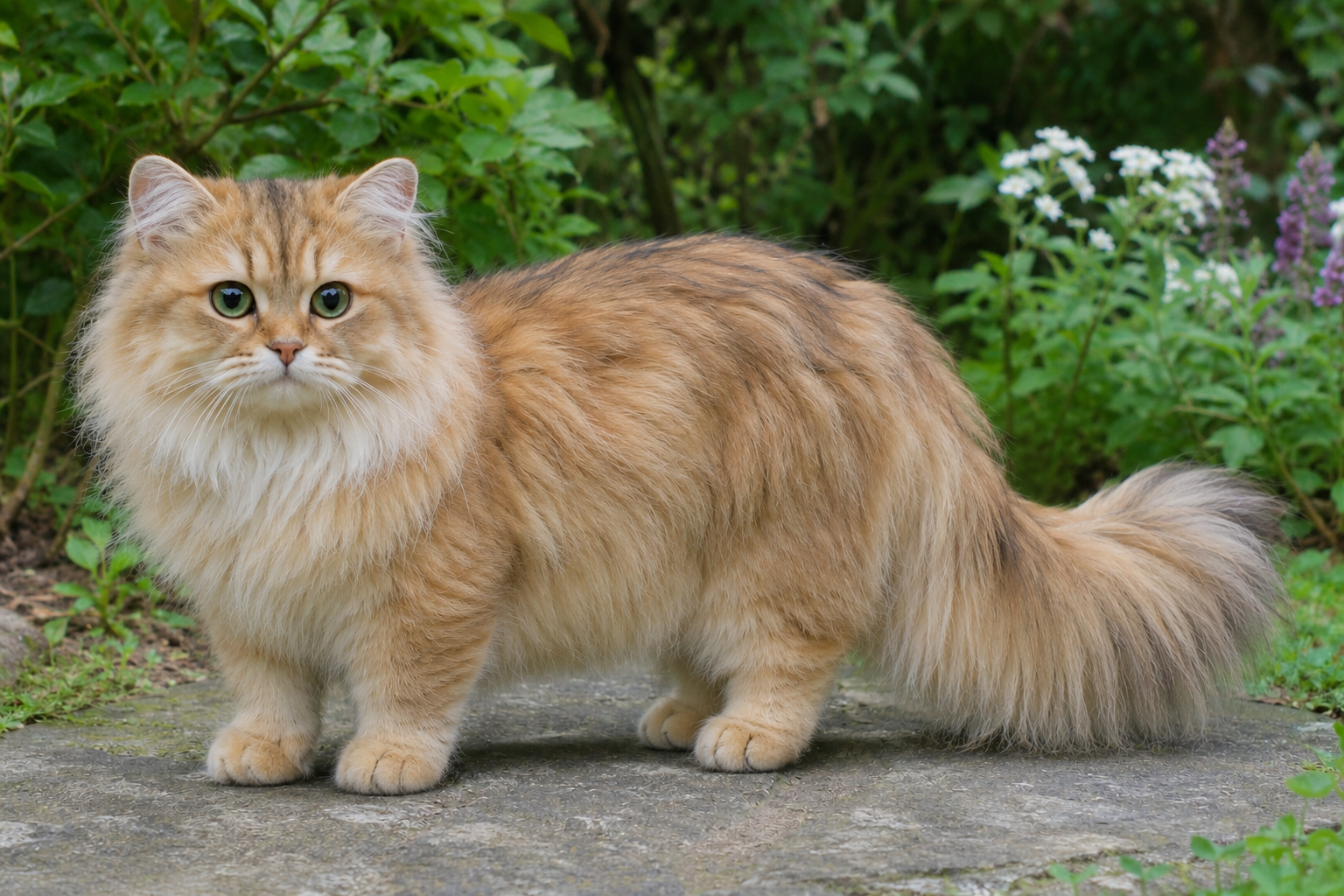 With its expressive round eyes, soft coat, affectionate personality, and distinctive body proportions, the Minuet brings together characteristics of the Persian and the Munchkin while maintaining a breed identity of its own.
The Minuet, formerly known as the Napoleon cat, is a relatively modern American breed developed by combining the rounded features and luxurious coat of the Persian breed group with the distinctive short-legged appearance of the Munchkin. The result is a sturdy, medium-sized cat with a sweet facial expression, large round eyes, and a generally affectionate and playful temperament.
Although the short-legged Minuet is the best-known representative of the breed, Minuets can also have legs of ordinary length. Both shorthaired and longhaired varieties exist, and the breed’s recognition within The International Cat Association (TICA) expanded significantly in 2026. Its unusual anatomy, however, continues to raise important questions about genetics, health, and responsible breeding.
Quick Facts
- Breed name: Minuet
- Former name: Napoleon Cat
- Coat: shorthair and longhair
- Origin: United States
- Development began: 1996
- TICA breed codes: MNT, MNL, MTT, MTL
- WCF breed codes: MIS (shorthair), MIL (longhair)
- WCF categories: Category 3 – Shorthair; Category 1 – Longhair
- Size: medium, with sturdy bone structure
- Weight: TICA lists an average adult weight of approximately 7–8 pounds (3.2–3.6 kg), although individual cats may weigh more or less
- Lifespan: TICA suggests that Minuets may live 15 years or longer; reliable population-level longevity data specific to the breed remains limited
- Activity level: generally playful and moderately active
- Social behavior: affectionate, curious, and people-oriented
- Grooming: regular combing, especially for longhaired cats
- Health considerations: inherited disproportionate dwarfism in short-legged varieties, Persian-associated genetic disorders, and potential issues related to facial conformation
The History of the Minuet Cat
The Minuet’s history began with an American dog breeder named Joe Smith, who had considerable experience with Basset Hounds. In June 1995, Smith came across an article about the Munchkin in The Wall Street Journal. Fascinated by the short-legged cats, he began considering how their unusual body proportions could be incorporated into a new feline breed with a recognizable appearance beyond leg length alone.
Smith wanted a cat with substantial bone structure, a rounded head, expressive eyes, and an abundant coat. The Persian family of breeds offered many of these characteristics. With the assistance of Persian breeder Deb Kenny, Smith began developing a breeding program that included Munchkins and cats from the Persian breed group: Persians, Himalayans, and Exotic Shorthairs.
In February 1996, Smith acquired a Munchkin kitten from breeder Penny Squires. The kitten already had Persian ancestry. Later, Deb Kenny provided a young male Exotic, and the first litter associated with Smith’s new breeding program arrived in late 1997. Other breeders subsequently became involved, helping establish a broader breeding population in the United States and eventually in Europe and Asia.
The Minuet is therefore classified by TICA as a domestic hybrid breed. Unlike breeds developed through crosses involving wild feline species, its ancestry comes entirely from domestic cats. Its development was deliberately directed toward combining selected characteristics of established domestic breeds.
Why Was the Napoleon Cat Renamed?
The breed was originally called the Napoleon, a name commonly associated with its short stature and the popular cultural image of French emperor Napoleon Bonaparte. The name became widely used during the early development of the breed, but it was not universally accepted within the cat fancy.
In 2015, TICA voted to change the official breed name to Minuet. The following year, on January 23, 2016, the organization’s board voted unanimously to grant the breed full championship status.
The former name Napoleon remains familiar to many breeders and cat enthusiasts, and older articles and pedigrees may still use it. Minuet, however, is the current official name used by TICA and the World Cat Federation (WCF).
Is the Minuet an Officially Recognized Cat Breed?
The Minuet has championship recognition within TICA and WCF, although the two organizations do not apply identical breed standards or exhibition rules.
TICA originally granted championship eligibility to the short-legged varieties. Effective May 1, 2026, the organization extended championship status to the normal-legged Minuet Tall varieties as well. This was a significant development because it established all four varieties as eligible for championship competition under the current TICA breed group standard.
WCF recognizes the shorthaired Minuet under the code MIS and the longhaired Minuet under the code MIL. Its published breed standards still specify that cats with normal-length legs may be used in breeding but are not eligible for exhibition as Minuets. The longhaired variety is classified in WCF’s Longhair category rather than its Semi-Longhair category.
Recognition is not universal. The Cat Fanciers’ Association (CFA) does not recognize the Minuet as a separate breed. The Fédération Internationale Féline (FIFe) prohibits breeding, registration, and exhibition under its rules for cats affected by inherited forms of dwarfism and limb shortening. The Governing Council of the Cat Fancy (GCCF) also lists the Minuet and other dwarf breeds as ineligible for recognition because of reported health concerns.
The Four Varieties of the Minuet
Under the TICA standard effective May 1, 2026, the Minuet breed group consists of four varieties:
- Minuet (MNT): short legs and a short coat.
- Minuet Longhair (MNL): short legs and a semi-long to long coat.
- Minuet Tall (MTT): normal-length legs and a short coat.
- Minuet Tall Longhair (MTL): normal-length legs and a semi-long to long coat.
Historically, short-legged Minuets were called standard Minuets, while those with ordinary leg length were referred to as nonstandard Minuets. These terms reflected their relationship to the former exhibition standard rather than their quality as companion animals.
The introduction of the Minuet Tall designation recognizes that leg length is not the only feature defining this breed. A normal-legged Minuet can retain the same rounded facial features, coat texture, body structure, and general temperament as its short-legged relatives.
Why Do Some Minuet Cats Have Short Legs?
The Minuet inherited its shortened limbs from the Munchkin. This characteristic results from a form of inherited disproportionate dwarfism known as chondrodysplasia, which affects skeletal development. Unlike proportionate dwarfism, in which the entire body is smaller, disproportionate dwarfism particularly affects the length and development of the limbs.
Genetic research published in 2020 identified a structural variant involving the UGDH gene, which is strongly associated with the short-legged phenotype in Munchkins. This gene plays an important role in biological processes involved in cartilage development. The associated variant follows a dominant pattern of inheritance with respect to limb shortening: a single copy is sufficient for the short-legged phenotype to appear.
The studies also found no living cats carrying two copies of the associated variant. Together with breeding observations, this supports the hypothesis that inheriting two copies may be lethal during embryonic development. The available evidence is consistent with this explanation, although the precise developmental consequences have not been fully characterized.
Because the Minuet inherited the short-legged trait through Munchkin ancestry, these findings are directly relevant to the breed. However, the original genetic studies were not large population surveys of modern Minuets, and their results should not be presented as though every individual Minuet has been genetically tested.
Are All Minuet Kittens Born with Short Legs?
No. A litter may contain both short-legged and normal-legged kittens. When a short-legged cat carrying one copy of the dwarfism-associated variant is bred with a cat that does not carry it, each kitten has an expected 50 percent probability of inheriting the variant. The actual proportions within an individual litter may differ considerably from that expectation.
Breeding two short-legged cats raises additional concerns because some embryos may inherit two copies of the associated variant. This is one reason why normal-legged cats have historically been valuable within Minuet breeding programs.
Under the current TICA standard, the Persian and Munchkin breed groups remain permissible outcrosses. An outcross is a mating involving a permitted breed outside the Minuet breed group. These allowances are part of the organization’s breeding framework and should not be confused with unrestricted crossbreeding.
What Does a Minuet Cat Look Like?
Roundness is one of the most recognizable elements of the Minuet’s appearance. Its head, eyes, cheeks, muzzle, and overall body contours create a soft expression without requiring an exaggeratedly flat face. The cat should look substantial and well proportioned rather than delicate or unusually miniature.
The body is medium in size, moderately compact, and supported by substantial bone structure and developed muscles. The chest is broad, the torso is rounded, and the back is approximately level or rises slightly toward the hindquarters. Mature males may be more robust than females.
In short-legged Minuets, all four limbs are noticeably shortened. The current TICA standard specifies that the legs should be at least one-quarter of the body’s length. The front legs should be reasonably straight, and the hind legs should be properly aligned. Excessive shortening, severe bowing, or abnormal limb positioning should not be regarded as desirable exaggerations of breed type.
The paws are rounded and compact. Longhaired cats may have fur growing between their toes. The tail is relatively long, gradually tapering toward a rounded tip, and longhaired Minuets often have a particularly attractive, flowing tail.
The Head, Eyes, and Facial Expression
The Minuet’s distinctive expression owes much to its Persian ancestry. Its head is broad and rounded, with full cheeks, a smoothly curved forehead, and a well-developed chin. The muzzle is relatively short and broad, with rounded whisker pads that blend naturally into the cheeks.
The nose is short but should not be extremely flattened. Viewed from the side, the transition between the nose and forehead is clearly visible but gently curved. An abrupt, deep break in the profile is undesirable. The upper edge of the nose leather should not extend above the lower edge of the eyes, and the nostrils should remain open enough to permit unobstructed breathing.
The eyes are large, round, widely spaced, and expressive, but should not protrude or appear deeply recessed. The ears are moderately sized, set well apart, and rounded at the tips. Together, these features produce the characteristic sweet expression sometimes described by breeders as a doll face.
The term doll face is an informal description rather than a separate officially recognized variety. It should not be interpreted as a guarantee that a cat is free from respiratory, dental, or eye problems.
Minuet Coat Types and Colors
The Minuet inherited a considerable variety of coat colors and textures from its parent breeds. It can be solid-colored, tabby, shaded, tortoiseshell, calico, bicolor, or colorpoint, among many other possibilities. Silver and golden shaded coats can be especially striking when combined with the breed’s large, expressive eyes.
TICA accepts all coat color categories, divisions, and colors for the Minuet breed group. WCF applies its own color regulations, so not every combination of coat color, white markings, and eye color is necessarily evaluated in the same way by both organizations.
Shorthaired Minuet. The coat is dense, soft, and plush, with an undercoat that gives it a fuller appearance than the close-lying coat of many other shorthaired breeds. It should have noticeable body without appearing coarse or excessively heavy.
Longhaired Minuet. The coat ranges from semi-long to long and should have a soft, silky texture. Longer hair around the neck, hindquarters, and tail creates a graceful outline, while the coat over the shoulders and back should fall naturally along the body. A woolly texture is undesirable.
Both coat varieties may change noticeably with the seasons. Coat density also depends on genetics, climate, age, hormonal status, and general health.
Eye Color
Minuets may have green, gold, copper, blue, or other eye colors, depending on their genetics and the applicable registration rules. Odd-eyed individuals may also occur.
The current TICA standard does not require eye color to correspond to coat color, while WCF establishes more specific requirements and restrictions. Regardless of color, healthy eyes and the correct rounded shape are more important than an unusually intense or fashionable shade.
Minuet Personality and Temperament
Minuets are generally described by breeders and TICA as affectionate, gentle, curious, and strongly oriented toward human companionship. Their personality is often associated with the relaxed disposition of the Persian and the inquisitive nature of the Munchkin. Many enjoy following their favorite people around the house, investigating everyday activities, or settling beside someone who is reading or working.
The breed’s calm expression can be misleading. A sociable Minuet may alternate between energetic play and long periods of comfortable relaxation. Toys that roll across the floor, puzzle feeders, tunnels, and interactive wand toys can all provide opportunities for physical and mental stimulation.
Nevertheless, temperament is not determined entirely by breed. Early experiences, socialization, individual genetics, health, and the living environment influence how a cat behaves. Not every Minuet will enjoy being held, sitting on a lap, or interacting with strangers.
Are Minuet Cats Good with Children and Other Pets?
A well-socialized Minuet can be a pleasant companion in a household with respectful children, other cats, or cat-friendly dogs. Their generally sociable nature may help them adjust to family life, but introductions should always be gradual and allow the cat to retreat whenever it feels uncomfortable.
Children should understand that short-legged cats are not toys and must never be pulled by their limbs, carried carelessly, or encouraged to jump from high surfaces. The Minuet’s unusual silhouette does not make its body more resistant to injury.
In households with several pets, each animal should have reliable access to food, water, litter boxes, sleeping areas, scratching surfaces, and places where it can rest without being disturbed.
How Active Are Minuet Cats?
Short-legged Minuets can be surprisingly playful and may enjoy running, chasing toys, exploring, and climbing. However, physical capability varies between individuals, and enthusiasm for movement does not establish that their skeletal structure is free from abnormalities.
Compared with cats of ordinary proportions, short-legged Minuets may have difficulty reaching high furniture, climbing certain structures, jumping down safely, or grooming some areas of their bodies. These limitations should be acknowledged rather than dismissed as insignificant simply because a cat appears energetic.
Minuet Talls, which have ordinary leg length, do not have the same limb-shortening characteristic. They still need regular exercise, enrichment, and a safe environment, just like any other domestic cat.
Creating a Comfortable Home for a Minuet
A thoughtfully arranged home allows a short-legged Minuet to explore independently without having to perform difficult jumps throughout the day. Low platforms, sturdy ramps, pet steps, and cat trees with closely spaced levels can provide access to favorite resting places. Nonslip surfaces are especially useful on smooth floors, where a cat with unusual limb alignment may have difficulty gaining traction.
A spacious litter box with a low entrance can make toileting more comfortable. Food and water should be easy to reach, and scratching surfaces can be provided in both horizontal and vertical forms. Avoid placing essential resources in locations that require the cat to climb or jump beyond its comfortable physical abilities.
Environmental adaptations should support natural behavior rather than unnecessarily restrict movement. Minuets still need opportunities to play, explore, climb, stretch, scratch, hide, and observe their surroundings. The aim is to make these activities accessible and safe.
Grooming a Minuet Cat
Both coat varieties benefit from regular grooming. A shorthaired Minuet may need combing several times a week, while a longhaired cat generally benefits from daily attention, especially during periods of heavy shedding. A metal comb with differently spaced teeth is useful for reaching through the coat and removing loose hair before it forms tangles.
Pay particular attention to the areas behind the ears, under the front legs, around the neck, on the abdomen, and near the hindquarters. These areas are especially prone to matting. Short-legged cats may need additional assistance if their body structure makes certain areas difficult to reach during self-grooming.
Routine bathing is not necessary for every Minuet. Bathing may occasionally be useful when the coat becomes unusually dirty or requires specific care, but it should be performed with appropriate feline grooming products and without causing unnecessary stress.
Nails should be checked regularly, ears examined for signs of irritation or excessive discharge, and teeth cared for with appropriate feline dental products. Persistent tearing, redness, squinting, or abnormal eye discharge should be evaluated by a veterinarian rather than treated as a normal consequence of Persian ancestry.
Feeding and Weight Management
The Minuet does not require a special breed-specific diet. A nutritionally complete and balanced cat food appropriate for its age, activity level, reproductive status, and health is the foundation of good nutrition. Both wet and dry foods can form part of a suitable diet when they meet the cat’s nutritional requirements.
Maintaining a healthy body condition is particularly important for short-legged cats. Excess weight places additional demands on their limbs, joints, and spine and can make everyday movement more difficult. Food portions should be adjusted according to the cat’s individual needs rather than an assumed ideal weight for the breed.
A healthy cat should have ribs that can be felt beneath a modest covering of tissue and an identifiable waist when viewed from above. Long fur can make changes in body condition difficult to notice, so regular weighing and gentle physical assessment are more informative than appearance alone. Fresh drinking water should always be available.
Minuet Health and Hereditary Conditions
The Minuet combines two ancestral breed groups with different inherited characteristics. This makes it important to consider both the skeletal implications of Munchkin-derived dwarfism and the genetic and anatomical risks associated with Persian ancestry.
Reliable large-scale studies examining the lifetime health of Minuets themselves remain limited. Consequently, claims that the breed is entirely free from inherited health problems are not supported by adequate evidence. At the same time, individual cats should be assessed on their actual health rather than assumed to have every condition associated with their ancestry.
Skeletal and joint abnormalities. A veterinary imaging study published in 2021 documented significant differences in the shape and alignment of limb bones in cats with inherited disproportionate dwarfism. All five dwarf cats assessed radiographically had limb deformities. The study was relatively small, however, and its findings cannot determine how frequently severe pain or disability develops across the entire Minuet population.
Abnormal bone and joint alignment raises concerns about mobility, joint loading, and the potential development of degenerative joint disease. Owners should watch for persistent limping, stiffness, reluctance to jump, changes in posture, reduced grooming, sensitivity to touch, or unexplained changes in activity.
Spinal and chest abnormalities. Conditions such as lordosis, an excessive inward curvature of the spine, and pectus excavatum, an inward deformity of the chest wall, have also been discussed in relation to dwarf breeds. Their prevalence specifically among Minuets has not been reliably established. Research has likewise not established how frequently intervertebral disc disease occurs in cats with this form of dwarfism.
Polycystic kidney disease (PKD). This is a particularly important inherited concern because of the breed’s Persian ancestry. The best-characterized hereditary form is associated with a variant in the PKD1 gene and follows a dominant inheritance pattern. Affected cats develop kidney cysts that may eventually compromise kidney function. DNA testing for the known PKD1 variant is available, and prospective owners should ask for documented test results from both parents. A negative result excludes this particular inherited variant but does not guarantee that the animal will never develop kidney disease.
Facial conformation and breathing. Although the Minuet standard calls for a less extreme facial structure than that of some modern Persians, individual cats may still inherit shortened facial proportions. Excessive brachycephaly, or shortening of the skull and muzzle, is associated in Persian and related cats with reduced airway space, abnormal tooth alignment, and eye problems. Cats with visibly restricted nostrils, persistent noisy breathing, excessive tearing, or difficulty tolerating ordinary activity should receive veterinary assessment.
Regular veterinary examinations, appropriate vaccinations, parasite prevention, dental care, and monitoring of weight and mobility are essential throughout the cat’s life. For short-legged Minuets, periodic assessment of musculoskeletal health is particularly valuable.
How Long Do Minuet Cats Live?
TICA’s breed information indicates that Minuets may live 15 years or longer, depending on factors such as nutrition and environment. However, there are not yet sufficient comprehensive breed-specific longevity studies to establish a reliable average life expectancy or determine whether short-legged and normal-legged Minuets have different survival patterns.
Genetics, veterinary care, body condition, kidney health, respiratory function, and the safety of the living environment can all influence an individual cat’s lifespan and quality of life.
The Ethical Debate Surrounding Short-Legged Cats
The Minuet is part of a broader discussion about the deliberate breeding of domestic animals for unusual physical characteristics. Supporters emphasize the breed’s personality, appearance, and the ability of many individual cats to lead active, affectionate lives. Veterinary researchers and animal welfare organizations, however, have raised concerns about intentionally selecting for skeletal abnormalities that may restrict natural feline behavior or contribute to pain and disease.
The ability of a short-legged cat to run, play, or appear comfortable does not necessarily mean that its underlying skeletal structure is normal. Conversely, evidence of inherited skeletal differences does not establish that every affected cat experiences severe clinical disease.
The recognition of normally proportioned Minuet Talls provides an alternative for people attracted to the breed’s rounded appearance, coat, and temperament but concerned about the consequences of inherited limb shortening. Normal leg length does not eliminate every possible inherited risk, particularly those associated with Persian ancestry, but it avoids the distinctive disproportionate dwarf phenotype.
Responsible consideration of this breed should prioritize physical comfort, healthy movement, normal breathing, and the ability to express natural feline behavior over increasingly exaggerated physical features.
Minuet vs. Munchkin
The Minuet and Munchkin share the genetic background responsible for shortened limbs. Their breed characteristics, however, extend beyond leg length.
The Munchkin generally has a more moderately shaped head and a less pronounced Persian-like appearance. The Minuet places greater emphasis on a broad rounded head, large round eyes, a short rounded muzzle, substantial body structure, and a dense plush or silky coat.
A longhaired Munchkin is therefore not automatically a Minuet. A cat’s breed identity depends on documented ancestry and the applicable breed standard, not simply its resemblance to photographs of another breed.
Minuet vs. Persian
The Persian contributed much of the Minuet’s recognizable facial structure, coat, and overall rounded appearance. However, the Minuet standard emphasizes a less extreme nasal profile and a body that is not excessively compact.
Longhaired Minuets may resemble traditional-looking Persians, particularly when their legs are of ordinary length. Short-legged Minuets are more easily distinguished by their proportions. Nevertheless, appearance alone cannot reliably establish whether a cat belongs to either breed.
Minuet vs. Himalayan and Exotic Shorthair
The Himalayan and Exotic Shorthair were also included in the Persian breed group used during the Minuet’s development.
A colorpoint Minuet Longhair may resemble a Himalayan, while a shorthaired Minuet Tall may look somewhat like an Exotic Shorthair. These similarities are understandable given their shared ancestry, but each breed has its own registration framework and physical standard.
Minuet vs. Minskin
Despite their somewhat similar names and shared Munchkin ancestry, the Minuet and the Minskin are distinct breeds developed through different breeding programs.
The Minuet has Persian-derived rounded features and a conventional short or long coat. The original Minskin breed concept, in contrast, emphasizes a sparse body coat with denser short hair on certain areas of the face, ears, legs, and tail. Their current recognition statuses also differ.
How to Choose a Minuet Kitten
Anyone considering a Minuet should look beyond coat color, eye color, and the length of the kitten’s legs. A responsible breeder should provide registration documents, appropriate veterinary records, information about the parents and older relatives, and documented results of relevant health screening.
Ask specifically about PKD1 testing, skeletal and joint health, respiratory problems, eye disorders, and the mobility of adult cats within the breeding line. A kitten’s ability to move comfortably and breathe normally is more important than achieving the lowest possible stature or the shortest possible muzzle.
Observe how the kitten walks, plays, and interacts with its surroundings. Persistent limping, pronounced limb deformities, labored breathing, chronic eye discharge, or unusual weakness should not be accepted as normal characteristics of the breed. An independent veterinary examination is advisable.
Unverified advertising labels such as teacup, micro, or ultra-short Minuet do not represent additional officially recognized varieties. Extreme physical features should not be promoted as evidence of superior quality or greater rarity.
Prospective owners interested in the Minuet’s facial expression, coat, and personality may also wish to consider a Minuet Tall. Adoption opportunities, including adult cats in need of homes, are another option worth exploring.
Is a Minuet Cat Right for You?
The Minuet may appeal to someone who appreciates affectionate, expressive cats with soft rounded features and enjoys spending time interacting with a companion animal. Longhaired Minuets require consistent grooming, while short-legged individuals may benefit from additional environmental adaptations and closer monitoring of mobility.
The breed is less suitable for anyone interested primarily in owning an unusually small or fashionable animal. Its distinctive characteristics carry practical responsibilities, and no aesthetic preference should take priority over the cat’s comfort and long-term well-being.
Whether short-legged or normally proportioned, a Minuet needs a stimulating environment, appropriate nutrition, regular veterinary care, companionship, and the freedom to behave like a cat.
Interesting Facts About the Minuet Cat
- The breed was created by a dog breeder. Joe Smith’s experience with Basset Hounds helped inspire his interest in developing a short-legged cat with substantial bone structure.
- The first litter arrived in late 1997. The Minuet is a distinctly modern breed with a documented recent history.
- Napoleon was its original name. TICA officially changed the name to Minuet in 2015.
- The Minuet gained TICA championship recognition in 2016.
- Not every Minuet has short legs. Normal-legged kittens are a natural part of the breed’s genetic inheritance.
- All four Minuet varieties have TICA championship eligibility as of May 1, 2026. This includes both coat lengths and both recognized leg-length types.
- The Minuet is not necessarily a miniature cat. Shortened legs do not mean that the torso, head, and other body structures are proportionately smaller.
- Its face should not be extremely flat. The breed standard favors a short but adequately developed nose and a moderately rounded profile.
- Minuets come in a wide variety of colors. Their Persian and Munchkin ancestry allows for numerous coat colors and patterns.
- Short legs are an inherited skeletal characteristic. Genetic research has linked the Munchkin-type dwarf phenotype to a structural variant involving UGDH.
- Breed recognition is not universal. Several major feline organizations do not recognize dwarf breeds because of animal welfare concerns.
The Minuet occupies an unusual place in the modern cat fancy. Its history brings together established breeds, deliberate selection for distinctive physical characteristics, changing exhibition standards, and ongoing questions about the relationship between appearance and animal welfare.
Its rounded expression, luxurious coat, and affectionate nature may be captivating, but the most important qualities of any Minuet are the same as those of every other cat: good health, comfortable movement, an engaging environment, and the opportunity to enjoy life as a beloved companion.
What would you like to see added to meow-cats.com?
- Funny cat videos (20%, 118 Votes)
- Ask a vet online (15%, 87 Votes)
- Classifieds for buying and selling cats (13%, 79 Votes)
- More useful articles on feline topics (13%, 76 Votes)
- Online cat memorial (11%, 63 Votes)
- Forum for cat lovers (8%, 49 Votes)
- Breeder and cattery ads (8%, 48 Votes)
- Veterinary clinic ads (7%, 41 Votes)
- Cat boarding and boarding cattery ads (6%, 38 Votes)
Total Voters: 273
 Loading ...
What are your 3 favorite cat breeds?
- Siamese Cat (11%, 184 Votes)
- Maine Coon (7%, 116 Votes)
- Bengal Cat (7%, 111 Votes)
- American Shorthair (6%, 104 Votes)
- Ragdoll (5%, 81 Votes)
- Persian Cat (5%, 79 Votes)
- Russian Blue (4%, 74 Votes)
- Egyptian Mau (4%, 68 Votes)
- Munchkin (4%, 61 Votes)
- Scottish Fold (4%, 61 Votes)
- Abyssynian (4%, 58 Votes)
- Other... (3%, 56 Votes)
- Norwegian Forest Cat (3%, 55 Votes)
- Turkish Angora (3%, 55 Votes)
- Siberian Cat (3%, 55 Votes)
- Himalayan Cat (3%, 53 Votes)
- British Shorthair (3%, 48 Votes)
- A Breedless Cat (2%, 40 Votes)
- Ocicat (2%, 40 Votes)
- Savannah Cat (2%, 39 Votes)
- Sphynx (2%, 38 Votes)
- Birman Cat (2%, 28 Votes)
- American Bobtail (2%, 25 Votes)
- Bombay Cat (1%, 23 Votes)
- Burmese Cat (1%, 21 Votes)
- Manx Cat (1%, 17 Votes)
- Havana Brown (1%, 16 Votes)
- Balinese Cat (1%, 12 Votes)
- Devonshire Rex (1%, 11 Votes)
- Singapura (1%, 9 Votes)
- Cornish Rex (0%, 7 Votes)
- Thai Cat (0%, 7 Votes)
- Donskoy Cat (0%, 1 Votes)
Total Voters: 661
Loading ...