Ojos Azules Cat
Ojos Azules Cat: The Story of an Unusual Blue-Eyed Breed
Discover the American cat breed that challenged conventional ideas about feline eye color, the genetic discoveries behind its striking appearance, and why its future remains uncertain.
Imagine a black cat with sapphire-blue eyes, or a tortoiseshell with a brilliant blue gaze and just a tiny white mark at the end of its tail. These unexpected combinations were what made the Ojos Azules stand out. Unlike many familiar blue-eyed cats, members of this developing breed did not need to have a colorpoint coat or extensive white markings to display their unusual eye color.
The Ojos Azules originated in New Mexico in the 1980s. Although it attracted the attention of breeders and geneticists, serious concerns about inherited developmental abnormalities complicated efforts to establish the breed. Today, its story is as much a part of feline genetics as it is a chapter in the history of pedigreed cats.
Ojos Azules Cat Breed at a Glance
- Breed names: Ojos Azules and Ojos Azules Longhair
- Name meaning: Blue eyes (Spanish)
- Country of origin: United States (New Mexico)
- Coat length: Short or semi-long
- TICA breed codes: OA (shorthair), OAL (longhair)
- Recognition status: Registration Only with TICA; no championship status
- Size: Medium, according to the historical breed standard
- Adult weight: No reliable breed-specific range is available
- Eye color: Blue or odd-eyed, with at least one blue eye in the historical standard
- Coat colors: A wide variety of colors and patterns, often with small white markings
- Personality: An alert, friendly disposition was the ideal described in the breed standard; reliable population-level data are lacking
- Grooming: Depends on coat length and texture
- Life expectancy: No reliable breed-specific estimate is available
- Health considerations: Congenital skull abnormalities reported in the original breeding program; the underlying genetic variant remains unidentified
Where Did the Ojos Azules Come From?
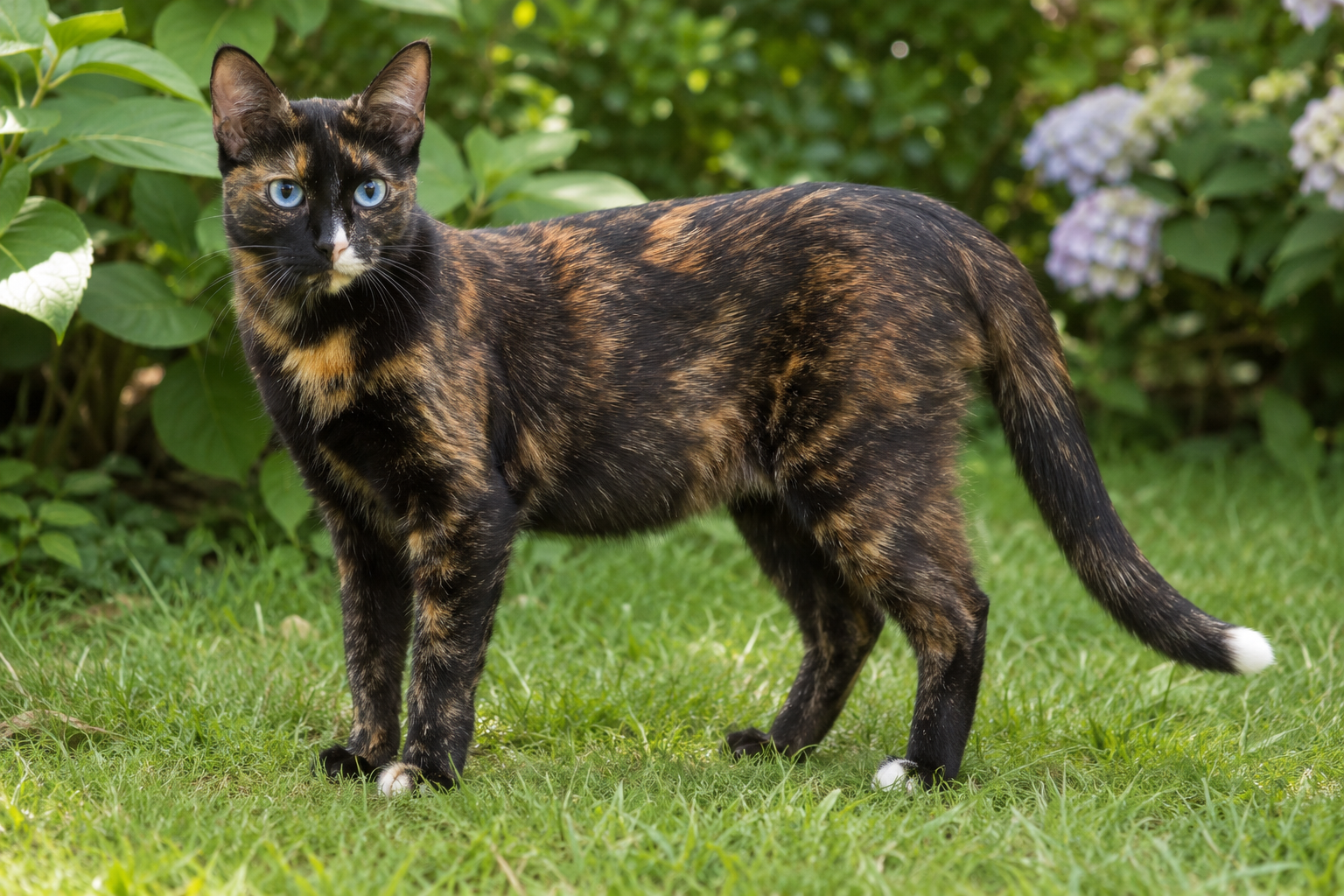 Despite its Spanish name, the Ojos Azules is an American breed. Its history began when naturally occurring blue eyes were observed in domestic cats with otherwise unexpected coat colors in New Mexico. Breeders became interested in preserving the trait because it appeared to follow a dominant pattern of inheritance. The name Ojos Azules, literally meaning “blue eyes,” reflected the feature that set these cats apart.
The International Cat Association (TICA) accepted the Ojos Azules into its New Breed or Color class effective May 1, 1991. This provided an opportunity to develop and exhibit the breed, but it did not give the cats championship status. Dr. Solveig Pflueger, who was involved in investigating the genetics of the trait, was appointed chair of the breed’s working group in 1996. A progress report presented to TICA in 2004 described additional cats with similar features found in Ohio and California. Whether these populations carried precisely the same genetic variant as the original New Mexico cats was not established.
Interest in the breed did not disappear immediately after the first health problems were reported. TICA’s records document continued efforts to develop the Ojos Azules in subsequent years, including appearances at cat shows during the 2008–2009 show season. Nevertheless, the breed never progressed to championship competition.
Is the Ojos Azules Still a Recognized Cat Breed?
The breed’s status changed several times during its development. In 2014, TICA’s board reinstated the Ojos Azules to Preliminary New Breed status after first voting to return it to registration only. On May 15, 2015, the board again returned the breed to Registration Only (RE). TICA’s June 2026 Standing Rules continue to list both Ojos Azules and Ojos Azules Longhair in that category. Neither has championship recognition. The breed is also absent from the recognized breed lists of the Cat Fanciers’ Association (CFA), the Fédération Internationale Féline (FIFe), and the World Cat Federation (WCF).
Registration status should not be mistaken for evidence of an active breeding population. A 2024 study of dominant blue eyes in cats describes the original Ojos Azules as extinct. However, there is no conclusive documentation establishing whether any of the original bloodlines survive today. It is more accurate to discuss the Ojos Azules as a historical breed whose present-day existence remains unverified than to describe it as a readily available, established pedigree cat.
What Did Ojos Azules Cats Look Like?
The breed description preserved in TICA’s 2001 meeting records provides a useful picture of the intended appearance. Ojos Azules cats were expected to have a medium-sized, well-balanced body with moderate musculature and a relatively light bone structure. Their legs were of normal length, with the hind legs somewhat longer than the front legs. The paws were small, and the tail tapered toward the tip. The overall impression was one of grace and proportion rather than an exaggerated physique.
The head had a triangular outline, softened by a gently rounded skull, prominent cheekbones, and a square muzzle. The ears were medium-sized and positioned relatively high on the head. Large, slightly angled eyes with a shape between round and almond were central to the breed’s appearance. A rich blue was preferred, although a clear blue-gray was also acceptable. Odd-eyed cats could have a blue eye paired with a green, gold, or copper one.
Two coat varieties were described. The shorthair had fine, silky fur without a particularly prominent undercoat, whereas the longhair had a semi-long coat of moderate fullness and a feathered tail. Its neck could have a ruff, but one was not essential.
Coat Colors and the Characteristic White Tail Tip
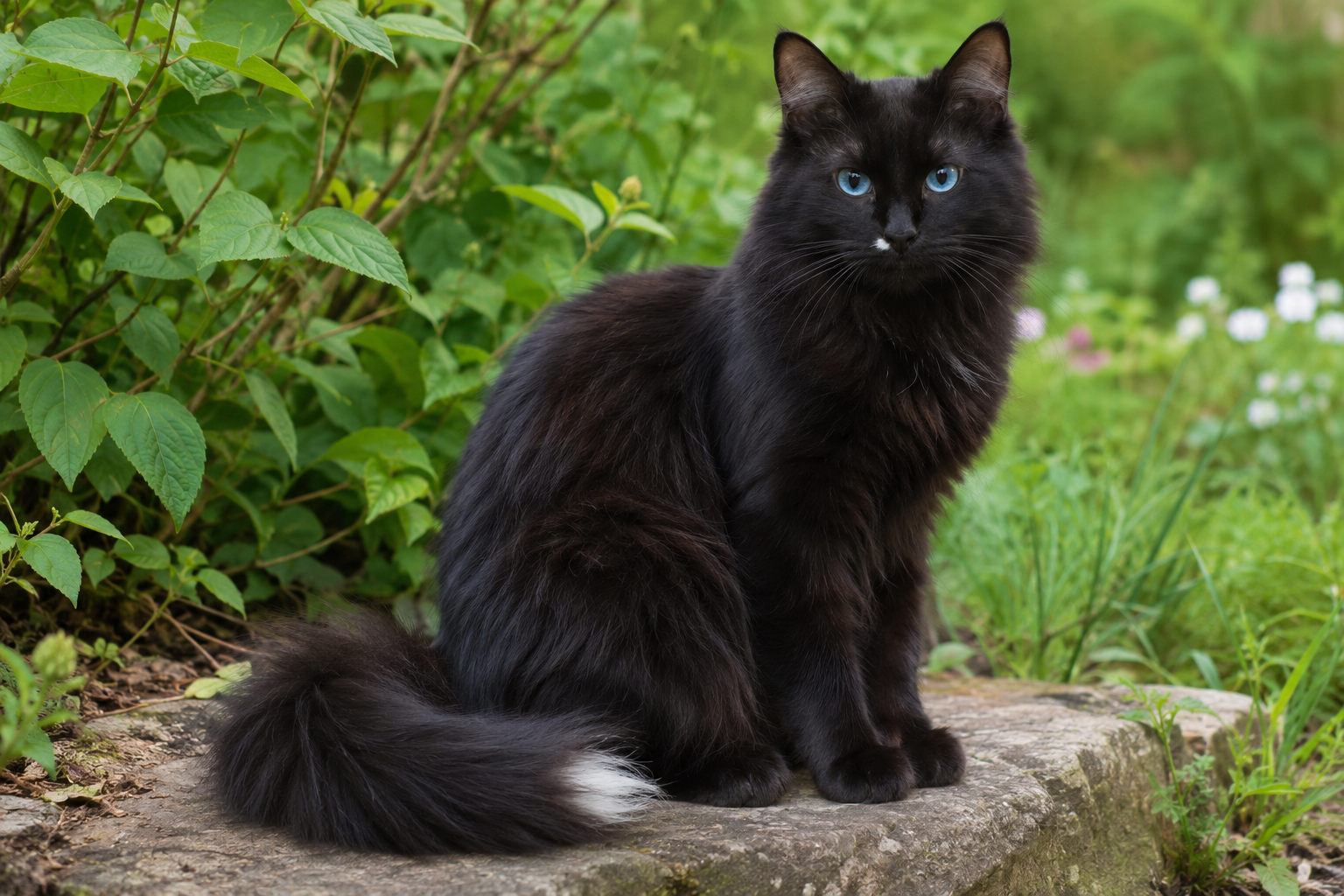 One of the breed’s most distinctive features was its broad range of coat colors. The historical standard favored combinations that would not normally be associated with blue eyes, such as solid black, tortoiseshell, or tabby. White markings were often small and irregular, appearing around the muzzle, on the hind toes, or at the end of the tail. A dark-coated cat with a white tail tip and blue eyes was particularly illustrative of the trait. Completely white cats were discouraged because their eye color could be attributed to another genetic mechanism, making the characteristic Ojos Azules trait harder to identify.
Why Were Their Blue Eyes So Unusual?
Blue feline eyes owe their appearance to the way light scatters in a relatively unpigmented iris, rather than to blue pigment. Different inherited mechanisms can produce this effect. For example, the colorpoint pattern of the Siamese and Himalayan is caused by a temperature-sensitive form of the enzyme tyrosinase, which also accounts for their characteristic blue eyes. In white cats, blue eyes can result from reduced pigmentation associated with the genes affecting white coat color.
The original Ojos Azules exhibited a different inherited pattern, now commonly discussed in the context of dominant blue eyes (DBE). The striking feature is that blue eyes can appear alongside a fully colored coat or only a few white markings. But DBE is a description of a visible trait, not the name of a single genetic mutation. In fact, research published between 2024 and 2026 has identified multiple independent variants involving the PAX3 gene in modern DBE cat lineages. This gene plays an important role in early development, including the development of pigment cells.
The precise mutation behind the original American Ojos Azules population has not been established by molecular testing. Historical breeding records also identified cats that appeared to carry the inherited trait without having blue eyes themselves. Geneticists call this incomplete penetrance: an animal may inherit a genetic variant without displaying the expected visible characteristic.
Health Concerns and the Difficulties of Breeding
During the original breeding program, some white kittens born to two blue-eyed parents had serious skull malformations. These findings raised the possibility that inheriting two copies of the responsible genetic variant could interfere with normal development. Because the original variant was never molecularly identified, the exact mechanism and the frequency of these outcomes cannot be established from the available records. Claims that every cat inheriting two copies inevitably dies go beyond what has been demonstrated for the historical population.
Congenital deafness is another important issue when investigating blue-eyed cats. Blue eyes alone do not mean that a cat is deaf, and reliable hearing statistics for the original Ojos Azules population are unavailable. However, studies of some modern DBE lineages have linked particular genetic variants to hearing impairment or other developmental problems. When hearing loss is suspected, a veterinary specialist can objectively assess auditory function using a brainstem auditory evoked response (BAER) test.
The health findings in later DBE lines should not automatically be applied to the original Ojos Azules, or vice versa. The genetic variant and its demonstrated effects matter more than the color of the eyes. These discoveries also illustrate why responsible breeding must put a cat’s health and welfare ahead of the desire to preserve an appealing physical feature.
Personality, Temperament, and Care
The historical standard called for a friendly, attentive cat. Beyond that, there is very little dependable evidence about the Ojos Azules as a population. Popular descriptions often portray these cats as exceptionally intelligent, affectionate, or particularly good with children, but there are no adequate breed-specific studies to support such predictions. A cat’s temperament depends on many factors, including individual genetics, early socialization, health, and life experiences.
For a blue-eyed domestic cat with a similar appearance, care is much the same as for other cats of comparable coat length and health. Short coats generally need occasional brushing, while semi-long coats may benefit from more frequent grooming to prevent tangles. A balanced diet, daily play, safe climbing opportunities, dental care, and regular veterinary visits are important regardless of eye color or pedigree.
Are Modern Dominant Blue-Eyed Cats Ojos Azules?
Since the discovery of the American Ojos Azules, similar traits have appeared in other domestic cat populations. The Altai lineage, for example, originated in Kazakhstan in the 1990s. Researchers have since investigated blue-eyed lines in several breeds, including the Maine Coon and British Shorthair. Some of these cats carry distinct genetic variants that arose independently of one another.
It would therefore be misleading to call every dark-coated, blue-eyed cat an Ojos Azules. A cat with the same physical features may have an entirely different ancestry. Even a positive test for one of the known contemporary DBE variants would not, by itself, establish that the cat descends from the original American breed. Documented ancestry is essential when making a claim about breed identity.
The Legacy of the Ojos Azules
The Ojos Azules never became an established championship breed, yet it remains an important example of the remarkable diversity of domestic cats. Its history helped draw attention to the complex relationship between pigmentation, inheritance, and early development. More than anything, it offers a reminder that an extraordinary appearance is not enough to justify preserving a genetic trait when its consequences for the animal’s health remain uncertain.
What would you like to see added to meow-cats.com?
- Funny cat videos (20%, 118 Votes)
- Ask a vet online (15%, 87 Votes)
- Classifieds for buying and selling cats (13%, 79 Votes)
- More useful articles on feline topics (13%, 76 Votes)
- Online cat memorial (11%, 63 Votes)
- Forum for cat lovers (8%, 49 Votes)
- Breeder and cattery ads (8%, 48 Votes)
- Veterinary clinic ads (7%, 41 Votes)
- Cat boarding and boarding cattery ads (6%, 38 Votes)
Total Voters: 273
 Loading ...
What are your 3 favorite cat breeds?
- Siamese Cat (11%, 184 Votes)
- Maine Coon (7%, 116 Votes)
- Bengal Cat (7%, 111 Votes)
- American Shorthair (6%, 104 Votes)
- Ragdoll (5%, 81 Votes)
- Persian Cat (5%, 79 Votes)
- Russian Blue (4%, 74 Votes)
- Egyptian Mau (4%, 68 Votes)
- Munchkin (4%, 61 Votes)
- Scottish Fold (4%, 61 Votes)
- Abyssynian (4%, 58 Votes)
- Other... (3%, 56 Votes)
- Norwegian Forest Cat (3%, 55 Votes)
- Turkish Angora (3%, 55 Votes)
- Siberian Cat (3%, 55 Votes)
- Himalayan Cat (3%, 53 Votes)
- British Shorthair (3%, 48 Votes)
- A Breedless Cat (2%, 40 Votes)
- Ocicat (2%, 40 Votes)
- Savannah Cat (2%, 39 Votes)
- Sphynx (2%, 38 Votes)
- Birman Cat (2%, 28 Votes)
- American Bobtail (2%, 25 Votes)
- Bombay Cat (1%, 23 Votes)
- Burmese Cat (1%, 21 Votes)
- Manx Cat (1%, 17 Votes)
- Havana Brown (1%, 16 Votes)
- Balinese Cat (1%, 12 Votes)
- Devonshire Rex (1%, 11 Votes)
- Singapura (1%, 9 Votes)
- Cornish Rex (0%, 7 Votes)
- Thai Cat (0%, 7 Votes)
- Donskoy Cat (0%, 1 Votes)
Total Voters: 661
Loading ...