Ragdoll Cat: History, Personality, Colors, Care and Interesting Facts
The Ragdoll is a large, affectionate, semi-longhaired cat known for its striking blue eyes, pointed coloring, and calm, easygoing personality. Ragdolls are generally quiet, relaxed cats that enjoy being close to their people. Many like being held and carried, although the famous tendency to go completely limp in someone’s arms is not something every Ragdoll does.

Despite their gentle appearance and laid-back temperament, Ragdolls are substantial cats. They have long, muscular bodies, sturdy bone, broad chests, and silky coats that require much less grooming than their luxurious appearance might suggest.
History of the Ragdoll Cat
The Ragdoll is a relatively young American breed. It was developed during the 1960s by breeder Ann Baker in Riverside, California. The foundation of her breeding program was a white domestic longhaired cat named Josephine.
Josephine was not a documented Persian, Angora, or other established breed, despite stories that are sometimes repeated about her ancestry. Ann Baker selected descendants of Josephine and other domestic longhaired cats for their appearance and temperament, gradually creating the cats that became known as Ragdolls.
Among the important early cats were a seal mitted male named Daddy Warbucks, a black female named Buckwheat, and a seal bicolor female named Fugianna. In 1965, Raggedy Ann Kyoto and Raggedy Ann Tiki, offspring of Daddy Warbucks and Buckwheat, became the first registered Ragdolls.
Baker eventually created her own registry, the International Ragdoll Cat Association, and imposed strict rules on breeders working with her cats. During the 1970s, other breeders, particularly Denny and Laura Dayton, worked to gain wider recognition for the Ragdoll and helped establish the breed standard that formed the basis of its acceptance by major cat registries.
Why Are They Called Ragdolls?
The name Ragdoll came from reports that some cats in the original breeding lines became unusually relaxed when picked up, almost like a soft rag doll. This trait became one of the best-known stories associated with the breed. Many modern Ragdolls are certainly relaxed and comfortable with handling, and some do become very loose in a person’s arms. However, this is not a requirement of the breed and should never be used as a test of whether a cat is a “real” Ragdoll. An old myth also claimed that Ragdolls had an unusually high tolerance for pain. This is false and potentially dangerous. Ragdolls experience pain just like other cats and should always be handled with the same care and respect.
Ragdoll Colors and Patterns
Ragdolls are pointed cats, which means the face, ears, legs, feet, and tail are darker than the body. The contrast develops because the gene responsible for the pointed pattern affects pigment production according to temperature. Cooler areas of the body develop more color than warmer areas. This is also why Ragdoll kittens are born white or nearly white. Their points begin to darken after birth, and the coat continues developing in color for several years.
The three classic Ragdoll patterns are colorpoint, mitted, and bicolor.
Colorpoint: The ears, mask, legs, feet, and tail are clearly darker than the body. There are no white markings in the classic colorpoint pattern.
Mitted: The cat is pointed but has white mittens on the front feet, white on the hind legs, a white chin, and a white stripe running along the underside of the body. A small white blaze on the face may also occur.
Bicolor: The face has a characteristic white inverted V. The chest, belly, legs, and much of the underside are white, while the ears, tail, and portions of the face retain the point color.
There is one registry difference worth knowing. CFA also recognizes the Van pattern, in which most of the body and legs are white and the point color is largely restricted to the head and tail. Other major standards generally describe the traditional Ragdoll through the three patterns of colorpoint, mitted, and bicolor. Common point colors include seal, blue, chocolate, lilac, red, and cream. Lynx and tortie variations are also recognized in various combinations, depending on the registry.
Ragdoll Eyes Are Always Blue
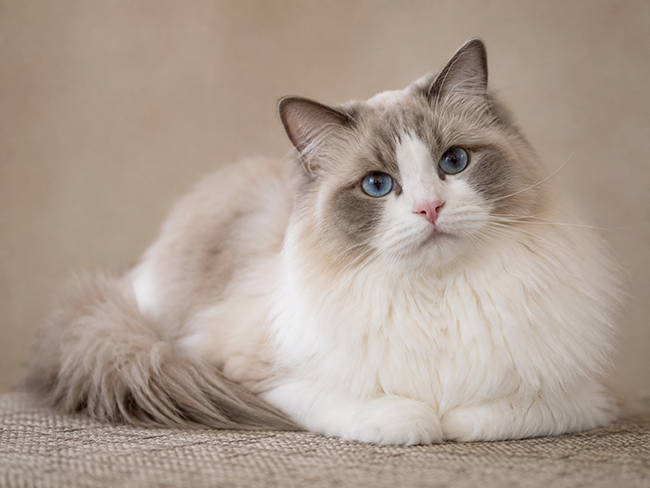
One of the most important characteristics of the Ragdoll is its blue eye color. The eyes should be large and oval, with a rich blue shade preferred.
Blue eyes are not simply a common feature that appears in some Ragdolls. They are part of the breed standard. Major registries including CFA, TICA, FIFe, and WCF define the modern Ragdoll as a blue-eyed pointed cat.
This distinction matters because cats are sometimes advertised as “Ragdolls” with green, gold, aqua, or other eye colors. Such cats may have Ragdoll ancestry or belong to related breeding programs, but they do not meet the standard definition of the Ragdoll in these registries.
Ragdoll, Cherubim and RagaMuffin Are Different Breeds
The Ragdoll is not another name for either the Cherubim or the RagaMuffin. The RagaMuffin developed from breeding lines historically related to the Ragdoll but became a separate breed with its own standard, broader range of colors, and different eye-color requirements.
Cherubim has a different relationship with the Ragdoll. Under the current TICA standard, the two belong to the same Ragdoll Breed Group and share the same general body and head type. However, the Ragdoll is the blue-eyed pointed breed, while Cherubim includes mink, sepia, and traditional-colored cats.
This distinction is especially useful when encountering terms such as “mink Ragdoll,” “sepia Ragdoll,” or “solid Ragdoll” in advertisements. Breed terminology can vary outside the show world, but under the current TICA standard those color categories belong to Cherubim rather than Ragdoll.
Physical Characteristics of the Ragdoll Cat
Ragdolls tend to be large cats with long, muscular bodies and substantial bone. The chest is broad, and the body should look powerful without appearing coarse or overweight. Adult males are usually noticeably larger than females. The head is a broad modified wedge with gently rounded contours rather than a completely round head. The ears are medium-sized, wide at the base, and slightly tilted forward. The eyes are large, oval, and blue. The paws are large and round, often with tufts of fur between the toes. The hind legs are slightly longer than the front legs, and the tail is long, bushy, and well furnished. The coat is semi-long, soft, and silky. A heavy woolly undercoat is not desirable. The fur is generally longer around the neck and on the hindquarters, where mature cats may develop a noticeable ruff and fluffy “britches.”
How Big Do Ragdoll Cats Get?
Ragdolls are among the larger pedigreed domestic cats. Females commonly weigh around 10 to 15 pounds, while adult males often reach 15 to 20 pounds and may occasionally exceed that range. They mature very slowly. A Ragdoll may not reach its full size and weight until around four years of age. Coat color also develops gradually during the first few years of life, and older cats commonly become darker while retaining contrast between the body and points.
Ragdoll Personality
Ragdolls are very quiet animals and often prefer a calm environment. They are known for being loving, trusting, and affectionate, and they usually enjoy spending time with their owners. Many Ragdolls follow their favorite people from room to room and like to settle nearby rather than remain alone in another part of the house. Their voices tend to be relatively soft, although every cat has an individual personality.
Ragdolls are intelligent and playful as well as calm. Kittens and young adults can be surprisingly energetic, while mature cats generally settle into a more moderate activity level. Many can learn to play fetch, come when called, or walk on a harness with patient training.
Are Ragdolls Good Pets?
Ragdoll cats are popular family companions because of their beautiful appearance, gentle nature, and affectionate personality. They are generally friendly and sociable, and many get along well not only with their owners but also with visitors, children, other cats, and cat-friendly dogs.
Ragdolls often enjoy being held and carried and are usually happiest when they can spend plenty of time with their people. Their relaxed temperament does not mean they should be treated like toys, however. Even the gentlest cat needs the freedom to walk away, rest undisturbed, and choose when it wants physical contact. Their size should also be taken into account around young children. A large adult male can weigh close to 20 pounds, so children should be taught how to handle the cat safely rather than trying to carry it without support.
How Much Grooming Does a Ragdoll Need?
Despite their semi-long coats, Ragdolls need relatively little maintenance compared with many heavily coated breeds. The silky coat has relatively little woolly undercoat, which helps reduce severe matting. Combing once or twice a week is usually enough to remove loose hair and small tangles. More frequent grooming can be helpful during seasonal shedding. Pay particular attention to areas under the front legs, around the belly, and on the hindquarters. Regular nail trimming, dental care, and routine checks of the ears and eyes should also be part of normal care.
Ragdoll Health
Ragdolls are generally robust cats, but the breed has an important inherited health concern: hypertrophic cardiomyopathy, or HCM. This disease causes abnormal thickening of the heart muscle and can vary greatly in severity. A specific variant in the MYBPC3 gene associated with HCM has been identified in Ragdolls, and a DNA test is available. Responsible breeders use genetic testing as one tool for reducing the risk of producing affected cats. A negative result for the known Ragdoll mutation does not guarantee that a cat can never develop HCM. Heart disease can have other genetic or non-genetic causes, so veterinary screening and responsible breeding decisions remain important. Ragdolls can also gain excess weight if their calm lifestyle is combined with too many calories and too little activity. Their natural large size and the small fatty pad permitted on the lower abdomen should not be confused with obesity.
Choosing a Ragdoll Kitten
Blue eyes, a pointed coat, and a fluffy appearance are not enough to prove that a kitten is a pedigreed Ragdoll. Breed ancestry should be supported by registration and pedigree records. A responsible breeder should be able to explain the health history of the parents, provide relevant documentation, and discuss genetic testing for the known Ragdoll HCM mutation. Kittens should be well socialized, active, and raised in a clean environment with appropriate veterinary care.
Do not judge a young Ragdoll by how dark its points are. Kittens are born very pale, and the final coat color develops gradually. Body size, coat, and overall maturity also continue changing for several years.
Interesting Facts About Ragdoll Cats
- The breed originated in California. Ann Baker developed the Ragdoll in Riverside during the 1960s.
- The foundation cat was named Josephine. She was a white domestic longhaired cat rather than a documented member of another pedigreed breed.
- The first registered Ragdolls appeared in 1965. They were Raggedy Ann Kyoto and Raggedy Ann Tiki.
- The name comes from the “rag doll” story. Some of the original cats reportedly relaxed dramatically when held.
- Not every Ragdoll goes limp. This behavior is not required by the breed standard.
- Ragdolls do not have reduced sensitivity to pain. Claims that they tolerate pain unusually well are a dangerous myth.
- Ragdoll kittens are born very pale. Their point color develops after birth.
- They have blue eyes. Blue eye color is a defining feature of the modern breed standard.
- Ragdolls mature slowly. Full adult size may not be reached until around four years of age.
- Their coats are easier to maintain than they look. The silky texture and limited woolly undercoat usually make weekly combing sufficient.
- They are often compared with dogs. Many Ragdolls follow their people around and can learn games such as fetch.
- RagaMuffin is not another name for Ragdoll. It is a separate breed with a related history.
- TICA now distinguishes Ragdoll from Cherubim. The Ragdoll remains blue-eyed and pointed, while mink, sepia, and traditional colors belong to Cherubim within the same breed group.
Is a Ragdoll Cat Right for You?
A Ragdoll can be an excellent choice for someone looking for a large, affectionate cat with a calm personality and a beautiful semi-long coat. They generally enjoy human company, adapt well to family life, and remain playful without usually becoming excessively demanding or hyperactive. They do need regular interaction, play, grooming, appropriate veterinary care, and enough space and equipment for a large cat. A sturdy cat tree, roomy litter box, and properly sized carrier are much more practical for an adult Ragdoll than equipment designed for a small cat.
What makes the Ragdoll distinctive is the combination of substantial size, silky fur, pointed coloring, vivid blue eyes, and a gentle temperament. The breed’s famous name may come from its tendency to relax in human arms, but a modern Ragdoll is much more than a cat that “goes limp.”

30 Responses to Ragdoll Cat: History, Personality, Colors, Care and Interesting Facts
Leave a Reply
What would you like to see added to meow-cats.com?
- Funny cat videos (20%, 118 Votes)
- Ask a vet online (15%, 87 Votes)
- Classifieds for buying and selling cats (13%, 79 Votes)
- More useful articles on feline topics (13%, 76 Votes)
- Online cat memorial (11%, 63 Votes)
- Forum for cat lovers (8%, 49 Votes)
- Breeder and cattery ads (8%, 48 Votes)
- Veterinary clinic ads (7%, 41 Votes)
- Cat boarding and boarding cattery ads (6%, 38 Votes)
Total Voters: 273
 Loading ...
What are your 3 favorite cat breeds?
- Siamese Cat (11%, 184 Votes)
- Maine Coon (7%, 116 Votes)
- Bengal Cat (7%, 111 Votes)
- American Shorthair (6%, 104 Votes)
- Ragdoll (5%, 81 Votes)
- Persian Cat (5%, 79 Votes)
- Russian Blue (4%, 74 Votes)
- Egyptian Mau (4%, 68 Votes)
- Munchkin (4%, 61 Votes)
- Scottish Fold (4%, 61 Votes)
- Abyssynian (4%, 58 Votes)
- Other... (3%, 56 Votes)
- Norwegian Forest Cat (3%, 55 Votes)
- Turkish Angora (3%, 55 Votes)
- Siberian Cat (3%, 55 Votes)
- Himalayan Cat (3%, 53 Votes)
- British Shorthair (3%, 48 Votes)
- A Breedless Cat (2%, 40 Votes)
- Ocicat (2%, 40 Votes)
- Savannah Cat (2%, 39 Votes)
- Sphynx (2%, 38 Votes)
- Birman Cat (2%, 28 Votes)
- American Bobtail (2%, 25 Votes)
- Bombay Cat (1%, 23 Votes)
- Burmese Cat (1%, 21 Votes)
- Manx Cat (1%, 17 Votes)
- Havana Brown (1%, 16 Votes)
- Balinese Cat (1%, 12 Votes)
- Devonshire Rex (1%, 11 Votes)
- Singapura (1%, 9 Votes)
- Cornish Rex (0%, 7 Votes)
- Thai Cat (0%, 7 Votes)
- Donskoy Cat (0%, 1 Votes)
Total Voters: 661
Loading ...
I want a cat like this they are very pretty. My friend has one and its really fluffy. thanks for the information
This cat looks like the one I’m getting
I want to own this breed of cat, but I don’t know where to get this.. Here in the Philippines this cat is quite unfamiliar,most cats here are domestic, siamese and persian breed.. How I wish I could own this too, but do you think they can get along easily with other breeds?
Yes the ragdoll will get along so well with other pets in the house or people that often you have to be the one to protect him or her from harm.Because they will not defend theirselves. I breed ragdolls in the states but would never ship anything living.To me my pets are precious family members.
I am having a hard time distinguishing my cat from a long haired siamese or a ragdoll. She acts more like a siamese but has more physical characteristics of a ragdoll.
She could be a mix of both
What do you mean they wont defend themselves?
Sooo cute
all you need is CAT! :)
Where can I buy one of these cats in South Carolina?
Ragdoll cat is something special. We were on holiday for 2 weeks. My cat
Pamper just died, we could not found out how she died. She was only 10years
old. Where in South Africa can I buy one !
We’ve had Holly for about 7 years, and she’s such a dream, and looks quite a bit like the cat in the above photo. She is quite frightened of loud noises, rustling bags, and strangers, but maybe that’s her personality, or based on what happened to her before we adopted her. She loves to play fetch, sit on my lap and really “looks” at me with human eyes. I only wish her old brother (Siamese) wouldn’t pester her. He’s such a bully at times…sigh…men…
I’m getting a rag doll cat for me and me only i can’t wait !
Just to balance the praise — worthy though it no doubt often is — with an alternative experience, I have a male ragdoll cat whose just under 1 year old. He does not like to be held, is never willing to sit on my lap, and spends most of his time bullying my two female shelter cats. I spent over $500.00 hoping to get an affectionate cat and what I got is an over-sized meanie. He does go limp when I pick him up, for a little while anyway, but then struggles to be free.
Thank you for your honesty. Yes these cats are sweet and do go limp (sometimes when picked up) but don’t be fooled by
all the writings of them being so gentle and calm all the time… ragdoll cat can holds it’s own with the biggest and feisty
of them all and ‘usually’ is the aggressor. Great cat.
Hi
I have a BEAUTIFUL female Ragdoll, and she is anything but friendly. I have actually heard her growl at strangers, and once I thought for sure she would attack a kitten, so I asked the owner of that kitten to leave. My baby was only about 6 months old then (she is 10 months old now). I have had her since she is 10 weeks old and the breeder should never ever have left her go that young (at that time I had no idea how important those weeks between 10 and 15 were, to socialize a baby Rag). My baby will not defend herself either, will only come on my lap when she’s in the mood (and not for long periods) and is afraid of every little noise, whether a car is passing on the street, a bird is chirping outside, and forget the vacuum – she almost goes into cardiac arrest! However, she IS gentle and she is low to the ground (very short legs) so she cannot, even if she tried, jump very high. To this day, my Ragdoll cat has not managed to get on my kitchen table or fridge, counter and she needs a chair in front of the window ledge to get on the ledge. She is 11 lbs. There was a time I thought I’d let her go (I have spent over $1,000.00 Canadian so far on this cat), but she is settling down. Not biting or scratching the living *hit out of me anymore and she now gets that I am the boss. It was a struggle at first for her to get that “I”, not “she” was the boss. She’s the only pet I have and I live alone, so when anyone comes to visit, she indeed freaks out, so as I said not friendly and depending on the day, sometimes not even friendly with me! Still, I wouldn’t let her go now unless she attacked me or others and I do not think that is within her capability as she is laid back and docile 99% of the time and she does have her affectionate “moments”. The other thing that is so cute with her, is if she feels threatened or afraid, she comes next to me for “protection”, so she is not stupid, she KNOWS I am her “god” LOL
I would not introduce a new pet in my home due to her personality. She is outrageously insecure, possessive of me and growling like a dog when another animal is within earshot tells me she would not do well (neither would the other animal) if she had to live with another animal, or even person as I am a young senior living alone and she sometimes barely tolerates me. There was a time I thought she was psychotic and I haven’t ruled out the possibility that as she gets older, she might get worst, but time will tell.
Just because the cat is a Ragdoll, it doesn’t assure you that each of them are wonderful. Mine has a pedigree a mile long and came from a reputable breeder in Navan, Ontario.
i have a very fluffy cat named mustache and i love him
Ragdolls are adorable!!!!
my sister has one ragdoll cat, its very stupid
I have,( I think), I am told a ragdoll. I had him since he was 6 weeks, My problem is I was living with my son and his family and they surprised me with him. They then obtained a puppy. Well, they both grew up together, they slept together and we let them out in the backyard together almost everyday. I moved and took him with me and now he wants to go out everyday. i believe he thinks he is a dog. I don’t have a yard so I bought a harness and I started walking him. He is very talkative and he also was used to getting up at 5am with my sons family. I am a senior and I need my rest He bites everything, he knocks over anything on shelves, dressers, tables etc. just to get my attention. I am at my wits end. I moved to NC from NY almost a year ago and all my other cats never upset me as this one does. I love him but I need my rest. anyone have any ideas as to what I should do?
I love Ragdolls, have ever since I first read about them. I am definitely getting one for my first cat. However, I do want to put in a correction to the description at the beginning of the page – Ragdolls are not Ragamuffins. Ragamuffins are actually a separate breed. They are very similar though, the only difference really being the fact that Ragamuffins come in any colour combo except points, and Ragdolls are just pointed with no other colour patterns.
I have 2 male 7 year old rag dolls (not from the same litter) and they have been around children and a visiting sheltie since they were kittens. Jaspers very vocal and quite shy and will disappear when strangers visit. He is affectionate but not overly and will only really sit next to me for stroking he purrs loudly too, he’s not very playful and you have to encourage him. Neo is very different he follows you everywhere,even bathroom,scratching at doors to get your attention.he’s not shy with guests, he’ll sit next to you for hours.his favourite game is fetch with hair bands which he’ll play for ages. When I’m getting ready in th mornings he’ll lie on my bed doing that thing with his paws purrs and meowing to me. I love them both dearly the way they are and would not change anything even all the fur everywhere.
My ragdoll is 6 mos old and she can't meow. Is this normal?
I have a raggie and he loves everyone and any attention but especially attatched to me, he was adopted so I wanted him to have some company when I was working so I adopted a desexed persian cross female and that seemed to work. I think your raggie is missing his or her friend so is acting up, you may need to get another cat for company.
I believe my kitten is a Ragdoll, he is very smart and 6 months old and very large. He loves for me to hold him upside down,I have taught him to fetch, roll over, shake paws, he loves to fly through the air, loves to dress up, loves to go for walks on a leash,and kiss on demand. But CANNOT teach him to stop biting viciously. Will he ever grow out of the biting? No matter what he is mine. I was afraid for my life one night, he had the meanest look on his face and was attacking me and didnt stop, till I locked him up. I love my baby big boy and his name is Thunderpaws
Buddy Lambert the blue point ragdoll came to us from the woods as a poorly socialized feral juvenile, covered head to toe in dreadlocks and addicted to scratching and biting everyone and everything in sight. Over a year of attentive care and loving training and now he is greatly improving with many typical ragdoll behaviors beginning to show, but he still won’t sit on my lap without getting into a plastic bin for protection first, and like other posters, he goes limo when picked up but quickly begins to struggle if held or carried for any length of time. That being said, he’s so impossibly cute that I couldn’t imagine letting him go even if he stayed standoffish, but now he’s getting cuddlier every day, so there is hope folks! Respecting his space, not picking him up very often, getting on the floor with him regularly and buying him an extra late super heavy duty cat tree to give him more sense of security seems to be helping greatly. And he does pay play fetch.
I have an almost 14 year old mixed breed cat, large, 22 lbs., may have some Maine Coon in him, and although he's always threatened, so to speak, to bite me, about which I was never happy, in the past year or so, he has actually bitten me about 5 times, and the sixth is still healing from the massive infection I got from that bite. It's been almost a month since the bite. I have called my vet of 14 years, who knows him and me only because she sees us once a year for his checkup as he's extremely healthy. She and I have yet to connect so I can get her input. Maybe he needs some sort of tranquilizer. I have no idea and nobody to discuss with. I just found you, and hope you have some ideas about why our cats actually attack us. I admit it's only very rarely and seemingly without provocation—actually it's sometimes just after I've had him beside be [his usual place on the den sofa] and petting him, which he usually begs for. Sometimes after a couple of the biting sessions, he's brought me one of his toys so I'll play with him. I do not do so at the time, I'm that angry—more upset than angry, and puzzled as all get out.
Please let me have your input.
He doesnt have the blue eyes, thats why I am wondering if he is a Ragdoll. Here is a photo of him and that is a dog sweater he has on that is way to small.https://www.facebook.com/photo.php?fbid=10202269020721621&set=pcb.10202269020921626&type=1
Have concern about Ragdolls/MaineCoons/Ragamuffins wanting to bite or even getting aggressive
Is there a good age to buy when we could tell its personality?
I’m single quasi-retired, travel 2/3 days at a time. No other pets. Occasional guests.
Roomed for 11 years with a female, Russian Blue, who was laid back and friendly, No problems.
She may have been a mix, as she was 18 lbs. Wanted a similar different breed.
Thanks
Are Ragdolls non-allergic cats?